
























The global push toward net-zero emissions has placed every industrial sector under intense scrutiny, with the construction industry facing a unique set of challenges. Historically dependent on high-torque diesel engines to power excavators, cranes, and loaders, the sector is one of the largest contributors to localized air pollution and global carbon emissions. However, the emergence of construction equipment electrification is fundamentally altering this dynamic. By replacing the traditional internal combustion engine with high-performance electric motors and battery storage, the industry is not only reducing its carbon footprint but also improving on-site efficiency and worker health. This transition is no longer a niche technological experiment but a critical component of the broader movement toward sustainable construction and “quiet” urban development.
The Technological Shift from Diesel to Battery-Electric
For decades, the diesel engine was the unchallenged king of the job site, valued for its power density and the ease of refueling. However, the advancement of lithium-ion battery technology largely driven by the passenger vehicle market has finally reached the point where it can meet the heavy-duty demands of the construction world. Modern construction equipment electrification involves more than just swapping the engine for a motor; it requires a complete rethink of the machine’s hydraulic and electrical systems. Electric motors provide instant torque, which is highly beneficial for the “stop-and-start” nature of earthmoving and lifting. Furthermore, the elimination of idling a major source of fuel waste and wear in diesel machines means that electric equipment is inherently more efficient for the varied load cycles typical of a busy construction site.
The Role of Hydrogen Fuel Cells in Heavy Machinery
While battery-electric power is ideal for compact and medium-sized machines, the “last mile” of construction equipment electrification for massive excavators and long-haul transport may require a different solution. This is where hydrogen fuel cells are becoming a vital part of the zero-emission toolkit. Hydrogen provides a much higher energy density than current battery technology, allowing for longer runtimes and faster “refueling” for heavy-duty applications. A hydrogen-powered machine uses a fuel cell to convert chemical energy into electricity, with water vapor as the only emission. By utilizing a hybrid approach batteries for smaller equipment and hydrogen for the heavy lifters the industry can achieve a comprehensive transition away from fossil fuels without compromising the productivity of its most demanding operations.
Operational Efficiency and the Reduction of On-Site Noise
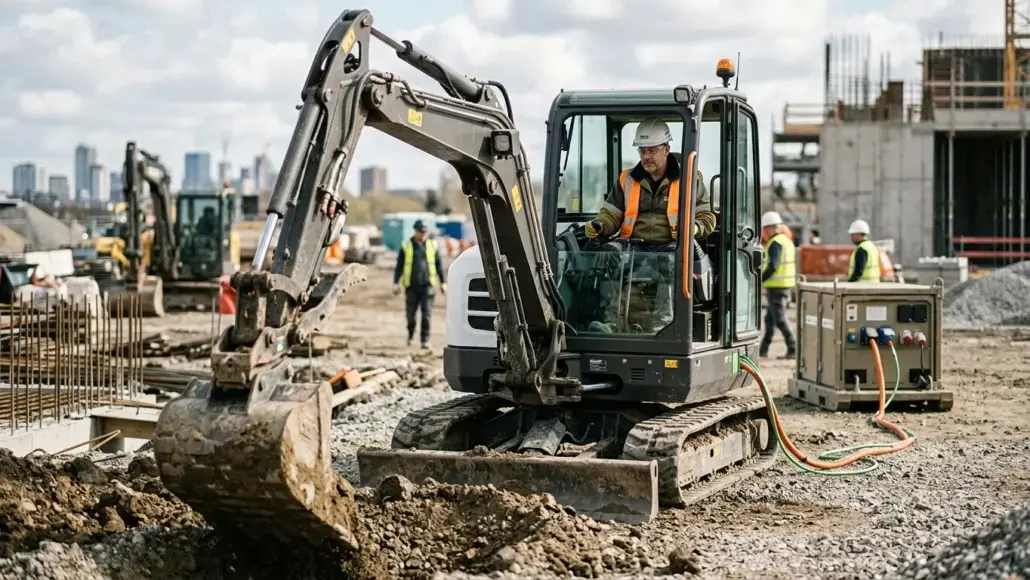
One of the most immediate benefits of construction equipment electrification is the radical reduction in on-site noise pollution. Traditional diesel sites are defined by a constant, high-decibel roar that creates stress for workers and significant disruption for neighboring communities. Electric machines are nearly silent during operation, allowing for extended working hours in noise-sensitive urban environments without violating local ordinances. This increased operational flexibility can lead to shorter project timelines and lower logistical costs. Furthermore, the lack of exhaust fumes makes electric equipment ideal for indoor demolition or tunneling projects, where air quality and ventilation costs are primary concerns. A “quiet and clean” site is not just more pleasant; it is more productive and socially responsible.
The Financial Case: Lower Total Cost of Ownership
While the initial purchase price of electric machinery is currently higher than its diesel counterparts, the total cost of ownership (TCO) is rapidly shifting in favor of electrification. Electric motors have significantly fewer moving parts than internal combustion engines, which means they require far less maintenance over their lifecycle no oil changes, no fuel filters, and no complex exhaust after-treatment systems. Furthermore, the cost of electricity is generally more stable and lower than the cost of diesel fuel, especially when integrated with on-site renewable energy. As carbon taxes and emission penalties become more common, the “green premium” of electric equipment is being transformed into a “green dividend,” where the operational savings more than offset the higher upfront investment.
Challenges of Charging Infrastructure and Power Delivery
The most significant hurdle to the widespread adoption of construction equipment electrification is the logistical challenge of power delivery. Unlike a traditional site where a fuel truck can visit once a week, an electric site requires a robust and reliable source of high-capacity charging. In remote locations or on new sites where the permanent electrical grid has not yet been established, this requires innovative solutions. “Mobile battery hubs” and solar-integrated charging containers are becoming essential tools for the modern green contractor. These units can be moved from site to site, providing a localized “microgrid” that can charge machinery overnight or during breaks. Overcoming the “charging anxiety” of project managers is the final hurdle to the full-scale electrification of the industry.
Standardizing Charging Ports and Battery Management
For construction equipment electrification to scale effectively, the industry must move toward standardized charging protocols. In the early stages of the transition, different manufacturers often used proprietary charging systems, creating a logistical nightmare for contractors who manage mixed fleets. The movement toward a universal charging standard similar to what is happening in the passenger EV market is essential for ensuring that any machine can be charged at any site. Furthermore, the development of sophisticated “Battery Management Systems” (BMS) is vital for ensuring the long-term health and safety of the equipment. These systems monitor temperature, state-of-charge, and health in real-time, preventing the thermal issues that can sometimes plague high-capacity battery installations in harsh environments.
The Impact on Workforce Skills and Maintenance Culture
The shift to electric power is also driving a significant workforce transformation in the digital era. The traditional “grease and wrench” mechanic is being replaced by a technician who is equally comfortable with a multimeter and diagnostic software. Maintaining electric machinery requires a deep understanding of high-voltage systems and digital control logic. This shift is creating a demand for new training programs and certifications within the construction trades. Furthermore, the “predictive maintenance” enabled by electric machines which can report their health in real-time to a central dashboard is changing the culture of the shop from reactive repair to proactive asset management. Investing in the “human infrastructure” of the electric transition is just as important as investing in the machines themselves.
Decarbonizing the “Embodied” Carbon of Machinery
True sustainability in construction equipment electrification requires looking beyond the “tailpipe” to the embodied carbon of the machinery itself. The manufacturing of high-capacity batteries and electric motors involves the extraction of rare materials and energy-intensive production processes. To address this, the industry is increasingly focused on the circular economy for machinery. This includes “remanufacturing” programs where the structural frame of a diesel machine is retrofitted with an electric drivetrain, and the development of “closed-loop” battery recycling where the lithium and cobalt from old machines are used to build new ones. By ensuring that the production and disposal of electric equipment are as green as its operation, the industry can achieve a truly net-zero environmental profile.
Policy Drivers and Green Procurement Mandates
The adoption of zero-emission equipment is being accelerated by a wave of new environmental policies and green procurement mandates. Many major cities, including Oslo, Amsterdam, and London, have committed to “Zero Emission Construction Sites” by 2030. In these markets, the ability to provide electric equipment is becoming a prerequisite for winning public tenders. Furthermore, national governments are providing subsidies and tax incentives to help contractors offset the initial cost of the electric transition. These policy drivers are creating a “certainty of demand” that is encouraging manufacturers to scale up production and invest in new zero-emission technologies. In the modern market, “green” is not just a badge of honor; it is a license to operate.
Integration with the Smart Site Digital Ecosystem
Electric machinery is inherently “connected,” making it a perfect fit for the broader smart construction digital ecosystem. Because the machine’s operations are already controlled by digital logic, it is easy to integrate with Building Information Modeling (BIM) and telematics platforms. This allows project managers to track the exact energy consumption and carbon savings of every machine in real-time. By integrating machinery data with the project schedule, the site’s energy demand can be optimized, ensuring that charging occurs during periods of low grid strain or high renewable output. This data-driven approach to machinery management is the final step in turning the construction site from a source of pollution into a highly efficient and accountable production environment.
Conclusion: The Quiet Revolution in the Field
The roar of the diesel engine is being replaced by the hum of the electric motor, marking a historical pivot in the construction industry’s relationship with the environment. The implementation of construction equipment electrification is a vital part of the global effort to decarbonize our cities and protect our planet. While the challenges of infrastructure and cost remain, the trajectory is clear: the future of construction is electric. By embracing this transition, construction firms are not just reducing their emissions; they are building a more efficient, safe, and socially responsible industry. The quiet revolution in the field is a testament to our ability to innovate for a sustainable future, ensuring that the infrastructure of tomorrow is built with the clean energy of today.