


























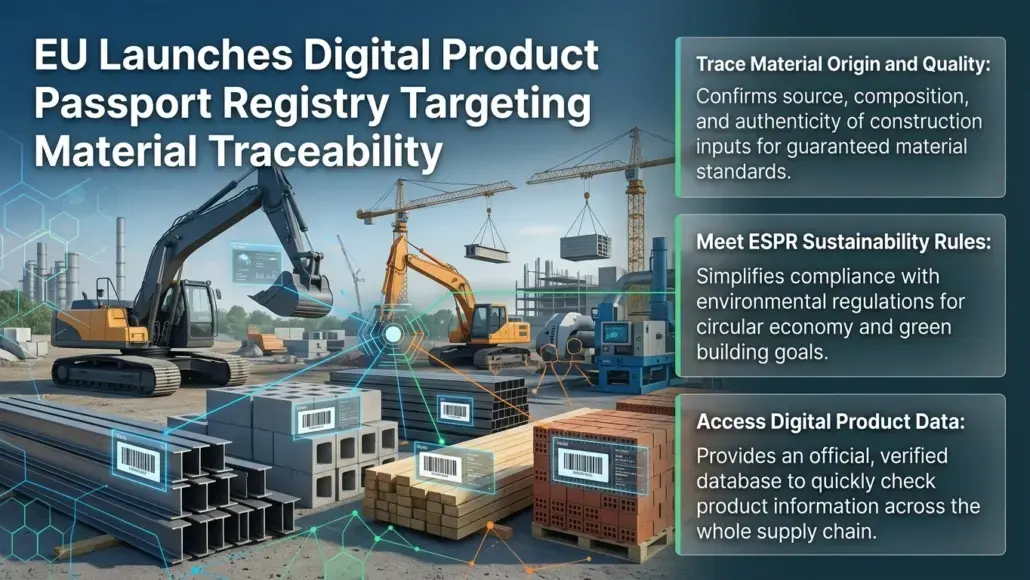


The European Commission has officially launched the Digital Product Passport Registry, establishing a centralized index for the registration and verification of digital identity cards for goods marketed within the European Union, including construction materials. Announced on July 22, 2026, this infrastructure is a primary component of the Regulation on Ecodesign for Sustainable Products (ESPR). For the construction sector, the registry will serve as a critical tool for verifying the origin, material composition, and compliance of structural components before they enter the building supply chain. The EU executive noted that while the registry will not store all individual product details, it will maintain unique identifiers and the metadata necessary to ensure the authenticity and traceability of products across the continent.
By utilizing a QR code or another digital medium, digital product passports will enable developers, contractors, and regulatory authorities to access essential information such as a product’s origin and the specific materials used in its manufacturing. The system is also designed to provide clear instructions for the repair and reuse of products, alongside proof of compliance with European legislation. This move is intended to promote more transparent supply chains and support more informed purchasing decisions by providing a verifiable link to a product’s environmental and regulatory footprint. For the construction industry, where material provenance and sustainability are increasingly scrutinized, this digital identity card provides a standardized method for documenting the lifecycle of building components.
Strengthening Supply Chain Transparency and Compliance
The Digital Product Passport Registry is specifically engineered to serve as a high-efficiency tool for regulatory checks and enforcement. Customs authorities will now have the capability to verify that imported products possess a valid passport before they are permitted to enter the European market. This oversight is expected to significantly reduce the risk of non-compliant materials being used on job sites. Furthermore, supervisory authorities will gain quicker access to the information required for their inspection activities, streamlining the process of verifying adherence to European safety and sustainability standards. This proactive approach to market surveillance is designed to protect both the industry and consumers from sub-standard or fraudulent products.
The scope of this digital infrastructure is broad and will gradually encompass a wide variety of industrial categories. In addition to construction materials, the registry will cover sectors fundamental to the building industry, such as steel, aluminium, and energy products. Other categories slated for inclusion include textiles, tyres, furniture, and ICT, as well as products subject to specific regulations like detergents and toys. By creating a unified European index for these digital product passports, the Commission aims to create a more resilient and circular economy where the digital traceability of raw materials and finished goods becomes a standard operational requirement for all businesses operating within the EU.
Implementation Timeline and Support for Industry Operators
While the system is currently live, the first mandatory application of the digital identity cards will come into force on February 18, 2027, for certain categories of batteries. However, construction materials are designated as a priority category for early adoption under the rolling implementation schedule. To support businesses and operators during this transition, the European Commission has established a dedicated helpdesk and a test environment. These resources, along with a portal containing comprehensive technical documentation, are designed to assist companies in aligning their data management systems with the new requirements before the official sector-specific deadlines.
The transition to this new system represents a significant shift in how construction material suppliers and manufacturers manage their product data. By providing a test environment and technical support ahead of the mandatory deadlines, Brussels is aiming to ensure that the transition to the Digital Product Passport Registry is as seamless as possible for European operators. As the construction sector continues to prioritize sustainability and circularity, the integration of these digital passports will likely become an essential component of modern project management and procurement strategies, ensuring that every material used in a building project is fully documented and compliant with the latest EU regulations.