




























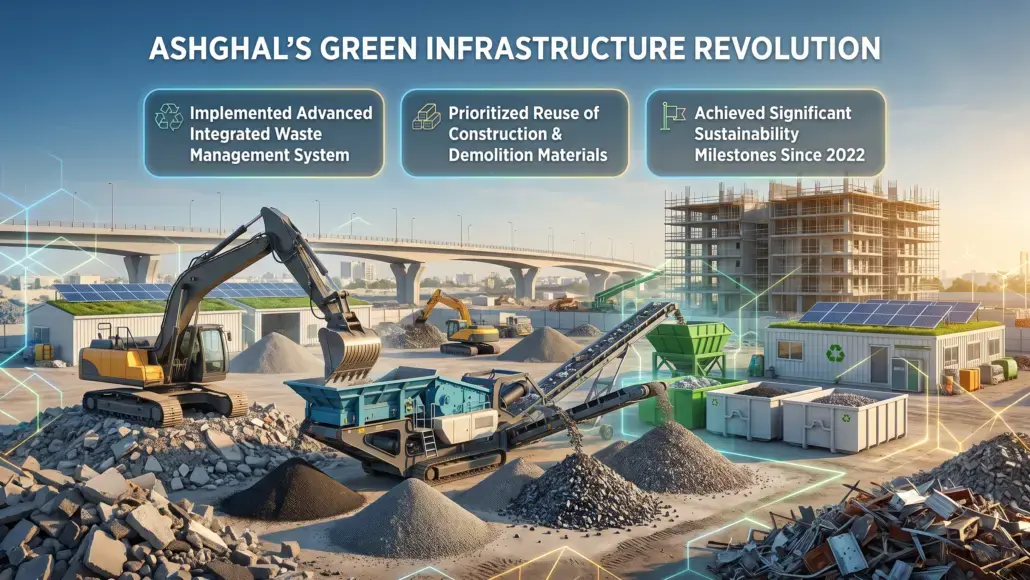


Qatar’s Public Works Authority, widely recognised as Ashghal, has officially unveiled a series of remarkable sustainability milestones achieved across its various building projects since 2022. Operating at the forefront of an ecological transformation in the region, the authority has deployed an advanced, integrated system for waste management across its active infrastructure developments. By prioritising the reuse and recycling of construction and demolition materials, the organisation is systematically reducing the environmental footprint of the nation’s infrastructure through sustainable construction initiatives.
Material Recovery and Resource Management Alignment
This environmental strategy is deeply intertwined with national developmental blueprints, specifically the Qatar National Vision 2030 and the Third National Development Strategy. Through these targeted efforts, Ashghal has successfully transitioned circular economy principles into an operational reality. The authority’s integrated approach dictates that materials previously routed to landfills are now systematically recovered, treated, and managed as valuable commodities. This systematic methodology enhances overall resource utilisation efficiency while mitigating the sheer volume of waste generated by large-scale urban developments.
According to the latest project data, Ashghal has successfully reused or transferred 2.5 million cubic metres of excavation materials. This earth and rock was strategically redirected to specialised recycling yards operated by the Qatar Primary Materials Company (QPMC) for processing and future construction integration, lowering the sector’s reliance on virgin raw materials. Additionally, the authority has completely recycled more than 300,000 tonnes of general construction and demolition waste.
Site-Level Waste Recovery Protocols
Resource recovery protocols implemented directly at project sites have yielded substantial results across multiple waste streams. Ashghal repurposed approximately 80,000 tonnes of timber waste—typically discarded from scaffolding and formwork—within active project perimeters, reducing landfill volume and transport emissions. Granular sorting mechanisms further enabled the diversion of 7,000 tonnes of plastic waste, 3,000 tonnes of paper waste, and 1,000 tonnes of scrap metal to officially approved recycling facilities.
Beyond industrial debris, Ashghal addressed biological waste across workforce accommodations and project sites, recovering nearly 8,000 tonnes of food waste. This organic material was systematically converted into organic compost or processed at designated treatment facilities to support local landscaping projects, further strengthening the circular economy framework. Through these comprehensive measures, Ashghal continues to demonstrate how sustainable construction standards can be successfully operationalized across public works projects.