





























Key Takeaways:
- Human-robot collaboration (HRC) moves beyond simple automation, establishing a symbiotic relationship where humans and robots work together to leverage their respective strengths.
- HRC significantly enhances construction safety by taking over high-risk tasks, providing real-time hazard monitoring, and offering ergonomic support to workers through tools like exoskeletons.
- Workforce efficiency is boosted as collaborative robots handle repetitive, strenuous, or precise tasks, freeing human workers to focus on complex problem-solving and skilled craftsmanship.
- The implementation of HRC contributes to greater construction productivity through increased precision, speed, and optimized material handling on job sites.
- While challenges like integration complexities and ethical considerations exist, the evolving landscape of human-robot collaboration in construction promises a future of smarter, safer, and more productive building environments, necessitating new skill development for the modern construction worker.
The very fabric of the construction industry, historically rooted in manual labor and demanding physical exertion, is undergoing a profound metamorphosis. For centuries, the backbone of every monumental structure, every critical infrastructure project, has been the human worker – their strength, their skill, and their indefatigable spirit. Yet, this reliance on manual effort has always come with inherent challenges: the relentless physical toll, the ever-present dangers of the job site, and the persistent quest for greater efficiency. In this dynamic landscape, a groundbreaking paradigm is taking root: human-robot collaboration in construction . This isn’t merely about introducing more machinery; it’s about forging a symbiotic relationship where human ingenuity and robotic precision converge, redefining safety protocols and elevating workforce efficiency to unprecedented levels. This collaborative approach promises not just incremental improvements, but a fundamental shift in how we build, making construction sites safer, smarter, and ultimately, more sustainable for everyone involved.
The Inherent Challenges of Traditional Construction
Before delving into the transformative power of human-robot collaboration, it’s crucial to acknowledge the enduring hurdles that have long plagued the construction sector. Understanding these challenges provides the essential context for why such innovative technological integration is not just beneficial, but becoming increasingly vital.
Safety Hazards and Manual Labor Strain
Construction remains one of the most hazardous industries globally. Workers routinely face risks from falls, falling objects, heavy machinery, hazardous materials, and confined spaces. The sheer physical demands, from lifting heavy beams to repetitive tasks like bricklaying or drilling, lead to a high incidence of musculoskeletal injuries, fatigue, and long-term health issues. These aren’t just statistics; they represent lives impacted, families affected, and a significant cost to both individuals and companies in terms of medical expenses and lost productivity. Traditional approaches, while continuously striving for better safety, often struggle to completely eliminate these pervasive risks that are intrinsic to the nature of the work.
Productivity Bottlenecks and Skill Gaps
Beyond safety, the industry grapples with chronic productivity challenges. Projects often face delays due to unpredictable weather, material shortages, complex logistics, and human error. Manual processes can be slow and inconsistent, leading to rework and cost overruns. Furthermore, a growing skill gap and labor shortage exacerbate these issues. Attracting and retaining skilled workers is becoming increasingly difficult, leaving projects understaffed and pushing deadlines further back. The reliance on traditional methods, while tried and tested, struggles to keep pace with the increasing demand for faster, more complex, and more cost-effective construction.
Defining Human-Robot Collaboration in Construction
Against this backdrop of challenges, the concept of human-robot collaboration in construction emerges not as a replacement for human labor, but as an intelligent augmentation. It’s a deliberate strategy to harness the strengths of both human and machine, creating a partnership far more capable than either working in isolation.
Beyond Automation: A Symbiotic Relationship
It’s important to distinguish human-robot collaboration from full automation. While automation focuses on machines independently performing tasks without human intervention, collaboration emphasizes a shared workspace and mutual assistance. Humans bring cognitive abilities, problem-solving skills, adaptability to unexpected situations, and intricate judgment. Robots, in turn, offer tireless strength, unwavering precision, relentless repetition, and the ability to operate in environments too dangerous or inaccessible for humans. The synergy allows complex tasks to be broken down, with each partner contributing what they do best, leading to superior outcomes in terms of quality, speed, and safety. This symbiotic relationship is the cornerstone of collaborative construction robots.
Categories of Collaborative Robots
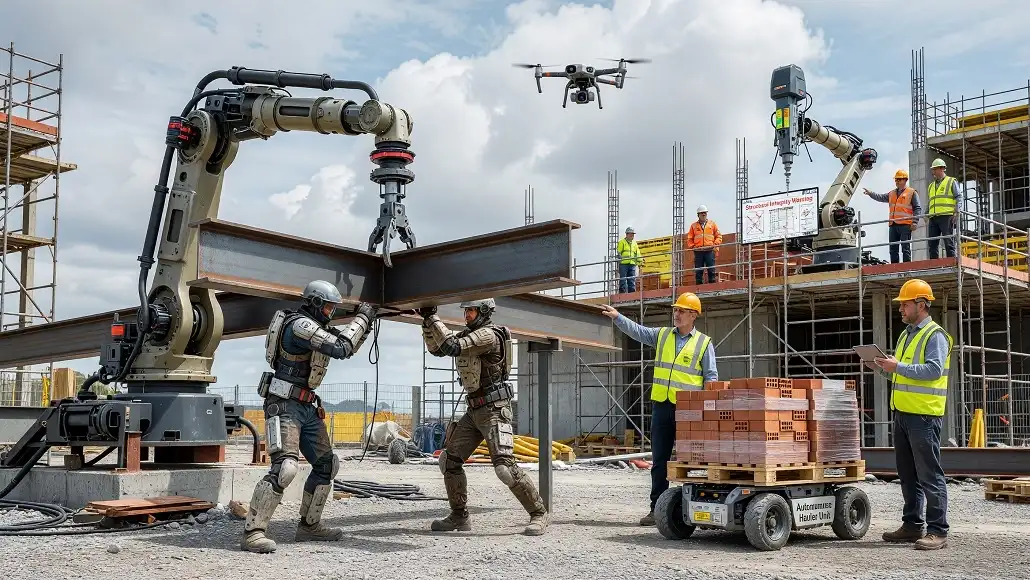
The spectrum of collaborative robots deployed in construction is diverse. It includes worker-assist robots such as exoskeletons that reduce physical strain and enhance strength for human operators. There are also mobile collaborative robots that transport materials, assist with precise positioning, or perform inspection tasks alongside human teams. Collaborative robotic arms can execute intricate assembly tasks or operate tools with precision, often guided or supervised by a human. The common thread is their design for safe interaction in a shared environment, often equipped with advanced sensors and safety protocols to detect and react to human presence.
Elevating Safety Standards Through HRC
One of the most compelling arguments for adopting human-robot collaboration in construction is its profound impact on safety. By strategically deploying robotic safety systems and construction safety technology, companies can drastically reduce the exposure of human workers to hazardous conditions, transforming historically dangerous job sites into environments where safety is paramount.
Mitigating High-Risk Tasks
Collaborative robots excel at taking on tasks that traditionally pose the highest risks to human workers. This includes heavy lifting, which can lead to sprains, strains, and crush injuries; working at precarious heights, where falls are a constant threat; or operating in environments with extreme temperatures, toxic fumes, or unstable ground. For instance, worker-assist robots in the form of exoskeletons can bear the brunt of heavy loads, protecting workers’ backs and joints. Drones equipped with advanced sensors can inspect dangerous structures or assess hazardous areas before human entry, providing invaluable data without putting lives at risk. Similarly, collaborative manipulators can perform drilling, welding, or demolition in confined or unstable spaces, keeping human hands far from immediate danger.
Real-time Monitoring and Alert Systems
Beyond direct task execution, collaborative robots contribute to safety through continuous monitoring and intelligent alerting. Equipped with an array of sensors – lidar, cameras, thermal imagers – these robots can scan job sites for potential hazards, identify deviations from safety protocols, or detect changes in environmental conditions. For example, a mobile robot might continuously monitor air quality in a tunnel construction project, immediately alerting supervisors to unsafe gas levels. Another could track the movement of heavy machinery and personnel, issuing warnings if a person enters a designated exclusion zone, effectively acting as an omnipresent safety guardian. This proactive construction safety technology empowers teams to prevent accidents before they occur, fundamentally changing reactive safety measures to preventative ones.
Ergonomic Support with Worker-Assist Robots
The strain of repetitive motions and sustained physical exertion is a silent assailant in construction, leading to chronic injuries and burnout. Worker-assist robots, particularly exoskeletons, are game-changers in this regard. These wearable robotic systems provide physical support, offloading weight from shoulders, arms, and backs, allowing workers to perform strenuous tasks with less fatigue and reduced risk of injury. Imagine a bricklayer using an exoskeleton that supports the weight of bricks and tools, enabling them to work longer, more comfortably, and with greater precision. This not only improves the individual worker’s well-being but also extends their career longevity, contributing significantly to construction labor innovation and overall workforce health.
Boosting Workforce Efficiency and Productivity
The synergy created by human-robot collaboration in construction extends far beyond safety, making profound contributions to workforce efficiency construction and overall construction productivity. By intelligently reallocating tasks between humans and machines, projects can move faster, with greater accuracy, and with optimized resource utilization.
Automating Repetitive and Labor-Intensive Tasks
Many construction tasks are inherently repetitive and physically demanding. These are precisely the areas where collaborative robots shine. Tasks such as material handling, basic assembly, repetitive drilling, or surface preparation can be delegated to robots, freeing human workers from monotonous labor. This not only reduces physical fatigue and the potential for human error but also allows skilled human craftspeople to dedicate their time and expertise to more complex, cognitive, and value-adding activities like intricate finishing work, quality control, or creative problem-solving on site. The result is a more engaged and less physically stressed human workforce, leading to higher morale and better overall performance.
Precision and Speed in Execution
Robots operate with a level of precision and consistency that is challenging for humans to maintain over long periods. Whether it’s placing components with millimeter accuracy, welding seams uniformly, or applying coatings precisely, collaborative construction robots perform these tasks flawlessly, every single time. This enhanced precision minimizes errors, reduces waste, and improves the overall quality of construction, leading to fewer reworks and ultimately, faster project completion. Furthermore, robots can work continuously without breaks, fatigue, or the need for rest, significantly increasing the speed of execution for specific tasks, thereby enhancing construction productivity.
Optimizing Material Handling and Logistics
The movement of materials on a busy construction site is a complex logistical challenge, prone to delays and inefficiencies. From transporting heavy bundles of rebar to moving delicate prefabricated components, robots can streamline these processes. Autonomous or semi-autonomous mobile robots can navigate complex terrains, lift and transport materials safely and efficiently, and even assist in organizing inventory. This optimization reduces the need for multiple manual handling steps, minimizes damage to materials, and ensures that the right materials are at the right place at the right time, contributing directly to workforce efficiency construction by preventing bottlenecks and keeping the construction flow smooth.
Case Studies and Practical Applications
The theoretical benefits of human-robot collaboration in construction are increasingly being validated through real-world applications, showcasing its practical utility across diverse aspects of building and infrastructure development.
Robotic Drilling and Inspection Systems
One compelling area of application is precision drilling and inspection. In infrastructure projects, collaborative drilling robots can accurately bore holes for anchor points or utility conduits, reducing the physical strain on workers and ensuring consistent depth and alignment. For inspection, drones equipped with high-resolution cameras and thermal sensors can quickly and safely assess the structural integrity of tall buildings, bridges, or wind turbines, providing detailed data that would otherwise require scaffolding or hazardous manual ascents. These robotic safety systems provide crucial data without compromising human safety, embodying the essence of construction safety technology.
Autonomous Material Transport and Assembly
On large construction sites, collaborative construction robots are being deployed for material transport. Mobile autonomous robots navigate paths, delivering heavy loads of bricks, cement, or steel to specific workstations, often coordinating with human teams via digital interfaces. Beyond transport, some robots are assisting in the assembly of modular components, holding elements in place while human workers secure them, or performing repetitive fastening tasks. This accelerates the building process and significantly contributes to construction productivity, especially in areas with a shortage of skilled labor for repetitive tasks.
Wearable Robotics for Enhanced Worker Capabilities
The most direct form of human-robot interaction often comes through wearable robotics. Exoskeletons designed for construction workers are no longer science fiction. These worker-assist robots empower humans by providing additional strength and endurance for tasks like overhead drilling, concrete breaking, or even simply carrying heavy tool belts for extended periods. By augmenting human capabilities, these devices reduce the physical burden, mitigate fatigue-related errors, and help to extend the working life of experienced personnel, representing a significant stride in construction labor innovation.
Challenges and the Path Forward
While the promise of human-robot collaboration in construction is immense, its widespread adoption is not without hurdles. Addressing these challenges thoughtfully will pave the way for a more integrated and successful future.
Integration Complexities and Training Needs
Integrating new robotic systems into existing construction workflows can be complex. It requires careful planning, ensuring interoperability with existing digital platforms and machinery. Furthermore, human workers need comprehensive training not just to operate these robots, but to effectively collaborate with them. This involves understanding robotic capabilities, safety protocols, and how their roles will evolve to supervise, program, and maintain these intelligent partners. Investing in robust training programs and user-friendly interfaces will be critical for seamless adoption.
Ethical Considerations and Job Displacement Concerns
A perennial concern with automation and robotics is the fear of job displacement. While human-robot collaboration in construction aims to augment rather than replace, it will undoubtedly change the nature of construction jobs. The ethical imperative is to ensure a smooth transition, focusing on upskilling the existing workforce for new roles that leverage human cognitive strengths alongside robotic capabilities. Open communication and proactive strategies for workforce development are essential to manage these transitions responsibly and ethically.
The Evolving Role of the Construction Worker
The future construction worker will likely be less about brute strength and more about supervisory skills, data interpretation, robotic programming, and problem-solving. They will become ‘robot whisperers,’ managing fleets of collaborative construction robots and orchestrating complex operations. This shift requires a continuous investment in education and reskilling initiatives, transforming traditional roles into highly technical and intellectually engaging positions. The objective is to foster an environment where technology empowers workers, creating more fulfilling and safer careers within the industry.
Conclusion
The journey towards a smarter, safer, and more efficient construction industry is undeniably being steered by technological advancements, and at the heart of this evolution lies human-robot collaboration in construction. This synergistic partnership, far removed from the notion of robots replacing humans, is instead focused on enhancing human capabilities, mitigating pervasive risks, and driving unprecedented construction productivity. From leveraging construction safety technology to prevent accidents and alleviate physical strain through worker-assist robots, to boosting workforce efficiency construction by automating mundane tasks and ensuring precision, collaborative robots are redefining the very essence of building. While the path ahead includes integration challenges and the imperative to adapt skill sets, the undeniable advantages in safety, efficiency, and construction labor innovation present a compelling vision. As we look to the future, the integration of collaborative robots promises not just more efficient project delivery, but a profound commitment to the well-being and sustained success of the human element, ensuring that the next generation of builders works smarter, safer, and in perfect harmony with their robotic counterparts.