






























In the complex orchestration of public space design, the most critical safety feature is often the least visible: the friction between a shoe and the floor. Slip-and-fall accidents represent one of the leading causes of non-fatal injuries globally, resulting in significant medical costs and legal liabilities for building owners. To combat this, the architecture and construction industries have prioritized the development of slip resistant flooring. This is not merely a matter of choosing a “rough” surface it is a sophisticated engineering challenge that involves calibrating micro-textures, managing moisture dispersion, and adhering to rigorous public safety standards. As our cities become more crowded and our populations age, the role of high-performance safety flooring in protecting the public has never been more vital.
The Science of Friction and Surface Engineering
At the heart of slip resistant flooring is the concept of the Coefficient of Friction (COF). This mathematical value determines how much resistance a surface offers to a sliding object. In the context of public space safety, engineers focus on both static and dynamic friction, ensuring that a person can both start walking and stop suddenly without losing their footing. Modern anti slip flooring solutions are engineered at the microscopic level, utilizing materials like aluminum oxide, quartz, or silicon carbide embedded within the wear layer. These particles create “peaks and valleys” on the surface that cut through liquid films such as water, grease, or cleaning agents to maintain direct contact with the sole of the shoe. This “aquaplaning” prevention is the primary defense against slips in high-risk areas like commercial kitchens and transit platforms.
Certified Grip Ratings and Compliance Standards
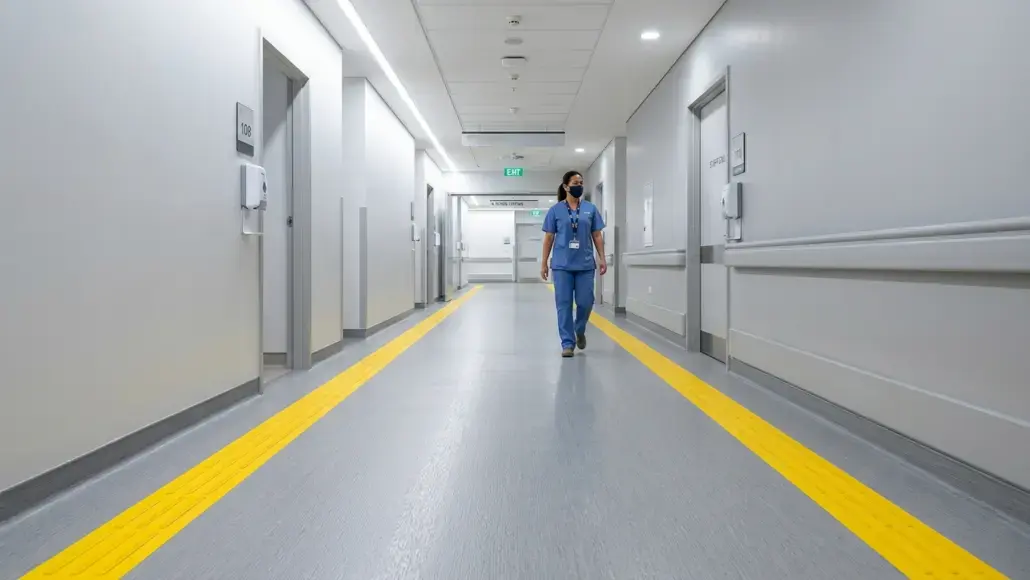
To ensure a consistent level of protection, the industry relies on a variety of certified grip ratings and testing methodologies. The most common among these is the “R-rating” (R9 to R13), which classifies surfaces based on their performance on an oil-wet ramp. An R9 tile might be suitable for a dry hallway, while an R13 surface is required for industrial environments where heavy liquid spills are frequent. Another critical metric is the Pendulum Test Value (PTV), which simulates the action of a human heel striking a wet floor. Achieving building code compliance requires architects to match these ratings to the specific risk profile of the space. In hospitals, for example, flooring must provide high slip resistance to protect patients with impaired mobility, while also remaining smooth enough to meet stringent hygiene and cleaning requirements.
The Role of Texture in Commercial Floor Safety
The visual and tactile quality of textured floor surfaces is a key component of public safety. However, there is a delicate balance to be struck between safety and maintenance. A surface that is too aggressively textured can trap dirt and bacteria, making it difficult to clean and potentially compromising hygiene. Modern slip resistant flooring addresses this through “intelligent texturing” patterns that are engineered to provide maximum grip under pressure while allowing for easy mechanical cleaning. This is often achieved through the use of “positive” textures (raised bumps) or “negative” textures (recessed grooves) that are spaced to allow cleaning pads to reach the bottom of the profile. This synergy between commercial floor safety and facility management is what makes these surfaces viable for large-scale public institutions.
Protecting Vulnerable Populations in Urban Environments
One of the most compelling arguments for the widespread adoption of slip resistant flooring is the protection of the elderly and those with disabilities. As the global population ages, the risk of life-altering injuries from simple falls increases dramatically. In public spaces like libraries, government buildings, and community centers, the floor must provide a stable and predictable environment for all users. High-performance safety flooring often incorporates tactile warnings and high-visibility contrast strips to help those with visual impairments navigate safely. By prioritizing slip resistance, urban planners are creating more inclusive cities where every citizen, regardless of their physical condition, can move with confidence and dignity.
Slip Resistance in Transit and High-Traffic Hubs
Transit hubs, such as subway stations and airports, represent the ultimate test for slip resistant flooring. These environments are subject to massive volumes of pedestrian traffic, often carrying rainwater or snow into the building. The flooring in these zones must maintain its grip ratings under the most extreme conditions while resisting the abrasive wear of thousands of daily commuters. Modern anti slip flooring solutions for transit often utilize vulcanized rubber or heavy-duty vinyl composites that are inherently slip-resistant even when completely submerged. Furthermore, these materials are engineered to be “self-healing,” where the textured profile remains effective even as the material slowly wears down over decades of use. This long-term performance is a critical factor in the economic and operational success of public infrastructure.
Chemical Resistance and the Impact of Cleaning Protocols
A factor that is often overlooked in public space safety is the impact of cleaning chemicals on the floor’s slip resistance. Some traditional floor waxes and cleaners can actually decrease friction, turning a safe surface into a hazard. To prevent this, modern slip resistant flooring is designed with high chemical resistance, ensuring that the material does not degrade or become “slick” when exposed to industrial-strength disinfectants. Manufacturers now provide detailed maintenance protocols that specify exactly which cleaning agents should be used to preserve the floor’s grip ratings. This holistic approach to safety flooring ensures that the surface remains as safe on day 1,000 as it was on day 1, protecting the owner from the risk of negligence claims.
The Aesthetic Evolution of Safety Flooring
In the past, slip resistant flooring was often associated with institutional, “utilitarian” aesthetics think of the rough, gray concrete of a parking garage. However, recent design trends have proven that safety and beauty are not mutually exclusive. Advanced digital printing and embossing technologies now allow manufacturers to create safety flooring that replicates the look of natural wood, marble, or polished concrete while maintaining an R10 or R11 slip rating. This allows architects to maintain a high-end design aesthetic in lobbies and retail spaces without compromising on public safety standards. The ability to hide the “tech” of slip resistance within a beautiful surface is a major achievement of modern material science, proving that the safest buildings can also be the most attractive.
Future Trends: Responsive and Smart Safety Surfaces
Looking ahead, the next generation of slip resistant flooring will likely incorporate “active” safety features. We are seeing the development of surfaces that can change their friction properties in response to moisture levels, utilizing hydro-reactive polymers that expand when wet to provide additional grip. Other innovations include floors with embedded sensors that can detect a “slip event” or a fall in real-time, immediately alerting security or medical staff in a public building. As our environments become more connected and data-driven, the floor will transition from a passive safety feature to an active guardian of public health. This evolution will further reduce the human and economic cost of falls, making our cities safer and more resilient for everyone.
Conclusion: The Foundation of Public Trust
The relationship between a citizen and their urban environment is built on trust the trust that the buildings we enter and the stations we use are designed with our safety in mind. Slip resistant flooring is the literal foundation of this trust. By combining rigorous surface engineering, certified grip ratings, and beautiful design, the construction industry is creating public spaces that are not only functional but also protective. As we continue to build and renovate the infrastructure of our modern world, the prioritization of slip resistance will remain a non-negotiable standard for excellence. In the end, a safe floor is more than just a surface it is a commitment to the well-being of every person who walks upon it.