



























Close
ALUMINIUM CHINA2026
Thursday, July 2, 2026
LiGHT26

Trimble Integrates Advanced AI into MEP Estimating Solutions

Note* - All images used are for editorial and illustrative purposes only and may not originate from the original news provider or associated company.

Subscribe

- Never miss a story with notifications

- Gain full access to our premium content

- Browse free from any location or device.

Media Packs

Expand Your Reach With Our Customized Solutions Empowering Your Campaigns To Maximize Your Reach & Drive Real Results!

– Access the Media Pack Now

– Book a Conference Call

Leave Message for Us to Get Back

Related stories

Construction Cybersecurity Protecting Connected Job Sites

As digital transformation sweeps through the building industry, the vulnerability of connected job sites to sophisticated cyber threats has become a critical concern. Protecting sensitive project data, securing building information modeling systems, and ensuring the integrity of IoT-enabled machinery are now essential components of modern project management. Implementing robust defense mechanisms and a culture of digital vigilance is vital for safeguarding assets and maintaining the continuity of complex construction operations in an increasingly interconnected landscape.

Green Procurement Strategies in Construction Supply

Sourcing materials and services with environmental integrity has moved from a niche consideration to a core operational necessity within the global building sector. By prioritizing low-carbon alternatives, ethical labor practices, and circular economy principles, organizations can significantly mitigate their ecological footprint while fostering long-term resilience across the supply chain. This strategic shift requires a deep integration of sustainability metrics into the selection process, ensuring that every procurement decision aligns with broader climate goals and resource efficiency.

AI Vision Systems Transforming Building Inspections

Leveraging the power of computer vision and machine learning, the construction industry is undergoing a paradigm shift in how quality control and safety monitoring are conducted. Automated systems now enable the rapid detection of structural defects, deviations from design, and potential safety hazards with a level of precision that far exceeds human capabilities. By integrating these intelligent vision tools into the daily workflow, project teams can ensure higher standards of compliance while significantly reducing the time and cost associated with manual site evaluations.
- Advertisement -

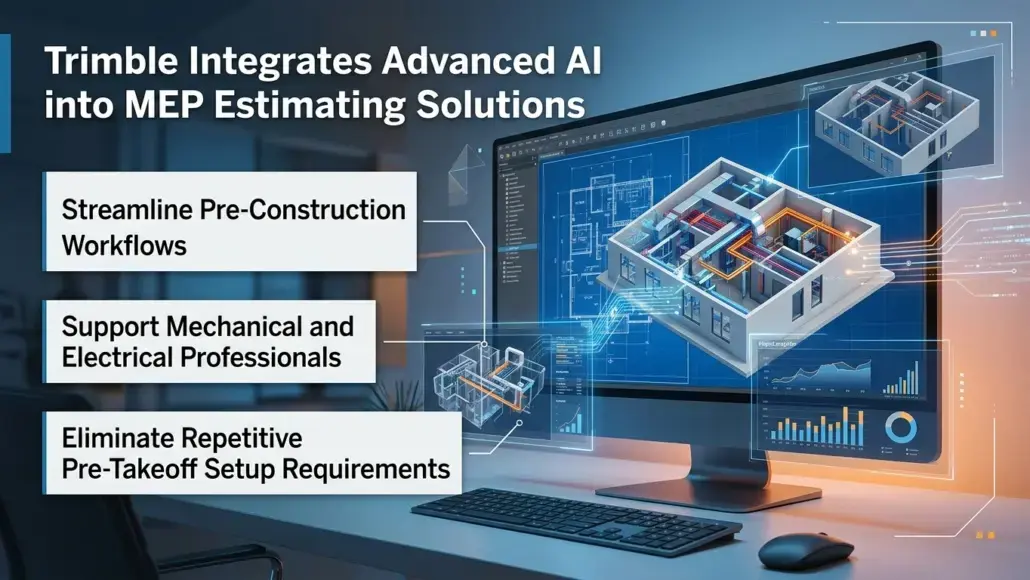
Trimble has announced the deployment of new artificial intelligence capabilities across its MEP estimating solutions, specifically designed to support the needs of mechanical contractors and electrical professionals. These advancements target the elimination of repetitive pre-takeoff setup requirements and enable the system to recognize objects directly from construction drawings. According to internal data from contractors utilizing these features in 2026, the integration of AI has reduced the time necessary for manual task completion by as much as 60 percent. This improvement in efficiency allows firms to increase their total project bidding volume and improve accuracy without the need to expand their existing headcount.

A core component of this update is the AI Smart Assistant, now integrated within the Trimble Accubid® Anywhere software. Built upon an agentic AI platform, the assistant allows users to interact with their datasets using natural language to perform autonomous operations. This includes researching historical material costs and conducting comparisons between complex estimate versions. Lawrence Smith, senior vice president of construction management solutions at Trimble, stated: “Manual takeoff is a massive drain on an estimator’s time. With over 4,000 contractors already leveraging AI within our MEP estimating solutions, we’re seeing a fundamental shift in pre-construction efficiency. For example, our automated takeoff feature has detected more than three million symbols to date, allowing estimators to bypass manual effort and focus entirely on high-value, strategic decision making.”

The new technology focuses on workflow automation by addressing the most labor-intensive aspects of the bidding cycle. The software can now instantly identify and establish the correct scale and naming conventions across entire plan sets, allowing estimators to transition from document upload to quantity takeoff in a matter of seconds. Furthermore, the AI interprets construction drawings to automatically identify and count symbols such as light fixtures, receptacles, and switches. To date, over three million symbols have been identified automatically, which has cut manual recognition time by more than half. Additionally, a new auto-routing feature assists with quantity takeoff by automatically calculating linear footage for conduit, including vertical rises and drops. These tools collectively enhance workflow automation, with time savings for comparing complex estimates often exceeding 80 percent.

Despite the high level of automation, Trimble’s AI tools are designed to function as intelligent collaborators through a “human-in-the-loop” approach. Estimators utilize their professional expertise for quality control, validating data while the system uses data analytics to learn from real-time inputs. Tim Jonas, executive director of estimation at Kidwell Electric, said, “The estimators on my team who are heavy users of Trimble AI tools cut overall estimating time significantly, which leads to more jobs, more projects and better accuracy. It’s really more of a review process for the estimator that allows them to focus on higher payoff activities rather than an actual takeoff process.” These specialized capabilities, which rely on deep data analytics to empower mechanical contractors, are currently available across North America and the United Kingdom.

Achema Middleeast

Never miss a construction headline

The construction industry moves fast – stay on top of it with our must - read briefings.

  • The top construction and infrastructure stories, straight to your inbox
  • The biggest news, features, interviews, and analysis
  • Dedicated coverage of the key developments shaping global construction markets

Latest stories

Related stories

Construction Cybersecurity Protecting Connected Job Sites

As digital transformation sweeps through the building industry, the vulnerability of connected job sites to sophisticated cyber threats has become a critical concern. Protecting sensitive project data, securing building information modeling systems, and ensuring the integrity of IoT-enabled machinery are now essential components of modern project management. Implementing robust defense mechanisms and a culture of digital vigilance is vital for safeguarding assets and maintaining the continuity of complex construction operations in an increasingly interconnected landscape.

Green Procurement Strategies in Construction Supply

Sourcing materials and services with environmental integrity has moved from a niche consideration to a core operational necessity within the global building sector. By prioritizing low-carbon alternatives, ethical labor practices, and circular economy principles, organizations can significantly mitigate their ecological footprint while fostering long-term resilience across the supply chain. This strategic shift requires a deep integration of sustainability metrics into the selection process, ensuring that every procurement decision aligns with broader climate goals and resource efficiency.

AI Vision Systems Transforming Building Inspections

Leveraging the power of computer vision and machine learning, the construction industry is undergoing a paradigm shift in how quality control and safety monitoring are conducted. Automated systems now enable the rapid detection of structural defects, deviations from design, and potential safety hazards with a level of precision that far exceeds human capabilities. By integrating these intelligent vision tools into the daily workflow, project teams can ensure higher standards of compliance while significantly reducing the time and cost associated with manual site evaluations.

Spain Allocates 364 Million Dollars to Decarbonize Cement Sector

The Spanish government has officially allocated 319 million euros,...

Subscribe

- Never miss a story with notifications

- Gain full access to our premium content

- Browse free from any location or device.

Media Packs

Expand Your Reach With Our Customized Solutions Empowering Your Campaigns To Maximize Your Reach & Drive Real Results!

– Access the Media Pack Now

– Book a Conference Call

Leave Message for Us to Get Back

Translate »