























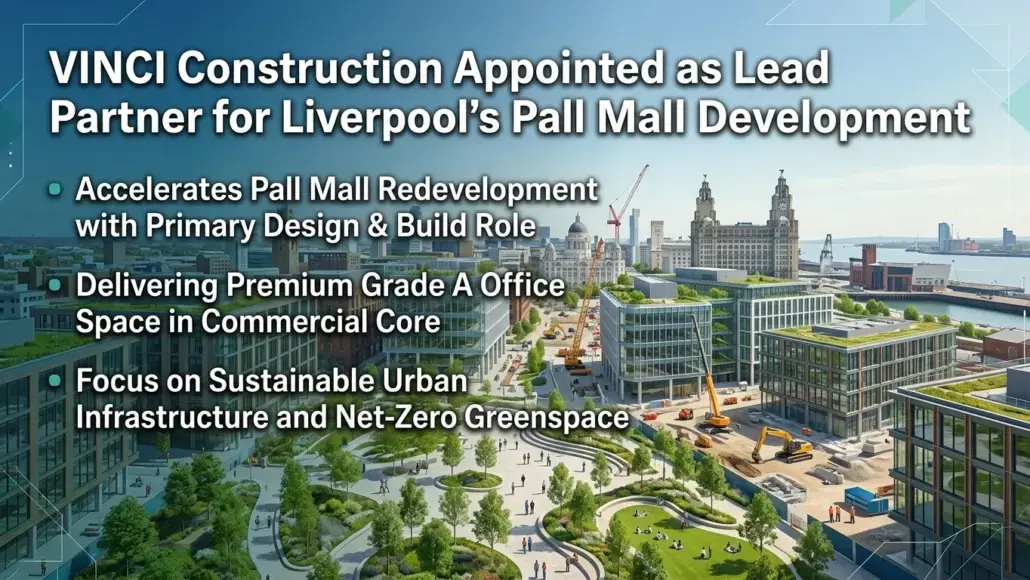


The strategic redevelopment of Liverpool’s commercial core has accelerated significantly with the official appointment of VINCI Construction as the primary design and build partner for the Pall Mall regeneration project. This decision concludes a rigorous two-stage tender process and sets a definitive timeline for the city’s most ambitious urban renewal initiative in decades. Anchored by a £60 million (KES 10.2 billion) phase-one valuation, the project aims to radically transform the former Bixteth Street Gardens. Driven by Kier Property in direct partnership with the Liverpool City Council, the development promises to end a prolonged 15-year drought in the delivery of premium, Grade A office space within the historic maritime city.
The architectural blueprint for the Pall Mall scheme represents an aggressive shift toward high-density, sustainable urban infrastructure. The targeted delivery date of 2028 will see the construction of state-of-the-art office facilities specifically engineered to accommodate modern corporate occupier demands, replacing long-vacant brownfield space. Crucially, the development explicitly balances concrete densification with ecological integration. The masterplan mandates the creation of a sprawling 0.5-acre net-zero greenspace, designed to offset the carbon footprint of the commercial towers while providing vital civic breathing room in the densely packed city center. VINCI Construction will utilize advanced, low-carbon building materials and high-efficiency energy grid integrations to ensure the finished structures undercut traditional power consumption metrics.
The financial viability of the Pall Mall regeneration project was secured in May 2026 following a decisive intervention by Chancellor Rachel Reeves. The development was successfully identified as a paramount priority under the Liverpool City Region Combined Authority’s sweeping £2 billion (KES 340 billion) Investment Fund. This high-level governmental backing effectively neutralized the crippling borrowing costs and severe construction inflation that had previously stalled the project. By leveraging limited public capital to unlock substantial private sector investment, the state has engineered a highly efficient funding pipeline designed to stimulate long-term job creation and commercial retention.
Liverpool’s central business district has suffered from a critical undersupply of modern, energy-efficient workspaces, placing the city at a competitive disadvantage compared to regional rivals. Councillor Liam Robinson, Leader of the Liverpool City Council, emphasized that the “Pall Mall delivery is an economic imperative rather than a luxury.” By introducing net-zero carbon enabled architecture to the market, the city positions itself to attract elite multinational corporations that require advanced sustainability metrics. This £60 million urban revitalization strategy shares striking parallels with African metropolitan upgrades, such as the KES 30 billion Nairobi Railway City project. Both initiatives leverage public-private partnerships to unlock dormant brownfield transit hubs, stimulating commercial densification without expanding urban sprawl. As VINCI Construction prepares to break ground, the successful execution of this masterplan is expected to permanently alter the Liverpool skyline, establishing the city as a resilient hub for global commerce while providing a vital net-zero greenspace for the public.