




























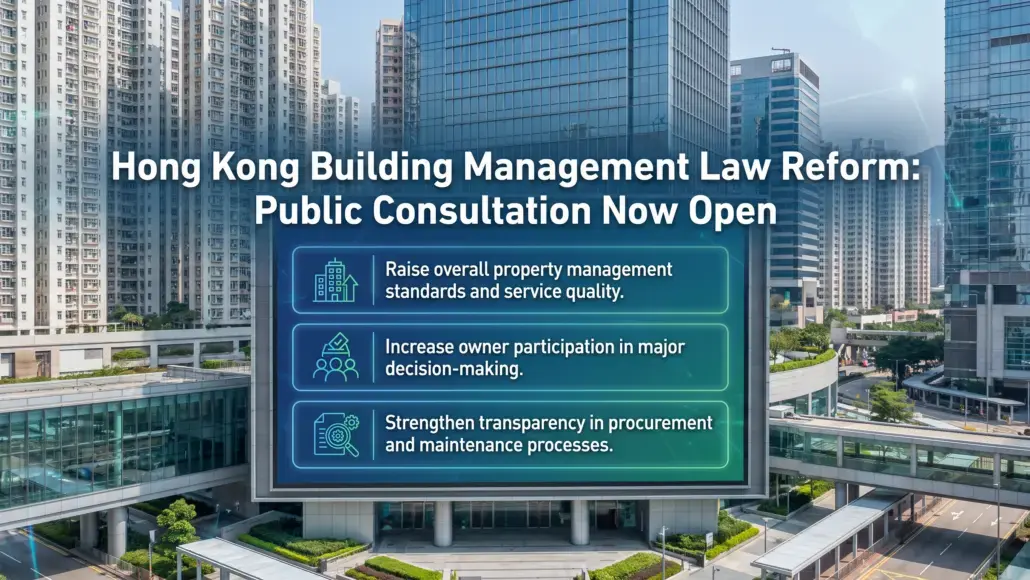


The Hong Kong government has officially launched a one-month public consultation on proposed legislative amendments to the Building Management Ordinance. The legislative initiative aims to raise overall property management standards, increase owner participation, and strengthen transparency in major decision-making processes across residential and commercial buildings.
Enhanced Thresholds for Procurement and Maintenance
The released consultation paper introduces comprehensive legislative amendments structured across five primary areas. Following public concerns arising from the Wang Fuk Court fire last November, officials announced plans to deepen institutional reforms designed to empower property owners. Under the newly proposed rules, stricter attendance and voting thresholds will be established for owners meetings regarding large-scale maintenance works and high-value procurements.
For Type 2 high-value procurements, defined as purchases that exceed or are likely to exceed 20 percent of a building’s average annual expenditure over the last three financial years, at least five percent of all owners, or 100 owners (whichever figure is lower), must attend and vote in person. For large-scale maintenance projects, officials propose a tiered system that raises quorum and in-person voting thresholds as project costs increase.
Regulation of Proxy Votes and Transparency Standards
To enhance governance standards and safeguard owner rights, the administration outlines several measures regarding proxy votes. In developments containing more than 50 units, a proxy holder will be restricted to representing a maximum of two percent of total owners or 20 owners, whichever is lower. Specific statutory restrictions will also be established regarding who can be authorized as a proxy holder.
Under the proposed building management law updates, a public list of units whose owners submitted proxy forms must be published within 48 hours of scheduled owners meetings. Standardized proxy forms will include a dedicated section allowing owners to state explicit voting instructions. Furthermore, work consultants and contractors will be mandated to disclose any potential conflicts of interest to all property owners.
Administrative Interventions and Appeals Process
The proposed changes to the building management law also aim to clarify standard procedures for calling owners meetings while granting statutory power to authorities to intervene if a management committee is deemed dysfunctional. Property owners who object to official intervention will have the opportunity to lodge a formal appeal to a statutory appeal board. Through this public consultation, the administration seeks to refine institutional governance and establish modern standards for building management.