
























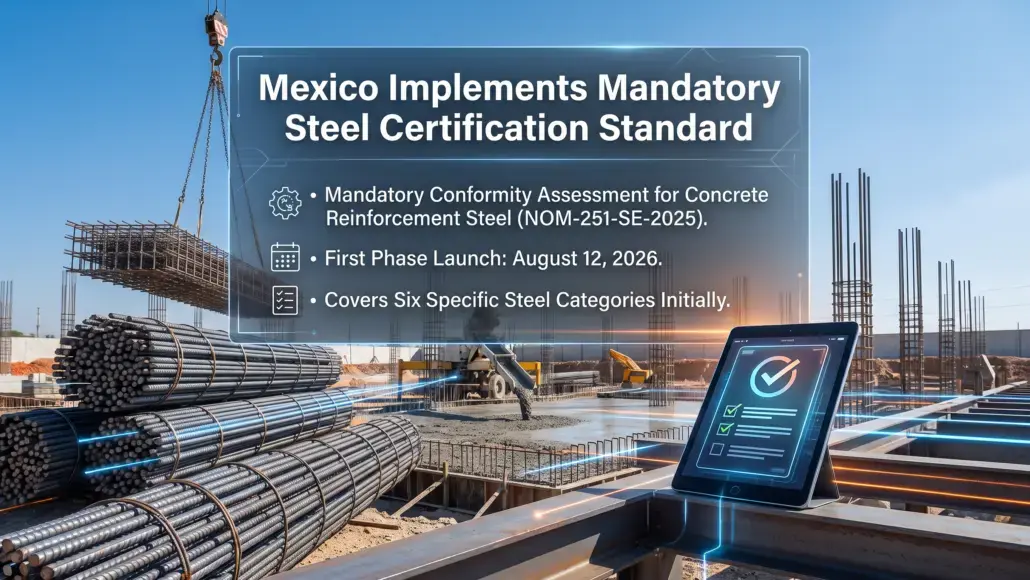


The Ministry of Economy will launch the first phase of official standard NOM-251-SE-2025 on August 12, 2026, establishing a mandatory conformity assessment scheme for steel used in concrete reinforcement across Mexico. The initial implementation stage covers six specific categories of steel for concrete reinforcement, including types of deformed rebar, welded wire mesh, welded triangular-section reinforcement, and reinforcement for columns and bond beams. A second implementation stage is scheduled to encompass all remaining categories starting August 13, 2027.
Under the new regulation, product quality guarantees transition from standard manufacturer declarations to official conformity assessment procedures, standardized test methods, and commercial labeling standards. This regulatory framework applies equal technical metrics to both domestic manufactures and foreign imports.
Industry Readiness and Verification Capacity
According to Juan Antonio Reboulen, director of Corporate Affairs and International Trade at Deacero, the primary operational focus centers on uniform market execution.
“The main challenge will be to ensure that the standard is effectively and uniformly enforced throughout the market. The NOM establishes the same standard for domestic producers and importers: it is no longer enough to declare that a product complies; compliance must now be demonstrated through verifiable procedures,” Reboulen stated.
To support verification across the supply chain, the Ministry of Economy’s Comprehensive Technological Platform for Quality Infrastructure (PLATIICA) has authorized four accredited Product Certification Bodies: OCIAC, IMCYC, ANCE, and NYCE. Developing this quality infrastructure provides domestic sector participants with formal administrative mechanisms to complete verification. Regarding this framework, Reboulen noted, “This gives us guarantees that we have the necessary bodies to move forward with certification.”
The mandatory framework establishes strict documentation for manufacturers, importers, and distributors, requiring certified sampling and testing. For companies like Deacero that already meet technical criteria, compliance involves documenting processes under the new guidelines, whereas non-compliant producers must adjust operations to gain approval. As Reboulen emphasized, “Quality will no longer be possible to fake, and it will not be enough just to claim it: it will have to be demonstrated with verifiable evidence and maintained permanently from now on.”
This standard also provides enhanced technical verification for self-construction projects, which currently represent more than 60% of housing builds in Mexico. Moving forward, obtaining formal steel certification will be a mandatory baseline across all distribution points.
Economic Landscape and Strategic Sector Measures
The rollout of NOM-251-SE-2025 arrives during a crucial economic period for national manufacturing. Industry data from Canacero shows that domestic mills were operating at an average of 64% of installed capacity in April. The sector faces a 53% drop in exports to the United States following tariff implementations, alongside import penetration reaching 42% of domestic demand after an 8.1% contraction in finished product output during 2025.
In response, the Mexican government signed an Agreement for the Promotion of the Steel Industry in April to prioritize public sector purchases of domestic products. According to Canacero, this pact aims to protect approximately 90,000 direct jobs and consolidate US$8 billion in capital expenditure, as part of a broader US$8.7 billion industry plan through 2030 targeting 30 million tonnes of national production.
Global pressures persist, as an OECD report highlights that Chinese steel exports reached a record 131 million tonnes in 2025 while Mexican domestic demand contracted by roughly 10%, shifting Mexico from eighth to tenth place in global consumption. Consequently, Mexico increased tariffs on imports from non-FTA nations at the end of 2025, combining trade measures with rigorous steel certification standards to address international market imbalances.