




























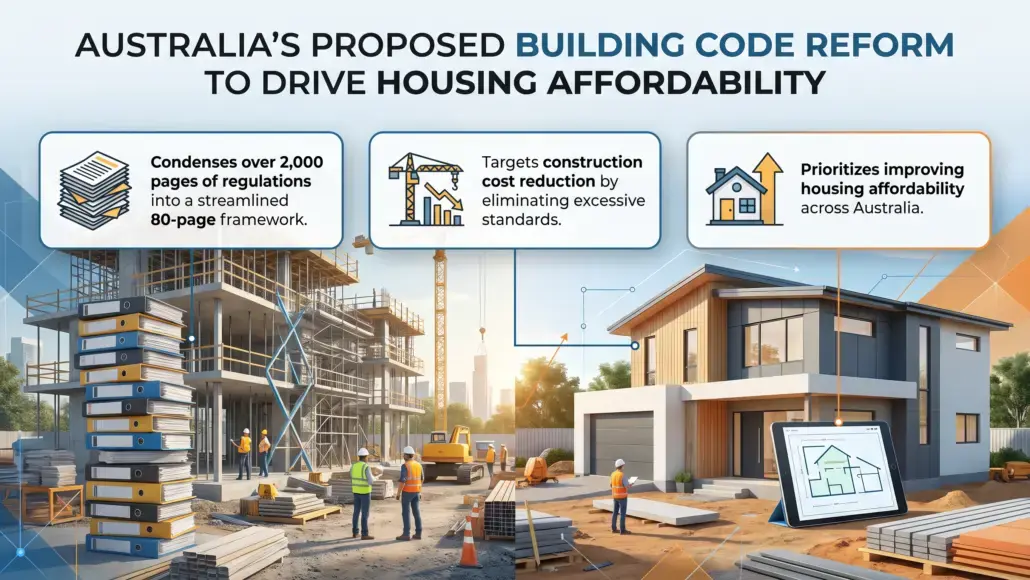


The federal opposition has announced a proposal for a sweeping building code reform designed to condense Australia’s regulatory framework from more than 2,000 pages into a streamlined 80-page document. Speaking at the National Press Club, Liberal housing spokesman Andrew Bragg outlined the initiative, arguing that current regulations demand “gold-plated houses” that inflate construction costs and severely restrict housing affordability across the nation.
Under the proposed plan, essential safety provisions within the National Construction Code would remain mandatory, while secondary requirements—including accessibility standards and energy efficiency guidelines—would become optional. Bragg stated that current regulatory structures make it illegal to construct low-cost residential properties, declaring, “We will pare this back” to help resolve the nation’s ongoing housing crisis.
Regulatory Complexity and Proposed Framework Changes
Originally spanning roughly 80 pages at its inception in 1988, the National Construction Code has expanded significantly over recent decades. This growth reflects broader regulatory mandates, enhanced compliance guidance for builders, and additional state and territory rules that contribute over 700 pages of local regulations. Industry advocates noted that these layered rules have increased home prices by thousands of dollars. Senate inquiries further revealed that recent adjustments to the construction code added between $3,600 and $33,000 to the average cost of a new home.
To streamline approvals alongside the building code reform, Bragg proposed introducing a federal pattern book containing pre-approved design templates to establish standardized, compliant housing models across all jurisdictions. However, implementing modifications to the National Construction Code requires formal cooperation from state and territory governments. Treasury’s Inspector-General of Housing highlighted that multi-jurisdictional regulatory overlap creates systemic inefficiencies that place additional burdens on residential builders.
Government Response and Housing Sector Policy
In response to the proposal, Treasurer Jim Chalmers stated that the government has actively pursued initiatives to simplify the construction code and reduce operational burdens. Chalmers acknowledged the financial and administrative impacts of existing rules, emphasizing that official efforts are already underway to ensure building processes become more efficient while supporting housing affordability.
Industry experts highlighted potential considerations regarding significant document reductions, noting that fire safety provisions alone currently comprise over 80 pages of the construction code. Beyond regulatory structure, the discussions touched upon the broader housing crisis. Bragg indicated that net overseas migration has outpaced current residential construction, resulting in an estimated 130,000-home shortfall. The Coalition proposes linking migration targets to housing completion metrics, while the Labor government is formulating policy frameworks to align future migration with national housing projections.