





























The European Commission has published new guidance on “Life Cycle Approaches to Decarbonise European Buildings”, outlining measures to reduce emissions across the entire building lifecycle while improving material efficiency and circularity in the construction sector. The guidance positions a whole-life carbon approach as central to aligning construction activity with the EU’s climate neutrality targets and broader industrial strategy.
Policy Framework and Key Measures
The guidance sets out how emissions from buildings can be addressed from design and construction through operation, renovation and demolition. It emphasises integrating both operational and embodied carbon into decision-making, supported by policy instruments already embedded in EU legislation and initiatives.
Key measures highlighted include:
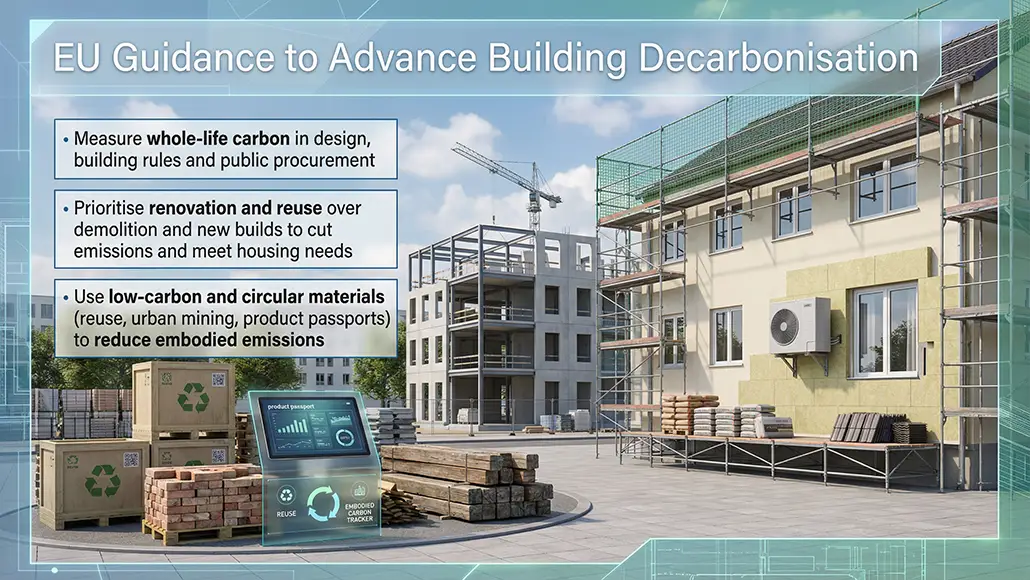
- Incorporating life-cycle assessment into building regulations and procurement
- Supporting demand for low-carbon construction products
- Expanding circularity practices and efficient material use
- Aligning building strategies with housing supply requirements
The Commission also links the guidance to broader frameworks such as the Clean Industrial Deal and the Affordable Housing Package, reinforcing the role of construction in achieving both decarbonisation and competitiveness objectives.
Whole-Life Carbon Approach Gains Strategic Focus
Central to the guidance is the whole-life carbon approach, which evaluates emissions across all stages of a building’s lifecycle. This includes both operational emissions from energy use and embodied emissions from materials, construction, renovation and demolition.
The analysis shows that operational emissions account for 73% of total building stock emissions, while embodied emissions contribute 27%. Notably, new construction representing only about 1% of built space annually accounts for 18% of emissions, highlighting the importance of material choices and construction methods.
Concrete and steel are identified as the largest contributors to embodied carbon, alongside other materials such as insulation, bricks, ceramics, paint and glue.
Construction and Renovation Implications
The guidance stresses that decarbonisation requires coordinated action across construction processes, material supply chains and building operations. It highlights that improving energy performance reduces operational emissions, while addressing material demand and supply is critical to lowering embodied carbon.
A key operational implication is the prioritisation of renovation and repurposing over new construction. The guidance identifies the conversion of existing buildings, including vacant office spaces, as a viable strategy to address housing demand while reducing emissions.
Demand-side measures such as limiting demolition, optimising space usage and extending building lifecycles are presented as underutilised tools that can significantly reduce material consumption and waste generation.
Regulatory and Market Developments
Several Member States, including the Netherlands, Finland, Denmark, France and Sweden, are already introducing requirements to measure and limit whole-life carbon in buildings. These include carbon thresholds for new construction and expanded reporting obligations.
At the city level, authorities are leveraging planning controls, procurement policies and building codes to drive emissions reductions. Initiatives include mandatory whole-life carbon assessments, limits on embodied emissions and incentives for circular construction practices.
In parallel, market-led initiatives such as green building certifications, benchmarking tools and net-zero commitments are contributing to data standardisation and accelerating adoption of low-carbon construction practices.
Strategic Role of Circular Construction
The guidance underscores circularity as a key enabler of decarbonisation, encouraging reuse of materials, urban mining strategies and digital tools such as product passports. These measures aim to reduce dependency on primary raw materials while supporting innovation and supply chain resilience.
The framework also aligns with the New European Bauhaus initiative, promoting sustainable and high-quality built environments while strengthening the construction sector’s innovation capacity.
Market and Industry Outlook
With buildings identified as the largest consumers of materials and energy in the EU, the Commission positions lifecycle-based approaches as critical to achieving climate neutrality by 2050. The integration of supply-side and demand-side measures is expected to reshape construction practices, investment flows and regulatory compliance requirements.
The guidance signals a shift towards performance-based regulation, increased reporting obligations and stronger alignment between construction activity and climate policy objectives.