


















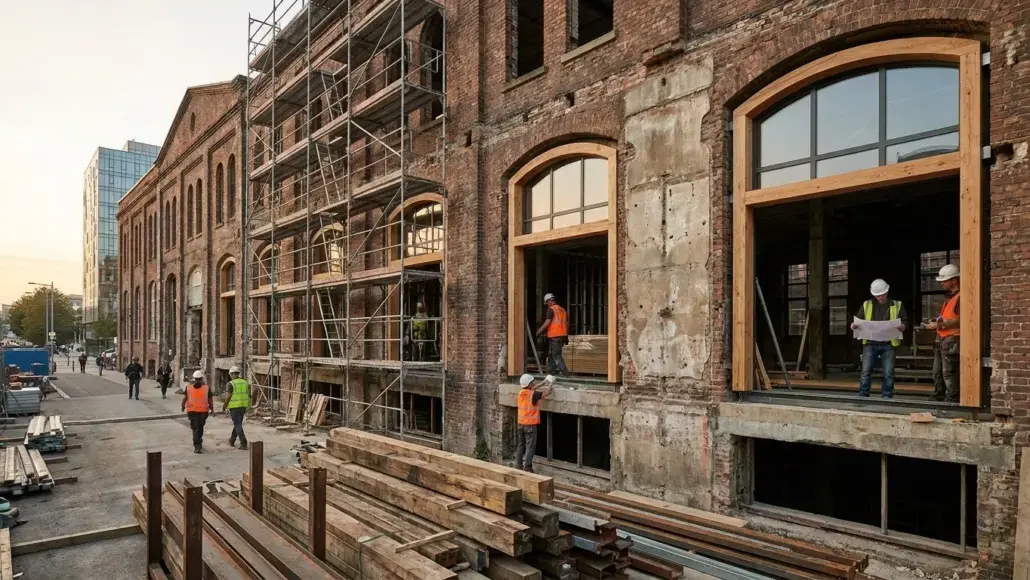


In the global pursuit of a more sustainable and resilient built environment, the concept of adaptive reuse has shifted from a niche architectural trend to a fundamental pillar of urban planning. As the construction industry grapples with its significant contribution to global carbon emissions, the mantra of “the greenest building is the one that is already built” has never been more relevant. Adaptive reuse strategies involve the process of repurposing an existing building for a function other than its original intent, such as converting an abandoned warehouse into luxury lofts or a decommissioned power station into a world-class art gallery. This approach not only preserves the cultural and historical fabric of our cities but also drastically reduces the environmental impact associated with the extraction of raw materials, manufacturing of new components, and the management of demolition waste.
The economic and social arguments for extending building lifecycles are equally compelling. Beyond the immediate environmental benefits, repurposing existing structures can often be more cost-effective than starting from scratch, especially when considering the infrastructure already in place. Socially, these projects breathe new life into neglected neighborhoods, fostering a sense of continuity and identity. However, the successful implementation of adaptive reuse requires a sophisticated understanding of structural integrity, modern building codes, and creative design. It is a delicate balancing act between honoring the past and engineering for the future, ensuring that the updated structure meets contemporary standards for safety, accessibility, and energy efficiency without losing its unique character.
The Environmental Imperative of Material Retention
At the heart of any adaptive reuse project is the principle of embodied carbon the total greenhouse gas emissions generated throughout the lifecycle of a building material. When a building is demolished, all the energy used to create its concrete, steel, and glass is effectively wasted, and the process of constructing a replacement generates a fresh wave of emissions. By adopting adaptive reuse strategies, developers can retain a significant portion of a building’s primary structure such as its foundation, frame, and envelope thereby avoiding the massive carbon spike associated with new construction. This makes retrofitting and repurposing one of the most effective tools in the climate action toolkit for the construction sector.
Moreover, the process of extending a building’s lifecycle contributes to the circular economy by reducing the demand for virgin resources. Instead of viewing an old building as a liability or a source of waste, adaptive reuse treats it as a valuable “material bank.” Even if parts of the structure cannot be kept in situ, the materials salvaged during the renovation can often be reused elsewhere in the project or sold back into the supply chain. This shift toward resource circularity is essential for an industry that consumes nearly half of all raw materials extracted globally each year. By prioritizing material retention, we can decouple urban growth from environmental degradation.
Strategic Planning and Feasibility Assessment
The journey of adaptive reuse begins long before the first hammer is swung. A comprehensive feasibility study is the foundation upon which successful strategies are built. This phase involves a rigorous evaluation of the existing structure’s physical condition, its historical significance, and its potential to accommodate a new program. Engineers must assess the load-bearing capacity of old floors, the presence of hazardous materials like asbestos, and the viability of integrating modern HVAC and electrical systems. If the structure is too far gone or the constraints are too rigid, the project may not be economically or environmentally viable.
Furthermore, planning for adaptive reuse requires a deep dive into local zoning laws and building regulations. Many modern codes were written with new construction in mind, and applying them to older buildings can be challenging. Innovative cities are increasingly adopting “Adaptive Reuse Ordinances” that provide more flexibility for developers who choose to repurpose rather than rebuild. These policies can include tax incentives, expedited permitting, and relaxed parking requirements, all of which serve to level the playing field. When the regulatory environment supports building lifecycle extension, it encourages a more diverse and vibrant urban landscape that reflects the layers of its history.
Technical Innovations in Retrofitting and Preservation
Advancements in technology have significantly expanded the possibilities for what can be achieved through adaptive reuse. Building Information Modeling (BIM) and 3D laser scanning allow architects to create highly accurate digital replicas of existing structures, enabling them to design interventions with surgical precision. This is particularly useful when dealing with irregular or historical geometries that would be impossible to measure by hand. By simulating the performance of different design options in a virtual environment, teams can optimize energy efficiency and structural performance before any physical work begins.
In addition to digital tools, new material technologies are making it easier to upgrade old buildings. High-performance insulation, smart glazing, and lightweight structural reinforcements can be integrated into existing envelopes to bring them up to modern “Net Zero” standards. For instance, applying a breathable, high-insulation lime plaster to the interior of a historic brick wall can dramatically improve thermal performance without trapping moisture or damaging the original masonry. These technical innovations ensure that adapted buildings are not just “recycled” but are actually superior in performance to many new-build counterparts.
Social and Cultural Impact of Urban Regeneration
While the technical and environmental aspects are critical, the true soul of adaptive reuse lies in its social impact. Buildings are the vessels of our collective memory, and their preservation helps maintain a sense of place in an increasingly homogenized world. When an old factory is converted into a community center or a school, it retains the stories of the people who worked there, creating a bridge between generations. This cultural continuity is a powerful driver of social cohesion and can be a catalyst for broader urban regeneration.
Furthermore, adaptive reuse projects often result in more diverse and human-scaled urban environments. Because they are constrained by existing footprints, these buildings frequently offer unique, idiosyncratic spaces that would never be created in a “clean slate” development. This variety attracts a diverse range of tenants, from boutique startups and local artisans to non-profit organizations, fostering a rich ecosystem of activity. By extending building lifecycles, we are not just saving structures; we are nurturing the social fabric that makes our cities worth living in.
Overcoming Economic and Design Challenges
Despite the myriad benefits, adaptive reuse is not without its hurdles. One of the primary challenges is the unpredictability of working with old structures. “Unknown conditions” behind walls or under floors can lead to significant budget overruns and schedule delays. To mitigate this risk, adaptive reuse strategies must include robust contingency plans and a collaborative approach between owners, architects, and contractors. Flexibility is key; designers must be willing to pivot their plans when the building reveals a hidden obstacle or a surprising opportunity.
The “design for change” philosophy is also gaining traction, where new buildings are intentionally designed to be easily adapted in the future. This involves using modular components, open floor plans, and accessible utility runs. While this doesn’t help with our current stock of historical buildings, it ensures that the projects we build today will not become the white elephants of tomorrow. By thinking across centuries rather than decades, we can create a truly sustainable built environment that evolves gracefully over time, proving that longevity and adaptability are the ultimate hallmarks of architectural excellence.