





















The global manufacturing landscape is currently navigating a period of profound transformation, often referred to as the Fourth Industrial Revolution or Industry 4.0. In the specific sector of building materials, the emergence of smart aluminium construction manufacturing is fundamentally altering the way we design, produce, and assemble the components of the modern built environment. For decades, the fabrication of aluminium for construction relied on manual processes and legacy equipment, but the integration of digital technologies, automation, and real-time data analysis is ushering in a new era of precision and efficiency. This shift is not merely a matter of upgrading machinery; it represents a comprehensive reimagining of the production chain, where physical systems and digital platforms work in seamless harmony to deliver high-performance building solutions at a global scale.
The primary driver behind the adoption of smart aluminium construction manufacturing is the demand for greater customization without the traditional cost penalties associated with bespoke design. In the past, achieving complex architectural forms required labor-intensive fabrication and significant material waste. Today, advanced digital fabrication techniques, such as robotic milling and laser cutting, allow manufacturers to create intricate, project-specific components directly from a 3D model. This “file-to-factory” workflow ensures that the final product is an exact replica of the architect’s vision, with tolerances measured in fractions of a millimeter. By eliminating the manual translation of designs into fabrication instructions, the industry is drastically reducing errors and ensuring a level of quality that was previously unattainable.
Automation and Robotics in High-Precision Fabrication
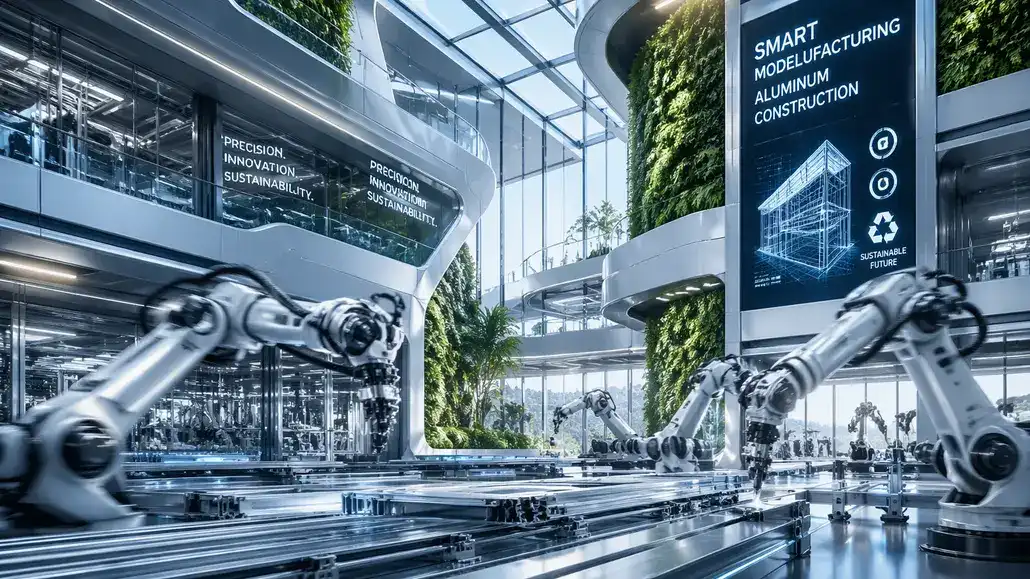
At the heart of smart manufacturing construction is the widespread implementation of robotics and automated systems. In the aluminium industry, robotic arms are now commonly used for tasks ranging from high-speed extrusion handling to precision welding and surface finishing. Unlike human operators, these machines can work around the clock with unwavering consistency, significantly increasing the throughput of fabrication facilities. For instance, in the production of complex curtain wall units, robotic assembly lines can precisely place and secure components with a speed and accuracy that manual labor cannot match. This automation in building is essential for meeting the compressed timelines of modern infrastructure projects, where every day of delay carries significant financial implications for developers and contractors.
Furthermore, the integration of collaborative robots, or “cobots,” is enhancing the capabilities of the human workforce. These robots are designed to work safely alongside people, taking over repetitive or physically demanding tasks while allowing human experts to focus on quality control and complex problem-solving. In a smart aluminium construction manufacturing environment, this synergy between human intuition and robotic precision is creating a more productive and safer workplace. The data generated by these automated systems is also being used to optimize the manufacturing process in real-time, identifying bottlenecks and predicting maintenance needs before they lead to costly downtime. This proactive approach to production management is a hallmark of Industry 4.0 construction.
Digital Twins and Real-Time Production Monitoring
One of the most transformative aspects of smart aluminium construction manufacturing is the use of digital twins virtual replicas of physical products and processes. By creating a digital twin of an aluminium extrusion line or a finished facade panel, manufacturers can simulate and analyze performance under various conditions before a single piece of metal is cut. This allows for the optimization of material usage, thermal performance, and structural integrity in the digital realm, saving time and resources during the physical production phase. Throughout the manufacturing process, sensors embedded in the equipment provide a continuous stream of data that is fed back into the digital twin, allowing for real-time monitoring and adjustment of production parameters.
This level of digital integration extends beyond the walls of the factory and into the entire supply chain. Through the use of cloud-based platforms and the Internet of Things (IoT), all stakeholders in a construction project can track the progress of specific aluminium components from the initial order through to delivery and installation on-site. This transparency is particularly valuable for large-scale global projects, where coordinating the logistics of thousands of unique components is a major challenge. By providing a “single source of truth” for production data, smart aluminium construction manufacturing is reducing the communication gaps and logistical friction that often plague traditional building processes, ensuring that the right components arrive at the right time.
Enhancing Sustainability Through Intelligent Production
The push toward smart manufacturing is also deeply connected to the construction industry’s sustainability goals. By optimizing every aspect of aluminium production, from energy use to material waste, smart systems are significantly reducing the environmental impact of the fabrication process. For example, intelligent heating systems in extrusion presses can adjust energy consumption based on real-time demand, while advanced nesting algorithms ensure that the maximum amount of usable material is extracted from every aluminium billet. These efficiencies are essential for reducing the embodied carbon of modern building components and aligning with the principles of the circular economy.
Moreover, the precision offered by smart aluminium construction manufacturing allows for the creation of lighter and more efficient structural systems. By utilizing advanced algorithms for topological optimization, engineers can design aluminium components that provide the necessary strength with the minimum amount of material. These “lean” designs not only reduce the raw material requirements but also lower the energy needed for transport and installation. As the industry moves toward a more sustainable future, the role of intelligent production in minimizing resource consumption will only become more critical. The ability to measure and report the exact environmental footprint of every manufactured component is also becoming a requirement for projects seeking high-level green building certifications.
The Role of 3D Printing and Additive Manufacturing
While still in the relatively early stages of industrial application, 3D printing or additive manufacturing is poised to become a significant component of smart aluminium construction manufacturing. Unlike traditional subtractive methods that cut material away, 3D printing builds components layer by layer, allowing for the creation of geometries that are impossible to manufacture through extrusion or casting. This technology is particularly valuable for creating complex structural nodes and connectors, where multiple beams meet at varying angles. By printing these components in aluminium, manufacturers can reduce the weight of structural joints while increasing their performance and aesthetic appeal.
The ability to “print on demand” also has the potential to revolutionize the spare parts market and the maintenance of existing infrastructure. Instead of keeping large inventories of rare or obsolete components, facilities can simply print the required part from a digital file when it is needed. This just-in-time approach to manufacturing is a core tenet of the smart factory and further reduces the waste and energy associated with traditional production and storage models. As the speed and scale of aluminium 3D printing continue to improve, we can expect to see this technology integrated more deeply into the smart manufacturing construction landscape, providing a powerful new tool for architects and engineers.
Conclusion: Navigating the Industrial Renaissance
The transition to smart aluminium construction manufacturing represents a true industrial renaissance for the building sector. By embracing the power of digital fabrication, automation, and real-time data, the industry is overcoming the limitations of traditional manufacturing and setting new standards for precision, efficiency, and sustainability. This transformation is not just about staying competitive in a global market; it is about building the capacity to create a more resilient and high-performing built environment for the future. As these technologies continue to evolve and converge, the possibilities for innovation in aluminium construction are virtually limitless, promising a new generation of buildings that are as intelligent as the processes used to create them.
