





















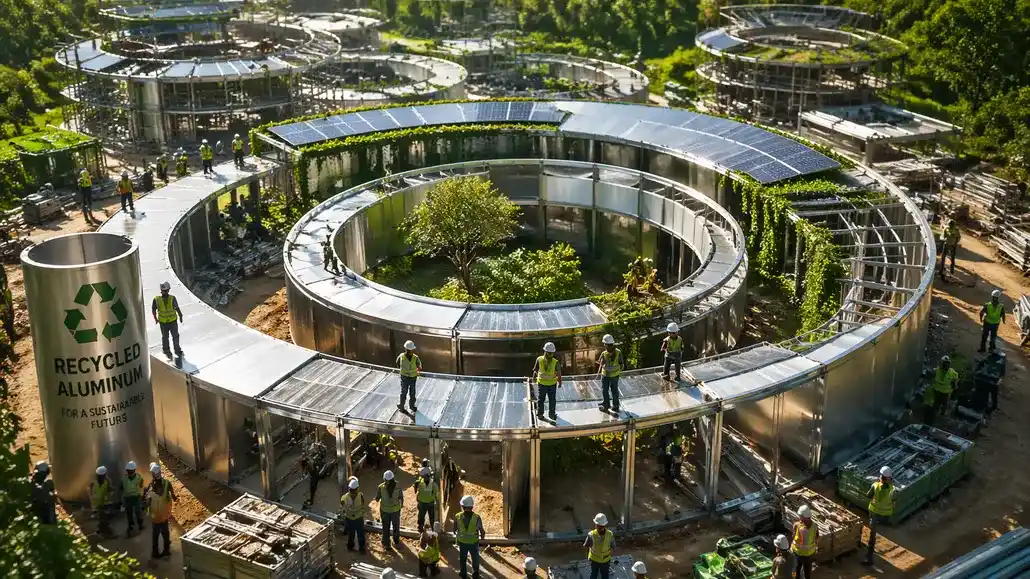

The global construction industry is currently undergoing a radical shift in its approach to material sourcing and lifecycle management, with a clear focus on the principles of the circular economy. At the heart of this transition is the strategic utilization of recycled aluminium circular construction, a movement that is redefining how we build, maintain, and eventually dismantle our urban environments. Unlike traditional linear models of “take-make-waste,” the circular approach prioritizes the continuous reuse of resources, ensuring that materials remain in the production loop for as long as possible. Aluminium, often referred to as a “permanent material,” is perfectly suited for this role because its physical properties do not degrade during the recycling process, allowing it to be repurposed indefinitely without a loss in quality or structural integrity.
As urban centers continue to expand at an unprecedented rate, the demand for high-performance building materials has never been higher. However, the environmental cost of primary material production is a growing concern for developers, architects, and government regulators alike. This is where recycled aluminium circular construction provides a decisive advantage. The energy required to recycle aluminium is approximately 5% of the energy needed to produce primary aluminium from bauxite ore. This massive 95% reduction in energy consumption directly translates to a lower carbon footprint for the construction project, making it an essential component of any strategy aimed at achieving net-zero emissions. By choosing recycled metal, the industry is not only preserving finite natural resources but also significantly mitigating the impact of industrial processes on the global climate.
The Infrastructure of Urban Mining and Material Recovery
The growth of the circular construction market is heavily dependent on the efficiency of material recovery systems. In the context of the built environment, this is often referred to as “urban mining.” When a building reaches the end of its functional life, the aluminium components ranging from window frames and curtain walls to structural beams and roofing represent a valuable resource that can be harvested and returned to the supply chain. The recovery rates for aluminium in the construction sector are remarkably high, often exceeding 95% in developed economies. This high rate of return is driven by the intrinsic value of the scrap metal, which ensures that it is economically viable for demolition contractors to sort and collect aluminium rather than sending it to a landfill.
Moreover, the advancement of sorting technologies is further enhancing the quality of recycled aluminium circular construction. Sophisticated techniques such as X-ray fluorescence and laser-induced breakdown spectroscopy allow recyclers to accurately categorize scrap by its specific alloy composition. This level of precision is critical for the construction industry, where the mechanical properties of the metal must be strictly controlled to meet safety and building code requirements. By ensuring that recycled alloys meet the same rigorous standards as virgin material, manufacturers are building confidence among engineers and architects, paving the way for the widespread adoption of circular materials in even the most demanding structural applications.
Economic Resilience through Secondary Material Markets
Beyond the environmental benefits, the shift toward recycled aluminium circular construction is also a matter of economic resilience. The global supply chains for primary metals are often subject to geopolitical instability and price volatility, which can lead to significant delays and cost overruns for large-scale construction projects. By developing robust domestic recycling loops, countries can reduce their reliance on imported raw materials and create a more stable and predictable market for building components. The secondary aluminium market is a thriving ecosystem of collectors, processors, and manufacturers, contributing to job creation and local economic development while supporting the broader goals of sustainable urbanization.
The integration of recycled materials into the design phase of a project is also becoming a key factor in securing green building certifications like LEED, BREEAM, and DGNB. These frameworks award points for the use of materials with high recycled content, providing a tangible incentive for developers to prioritize circularity. As these certifications become increasingly tied to financial incentives and planning approvals, the demand for recycled aluminium circular construction will only continue to grow. This market-driven approach is ensuring that sustainability is no longer viewed as an optional “extra” but as a fundamental requirement for any modern construction project, driving innovation across the entire value chain.
Designing for Deconstruction and Future Reuse
One of the most significant trends in the circular economy is the concept of “design for deconstruction.” This philosophy encourages architects to conceive of buildings not as permanent monoliths, but as temporary assemblies of valuable components that will one day be repurposed. Recycled aluminium circular construction is a vital part of this mindset, as the material’s lightweight nature and ease of fabrication make it ideal for modular and demountable systems. By using standardized connectors and avoiding the use of permanent adhesives or composite materials that are difficult to separate, designers can ensure that the aluminium components can be easily recovered and reused in future projects without the need for extensive processing.
This approach to the green building lifecycle is particularly relevant in the commercial and retail sectors, where building interiors and facades are often updated every few decades. By employing a circular strategy, owners can significantly reduce the waste generated during renovations and preserve the capital value of the materials used in the initial construction. The ability to “lease” or “buy back” aluminium components is an emerging business model that aligns the interests of manufacturers and developers, fostering a long-term commitment to material stewardship. As we look toward the future, the buildings of today will serve as the material banks of tomorrow, with aluminium acting as a reliable and high-value asset within the urban landscape.
Overcoming the Challenges of Circularity in Practice
Despite the clear advantages, the full realization of recycled aluminium circular construction faces several practical challenges. One of the primary hurdles is the complexity of the global construction supply chain, which often makes it difficult to track the exact recycled content of finished products. To address this, the industry is increasingly adopting digital “material passports” and blockchain technology to provide transparency and traceability throughout the material’s lifecycle. These digital tools allow all stakeholders to verify the origin, composition, and environmental impact of the aluminium used in a project, facilitating more informed decision-making and ensuring that circularity claims are backed by reliable data.
Furthermore, there is a need for greater collaboration between the demolition, recycling, and manufacturing sectors to ensure that high-quality scrap is consistently available. This requires a shift in how demolition is perceived moving away from a focus on speed and toward a focus on careful disassembly and material sorting. While this may increase the initial time and cost of deconstruction, the long-term economic and environmental benefits far outweigh the initial investment. By fostering a culture of circularity that spans the entire lifecycle of a building, the construction industry can transform itself from a major consumer of resources into a leader in sustainable material management, with recycled aluminium circular construction at the very core of this transformation.
