



















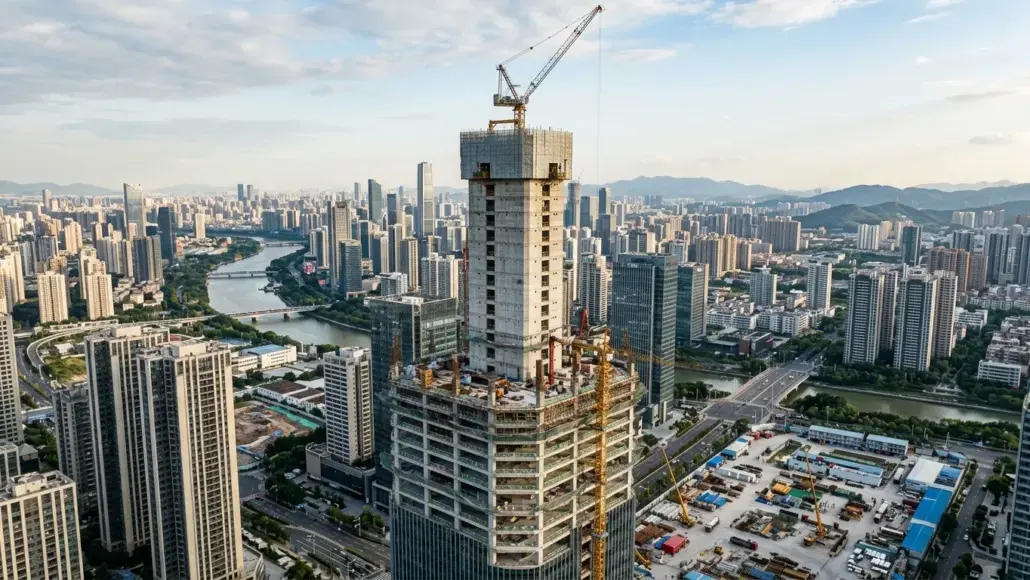


The global construction industry stands at a critical crossroads where the imperative for vertical expansion in urban centers meets the urgent necessity of decarbonization. As cities continue to grow upward, the reliance on high-rise structures becomes unavoidable, yet the environmental cost of traditional reinforced concrete the backbone of modern skyscrapers is increasingly untenable. Cement production alone accounts for approximately 8% of global carbon dioxide emissions, a figure that demands radical innovation in material science. The emergence of low carbon concrete for high rise applications represents more than just a technological shift; it is a fundamental reimagining of how we build for a sustainable future. By integrating alternative binders, recycled aggregates, and advanced chemical admixtures, engineers are now capable of delivering the high-strength performance required for verticality while significantly slashing the embodied carbon of these massive structures.
The Evolution of Sustainable Binders and Chemical Composition
The evolution of low carbon concrete for high rise development is rooted in the transition from traditional Portland cement to more sustainable cementitious materials. Historically, the high-strength requirements of skyscrapers necessitated a heavy reliance on clinker, the most carbon-intensive component of concrete. However, the introduction of Supplementary Cementitious Materials (SCMs) such as ground granulated blast-furnace slag (GGBS), fly ash, and silica fume has revolutionized the field. These industrial byproducts not only reduce the carbon footprint by replacing a portion of the cement clinker but often enhance the long-term durability and strength of the concrete. In high-rise construction, where the lower floors must withstand immense compressive loads, the slow strength gain of certain SCMs was once viewed as a drawback. Today, advanced curing techniques and precision mix designs allow for the use of high-volume SCM mixes that meet rigorous performance standards while contributing to a circular economy.
Aggregate Selection and Carbon Mineralization Techniques
Beyond the chemical composition of the binders, the role of aggregate selection and water-cement ratios plays a pivotal role in the viability of low carbon concrete for high rise projects. Lightweight aggregates, derived from recycled sources or expanded minerals, offer the dual benefit of reducing the overall dead load of the building and improving thermal insulation. When a building’s weight is reduced, the foundation requirements become less intensive, leading to further savings in material use and carbon emissions. Furthermore, the application of carbon capture and mineralization technologies during the concrete mixing process is gaining momentum. By injecting captured CO2 directly into the wet concrete, the gas is chemically converted into a solid mineral, permanently sequestering the carbon and potentially enhancing the compressive strength of the final product. This “carbon-negative” potential transforms concrete from a liability into a tool for climate mitigation.
Structural Integrity and Vertical Logistics
The structural integrity of a skyscraper is non-negotiable, and the adoption of low carbon concrete for high rise buildings must undergo stringent testing to ensure safety and longevity. Modern high-rises often exceed fifty stories, placing unprecedented demands on the pumping capability and workability of the concrete mix. Low carbon alternatives must maintain specific rheological properties to ensure they can be transported hundreds of meters vertically without segregation or blockage. The use of high-performance superplasticizers allows for the reduction of water content without sacrificing flowability, ensuring that the resulting concrete is dense, impermeable, and resistant to environmental stressors. This technical precision ensures that sustainable buildings are not just environmentally friendly but are also built to last for generations, reducing the need for future demolition and reconstruction.
Digital Optimization and Smart Construction Technologies
Urban development in the twenty-first century is increasingly defined by the integration of smart technologies and sustainable materials. The data-driven optimization of concrete mixes allows for real-time adjustments based on temperature, humidity, and structural feedback. For instance, sensors embedded within the concrete can monitor the hydration process and strength development, providing engineers with precise data on when formwork can be removed or when the next floor can be poured. This efficiency reduces construction timelines and minimizes resource waste. As cities like New York, London, and Singapore implement stricter green building codes, the demand for low carbon concrete for high rise structures is shifting from a niche preference to a regulatory requirement. Developers who embrace these innovations early are finding that sustainability is a powerful driver for investment and tenant retention.
Economic Viability and Long-term Value Proposition
The economic landscape of sustainable construction is also shifting. While the initial cost of specialized low carbon concrete mixes may be slightly higher than traditional options, the long-term value proposition is compelling. Reduced carbon taxes, incentives for green building certifications like LEED or BREEAM, and the lower operational energy costs associated with high-performance building envelopes all contribute to a favorable return on investment. Moreover, the brand value of occupying a flagship sustainable tower is immense in a corporate world increasingly focused on Environmental, Social, and Governance (ESG) goals. The transition to low carbon concrete for high rise projects is therefore as much an economic strategy as it is an environmental one, signaling a shift toward a more responsible and resilient construction sector.
Load Distribution and High-Strength Engineering Requirements
To fully appreciate the impact of low carbon concrete for high rise engineering, one must delve into the intricate mechanics of structural load distribution in supertall buildings. In a structure exceeding three hundred meters, the columns and shear walls at the base must support the cumulative weight of the entire building. Traditionally, this required extremely high-strength concrete, often reaching compressive strengths of 80 to 100 megapascals (MPa). Achieving such strength with low-carbon alternatives requires a sophisticated understanding of particle packing and chemical interaction. By optimizing the size distribution of aggregates and binders, engineers can create a more dense matrix that minimizes voids, thereby increasing strength without needing excessive amounts of Portland cement. This micro-level optimization is where the true science of sustainability meets the reality of structural necessity, allowing for a reduction in material volume while maintaining the rigid safety margins required by international building codes.
Policy Standards and Life Cycle Assessments
The role of international policy and standardization cannot be overstated in the global shift toward sustainable verticality. Organizations such as the Global Cement and Concrete Association (GCCA) have laid out ambitious roadmaps for achieving net-zero concrete by 2050. For developers of high-rise projects, adhering to these roadmaps involves conducting rigorous Life Cycle Assessments (LCA) from the design phase. An LCA evaluates the environmental impact of a building from “cradle to grave,” accounting for raw material extraction, transportation, construction, operation, and eventual demolition. Low carbon concrete for high rise applications significantly improves the results of these assessments, making projects more attractive to institutional investors who are increasingly mandated to divest from carbon-intensive assets. Furthermore, the advent of Environmental Product Declarations (EPDs) provides a transparent, third-party verified way for manufacturers to communicate the carbon footprint of their concrete mixes, fostering a competitive market for green materials.
Future Frontiers in 3D Printing and Bio-Inspired Materials
Looking ahead, the potential for bio-inspired concrete and ultra-high-performance concrete (UHPC) promises to push the boundaries of what is possible in sustainable high-rise design. Researchers are exploring the use of bacteria that can “heal” cracks in concrete, extending the life of infrastructure and reducing maintenance needs. Additionally, the development of calcined clays and other novel binders offers a pathway to even deeper decarbonization. The journey toward net-zero skyscrapers is a collaborative effort involving architects, engineers, material scientists, and policymakers. By prioritizing the implementation of low carbon concrete for high rise construction, the industry is laying the foundation for a skyline that reflects a commitment to both human ingenuity and planetary health.
As we look toward the middle of the century, the convergence of low carbon concrete for high rise construction with automated building technologies like 3D concrete printing (3DCP) offers a glimpse into a new frontier. While 3DCP is currently used primarily for low-rise residential projects, research is underway to adapt this technology for the complex geometries and reinforcement requirements of skyscrapers. 3D printing allows for the precise placement of concrete only where it is structurally necessary, potentially reducing material consumption by up to 50%. When combined with low-carbon binders, the cumulative reduction in embodied carbon would be revolutionary. This synergy of material science and digital fabrication could lead to highly organic, optimized architectural forms that were previously impossible to construct using traditional formwork.
Psychological and Cultural Shifts in Urban Aesthetics
The psychological impact of these sustainable giants on the urban population is another facet often overlooked. A high-rise built with a clear commitment to environmental stewardship serves as a physical manifestation of a city’s values. It provides a narrative of progress that is not at the expense of the environment but in harmony with it. As more of these “green towers” dominate the skyline, they redefine the aesthetic of success from one of pure height and opulence to one of efficiency and intelligence. This cultural shift is essential for the broad acceptance of new construction technologies. When residents and office workers know that the walls surrounding them are part of a global effort to sequester carbon and reduce emissions, the building becomes more than just a place of business or residence it becomes a milestone in the human journey toward a sustainable existence.
Climate Resilience and Long-term Durability
The resilience of these structures in the face of a changing climate is also enhanced by the superior properties of many low-carbon mixes. Many SCMs, particularly those like slag and silica fume, produce a concrete with a much finer pore structure than traditional mixes. This increased density provides better protection against the ingress of chlorides and sulfates, which are major causes of reinforcement corrosion. In coastal cities where high-rises are exposed to salt air and rising sea levels, the use of low carbon concrete for high rise buildings offers a double benefit: it helps mitigate the causes of climate change while providing a more durable defense against its effects. This long-term durability is the ultimate form of sustainability, as it ensures that the energy and materials invested in a building today will continue to provide value for a century or more.
In conclusion, the rise of low carbon concrete for high rise construction is a transformative movement that addresses the dual challenges of urbanization and climate change. Through the innovative use of SCMs, carbon mineralization, and advanced digital tools, the construction industry is proving that high-density living and environmental stewardship are not mutually exclusive. As these technologies continue to mature and scale, the skyscrapers of the future will stand as testaments to a new era of sustainable engineering one where every cubic meter of concrete is designed with the health of the earth in mind. The path forward is clear: to reach new heights, we must first lower our carbon footprint, ensuring that our urban expansion is as enduring as it is visionary.