

























The construction industry has entered an era where digital intelligence is no longer just a supportive tool but a primary driver of operational excellence. Among the most transformative advancements in this space is the rise of autonomous building inspections using AI vision systems. Traditionally, the inspection process has been a labor-intensive, subjective, and often perilous task, requiring skilled professionals to manually traverse scaffolding, scale high-rises, and crawl through confined spaces to verify the quality and safety of a structure. This manual approach is not only time-consuming but also prone to human error a missed hairline crack in a concrete pillar or an improperly secured bolt can have catastrophic consequences years down the line. Today, the integration of high-resolution cameras, drones, and sophisticated computer vision algorithms is redefining the standard for accuracy and efficiency in the built environment.
AI vision systems building inspections represent the convergence of advanced hardware and cutting-edge software. By utilizing “deep learning” a subset of artificial intelligence that mimics the way the human brain processes information these systems can be trained to recognize thousands of different structural elements, materials, and defects. Whether it is identifying the incorrect placement of rebar in a foundation or detecting thermal leaks in a building’s envelope, AI vision provides a “superhuman” layer of oversight. This technology doesn’t just see the world; it understands it, comparing real-world progress against digital blueprints (BIM) in real-time to ensure that every millimeter of construction aligns with the intended design.
The Mechanics of Computer Vision in Construction
At its core, computer vision involves the automated extraction, analysis, and understanding of useful information from a single image or a sequence of images. In the context of a construction site, this process begins with data acquisition. This is typically achieved through a variety of sensors, including static site cameras, 360-degree handheld devices used during walkthroughs, and autonomous drones that can map an entire project from the air. These devices capture vast amounts of visual data, which is then fed into a neural network trained specifically on construction-related imagery. Unlike a human inspector who might tire or become distracted, an AI system remains vigilant, processing thousands of images per hour with unwavering consistency.
The true power of AI vision systems building inspections lies in their ability to perform “semantic segmentation.” This means the software can identify and label every pixel in an image, distinguishing between a concrete wall, a steel beam, and a safety barrier. Once the system identifies these elements, it can perform a variety of checks. For instance, it can automatically measure the distance between structural components to ensure they meet tolerance levels, or it can check for the presence of Personal Protective Equipment (PPE) on workers to ensure site safety. This level of granular analysis allows for the detection of issues that are often invisible to the naked eye, such as minute structural shifts or the early signs of material fatigue.
Integrating AI with Drones and Robotics
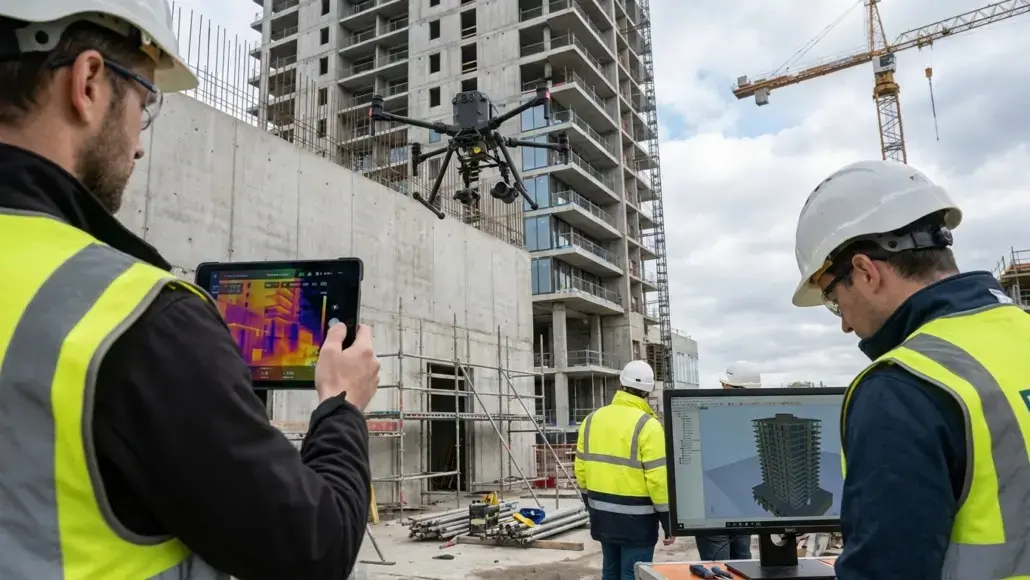
The physical deployment of these vision systems is increasingly being handled by autonomous robotics and Unmanned Aerial Vehicles (UAVs). Drones equipped with AI-driven vision can perform exterior inspections of high-rise buildings in a fraction of the time it would take a human crew, and without the need for expensive and risky scaffolding. These drones can follow pre-programmed flight paths, capturing high-resolution imagery and thermal data that provide a comprehensive “health check” of the building’s facade. Because the process is automated, inspections can be conducted much more frequently weekly or even daily providing a continuous stream of data that allows project managers to catch defects the moment they occur.
On the interior, autonomous ground robots are beginning to take over the task of site documentation. These robots can navigate complex, changing environments, moving through a job site after hours to capture a complete 3D record of progress. When paired with AI vision systems building inspections, these robots can automatically flag discrepancies between the “as-built” reality and the “as-designed” BIM model. This allows for immediate corrective action, preventing the “compounding of errors” where a small mistake in the plumbing layout, for example, leads to major problems for the electrical and flooring teams later on. The synergy between AI and robotics is creating a truly autonomous loop of observation, analysis, and reporting.
Elevating Quality Assurance and Compliance
The implications of AI-driven inspections for quality assurance (QA) and compliance are profound. In most jurisdictions, construction projects are subject to rigorous building codes and safety regulations, necessitating a series of “sign-offs” by official inspectors. These manual inspections often become bottlenecks, as teams wait for an inspector to be available before they can proceed to the next stage of the build. AI vision systems building inspections can streamline this process by providing a verifiable, digital audit trail of the entire construction process. By presenting a regulator with a complete set of high-precision data that proves every structural element meets code, developers can accelerate the approval process and reduce the risk of future legal liability.
Furthermore, the objectivity of AI is a significant asset in dispute resolution. Construction projects are notorious for “claims” and litigation over who is responsible for a particular defect or delay. With a continuous, AI-analyzed visual record of the site, there is no room for ambiguity. The data can pinpoint exactly when a particular component was installed and whether it was installed correctly according to the specs. This transparency fosters a culture of accountability among subcontractors and provides owners with the peace of mind that their investment is being built to the highest possible standards. In this sense, AI vision is not just a technical tool; it is a mechanism for building trust across the industry.
The Future of Predictive Maintenance and Structural Health
As we look beyond the construction phase, the data captured by AI vision systems will continue to provide value throughout the entire lifecycle of the building. This is the foundation of the “Smart Building” and the “Digital Twin.” By continuing to use AI vision for periodic inspections once the building is occupied, facility managers can move from reactive repairs to predictive maintenance. For example, the system could monitor the surface of a bridge or the walls of a stadium, detecting the earliest signs of corrosion or stress before they become safety hazards. This “structural health monitoring” can extend the lifespan of our infrastructure and save billions in emergency repair costs.
The future will likely see these systems becoming even more integrated with other forms of AI, such as natural language processing. Imagine a site manager simply asking their tablet, “Are there any defects in the concrete on the fifth floor?” and receiving a detailed, visual report in seconds. As the algorithms become more sophisticated and the hardware more affordable, AI vision systems building inspections will move from being a premium feature of mega-projects to a standard requirement for every construction site. We are moving toward a world where buildings are not just passive structures but intelligent assets that are monitored and maintained with the same level of digital precision as a high-end aircraft.
Overcoming Challenges and the Human-AI Partnership
Despite the clear advantages, the adoption of autonomous inspections faces several hurdles. Technical challenges include the need for robust connectivity on-site and the sheer volume of data that must be processed and stored. There is also the challenge of “edge cases” complex visual scenarios that the AI may not have encountered during its training, which can lead to false positives or missed detections. To address this, the industry must invest in better data standardization and continue to refine the underlying models.
Perhaps the most significant challenge, however, is the cultural shift required. There is a common fear that AI will replace human inspectors and engineers. In reality, the most effective model is a partnership. AI handles the repetitive, dangerous, and data-heavy tasks, while human experts focus on high-level decision-making and complex problem-solving. An AI system can flag a potential defect, but it often takes a human engineer to understand the root cause and determine the best course of action. By embracing AI vision systems building inspections, professionals can free themselves from the drudgery of manual documentation and focus on what they do best: building the safe, sustainable, and beautiful structures of tomorrow.