




























Close
ALUMINIUM CHINA2026
Tuesday, June 30, 2026
LiGHT26

Spain Allocates 364 Million Dollars to Decarbonize Cement Sector

Note* - All images used are for editorial and illustrative purposes only and may not originate from the original news provider or associated company.

Subscribe

- Never miss a story with notifications

- Gain full access to our premium content

- Browse free from any location or device.

Media Packs

Expand Your Reach With Our Customized Solutions Empowering Your Campaigns To Maximize Your Reach & Drive Real Results!

– Access the Media Pack Now

– Book a Conference Call

Leave Message for Us to Get Back

Related stories

Why a Jib Crane Is Essential for Safe and Efficient Material Handling

Material handling plays a vital role in manufacturing plants,...

NBS and BDP Partner to Advance Carbon Data in Construction

NBS, part of Hubexo, has entered into a long-term...

The Construction Technology Upgrades Delivering Real ROI in 2026

Construction technology has moved well past the “nice to...
- Advertisement -

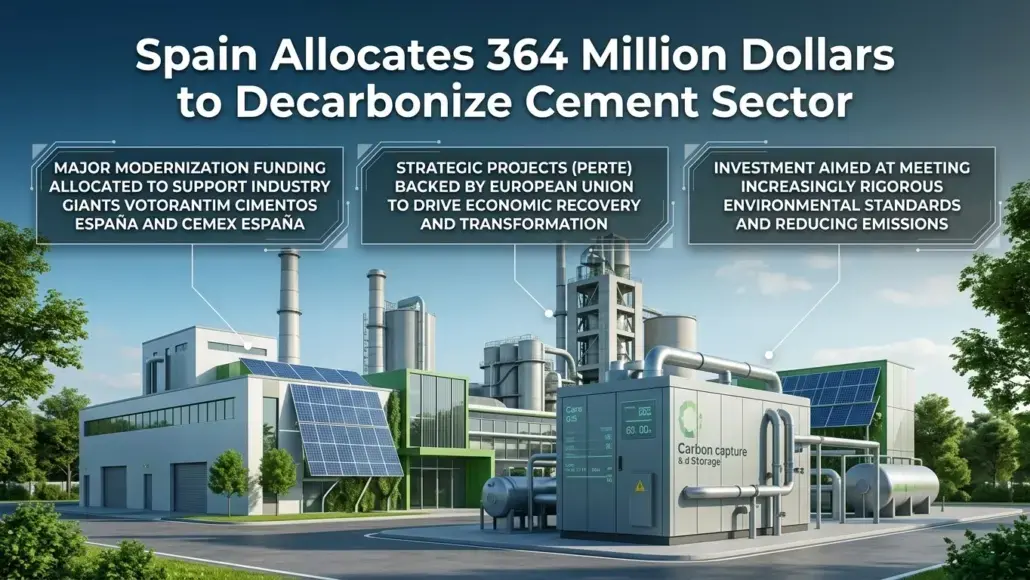
The Spanish government has officially allocated 319 million euros, which converts to approximately 364 million dollars, to support Votorantim Cimentos España and Cemex España in a significant modernization initiative. This funding is distributed through the Strategic Projects for Economic Recovery and Transformation initiative, known as PERTE, which receives backing from the European Union. The investment is designed to help the nation meet increasingly rigorous environmental mandates by focusing on hard-to-abate sectors. Currently, the global impact of cement production represents a substantial climate liability, accounting for nearly 7% of all carbon dioxide emissions worldwide and 4% within the European borders.

Strategic Funding for Carbon Capture and Hydrogen Overhauls

A major portion of this capital, totaling 119.6 million euros or about 136.4 million dollars, has been granted to Votorantim Cimentos España for the development of carbon capture infrastructure. This project will be located at the Toral de los Vados plant in El Bierzo, which maintains an annual output of 1.6 million tons. The technology will focus on the technological integration of systems that intercept and liquefy carbon dioxide from flue gases. By addressing this climate liability, the company aims to reduce its emissions to 475 kilograms per ton of cement by 2030. This initiative is a vital component to decarbonize cement sector and to reach carbon neutrality by 2050, ensuring the production cycle remains sustainable.

Implementation at Major Industrial Facilities

Additionally, Cemex España has been awarded 200 million euros, equivalent to 228 million dollars, to transition toward alternative fuel sources at its Alcanar site in Tarragona. This facility is currently a site for technological integration through a waste-to-hydrogen pilot program managed by the HYIELD consortium and WtEnergy. This project, which also receives 10 million euros from the Horizon Europe program, aims to utilize hydrogen to remove fossil fuels from the production cycle. These efforts are part of the broader 3.17 billion euro PERTE framework. The plan to decarbonize cement sector intends to cut 13 million tons of emissions annually, ensuring that domestic modernization initiative efforts keep pace with evolving environmental mandates.

Achema Middleeast

Never miss a construction headline

The construction industry moves fast – stay on top of it with our must - read briefings.

  • The top construction and infrastructure stories, straight to your inbox
  • The biggest news, features, interviews, and analysis
  • Dedicated coverage of the key developments shaping global construction markets

Latest stories

Related stories

Why a Jib Crane Is Essential for Safe and Efficient Material Handling

Material handling plays a vital role in manufacturing plants,...

NBS and BDP Partner to Advance Carbon Data in Construction

NBS, part of Hubexo, has entered into a long-term...

The Construction Technology Upgrades Delivering Real ROI in 2026

Construction technology has moved well past the “nice to...

Smart Water Systems Improving Construction Efficiency

The integration of digital monitoring, automated leak detection, and advanced recycling technologies is fundamentally altering how the building industry manages one of its most critical and overlooked resources.

Subscribe

- Never miss a story with notifications

- Gain full access to our premium content

- Browse free from any location or device.

Media Packs

Expand Your Reach With Our Customized Solutions Empowering Your Campaigns To Maximize Your Reach & Drive Real Results!

– Access the Media Pack Now

– Book a Conference Call

Leave Message for Us to Get Back

Translate »