




























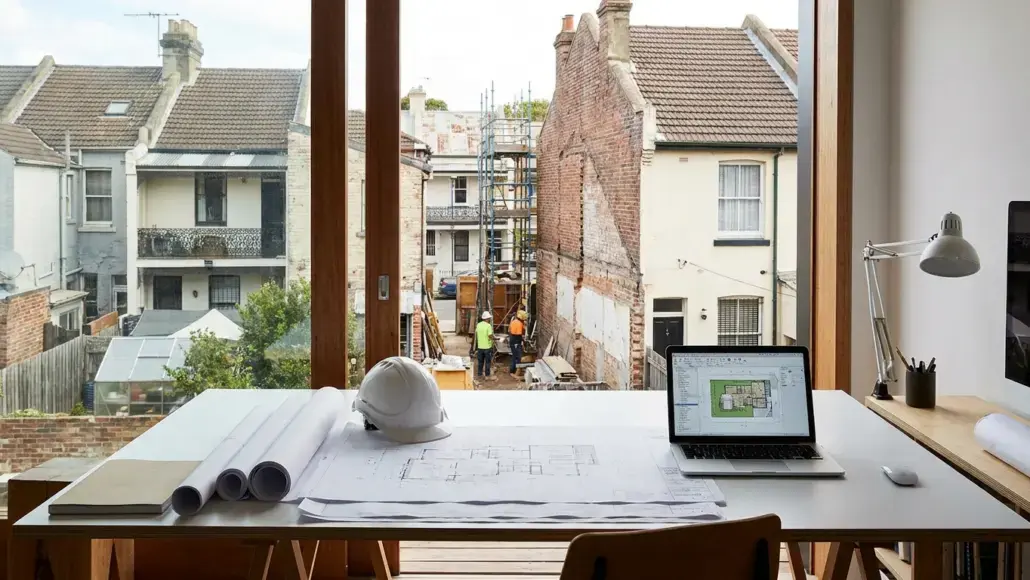


For designers working on residential projects in built up areas, the Party Wall etc. Act 1996 is something that needs to be understood early, not discovered late. A party wall surveyor often becomes involved once notices have been served, but the decisions that determine whether notices are needed are made at the design stage.
Understanding the basics of the Act, and knowing when to flag potential issues, helps designers avoid situations where a finished scheme cannot proceed to site without further delay.
What Triggers the Act
Three types of work fall under the Act. The first is building on the line of junction between two properties, which can apply to extensions built up to a boundary. The second is work directly affecting a party wall, such as cutting in beams or removing a chimney breast that forms part of a shared structure.
The third is excavation near a neighbouring building’s foundations, typically within three metres, or six metres for deeper excavations such as basements. Many residential designs involve at least one of these elements, even where the overall scheme seems modest.
Spotting Issues at Concept Stage
At concept and feasibility stage, designers can often identify likely party wall triggers simply by looking at where new structure meets existing boundaries. A new steel beam bearing on a shared wall, a rear extension with foundations close to next door, or a side extension built up to the boundary line are all common examples.
Flagging these early means the client can be made aware that party wall notices are likely to be needed, and that this will affect the overall programme. It also allows the design to be reviewed for any changes that might reduce the scope of works requiring notice, if that is desirable.
Working With Structural Decisions
Many party wall triggers relate directly to structural design decisions, such as where beams bear, how deep foundations need to be, and whether underpinning is required. Architectural technologists and structural engineers often need to work together on these details, since small changes to a structural approach can sometimes avoid or reduce the extent of party wall involvement.
This is not always possible or desirable, particularly where a particular structural solution is the most appropriate for the building. But understanding the implications allows informed decisions to be made, rather than discovering the issue only once notices are being prepared.
Communicating With Clients
Clients are not always aware that party wall notices may be needed, or that this could add one or two months to their programme before work can start. Designers are often well placed to explain this early, alongside other programme considerations such as planning permission and building regulations.
Setting expectations early helps clients understand why party wall surveys and notices form part of the overall project timeline, rather than seeing them as an unexpected delay introduced later.
Designing With the Full Picture in Mind
For designers, party wall considerations are best treated as part of the overall design process, alongside structural, planning and regulatory requirements. By identifying likely triggers early, working closely with structural input, and communicating clearly with clients, designers can help ensure that a scheme moves smoothly from concept to site, with party wall matters resolved well before construction is due to begin.