





























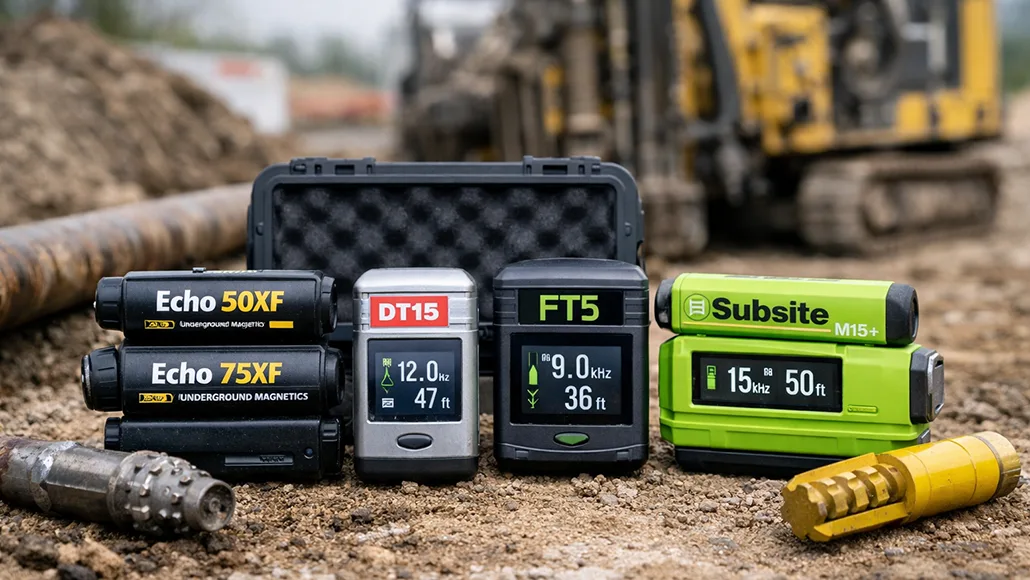


By Valeriy Volkov, Manager at UCG Underground Supplies LLC
A high-powered transmitter doesn’t automatically solve an interference problem.
Power lines, traffic loops, reinforced concrete, steel pipe, and guardrails affect locating signals in different ways. A transmitter that works well beside an electrical line may struggle under a reinforced road. A strong signal can still produce an incorrect location when nearby metal distorts its magnetic field.
The right choice depends on four factors:
- The type of interference.
- The available frequency range.
- The expected bore depth.
- The receiver and housing already in your locating system.
This comparison covers current transmitters from Digital Control Incorporated, Underground Magnetics, and Subsite Electronics. It uses manufacturer manuals, technical specifications, and published prices available in June 2026.
It does not use independent head-to-head field testing. All depth and battery figures are manufacturer-rated values.
Quick findings
The DigiTrak SuperCore DTS15p provides the broadest documented all-in-one frequency selection. It combines wideband and Sub-k operation in one 15-inch transmitter, but it works only with the DigiTrak ARES receiver.
The Underground Magnetics Echo 50XF transmitter offers a strong balance for Mag X users. It covers frequencies from approximately 0.32 to 41 kHz, fits a standard 15-inch housing, and costs less than the current DigiTrak Core models.
The Underground Magnetics Echo 75XF provides the highest published depth in this comparison. Its 19-inch body and specialized housing requirements make it a more project-specific choice.
The DigiTrak Classic-Core DT15p is the lower-cost ARES option. It provides the same published wideband and Sub-k frequency ranges as SuperCore, but with lower depth and data range.
The DigiTrak FT5p V2 and FTR5p remain practical choices for an existing Falcon fleet. However, DCI separates wideband and Sub-k operation into two transmitters.
The Subsite M15+ offers broad 1.9–46 kHz coverage for Marksman+ users. It supports low-frequency work around metal, but it does not reach true Sub-k frequencies below 1 kHz.
How we compared the transmitters
We compared each model using the same factors:
- Supported receiver system.
- Published frequency range.
- Sub-k capability.
- Power modes.
- Manufacturer-rated depth.
- Battery life.
- Transmitter dimensions.
- Published price.
- Documented operating limitations.
We treated manufacturer-rated depth as a specification, not a guaranteed field result.
Actual locating range can change with frequency, battery condition, housing design, soil, bore depth, receiver position, and local interference. Manufacturers also use different test methods and terminology. DCI, for example, separates depth range from transmitter data range.
That difference matters.
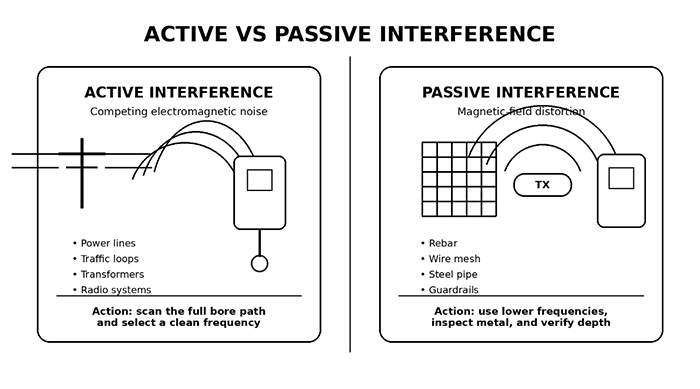
Active and passive interference require different strategies
High-interference jobsites usually contain active interference, passive interference, or both.
Active interference
Active interference comes from equipment or infrastructure that generates an electromagnetic field.
Common sources include:
- Power lines.
- Traffic detection loops.
- Transformers.
- Radio transmitters.
- Cellular equipment.
- Cathodic protection systems.
- Operating electrical equipment.
Active interference competes with the transmitter signal. The cleanest operating frequency can change from one section of the bore path to another.
The crew must scan the complete route. A reading at the entry point does not represent the entire crossing.
Passive interference
Passive interference does not generate its own signal. It changes the shape of the transmitter’s magnetic field.
Common sources include:
- Reinforcing steel.
- Wire mesh.
- Guardrails.
- Chain-link fences.
- Buried steel pipe.
- Steel drainage structures.
- The drill and drill pipe.
Passive interference creates a different problem. The receiver may show a stable signal while calculating the wrong depth or position.
Lower frequencies usually reduce coupling with nearby metal. However, a low frequency cannot remove every distortion caused by reinforced concrete or large steel structures.
You still need to verify the reading.
HDD transmitter comparison
| Transmitter | Confirmed receiver | Published frequency range | True Sub-k | Manufacturer-rated depth | Published battery life | Size | Advertised price* |
|---|---|---|---|---|---|---|---|
| DigiTrak SuperCore DTS15p | DigiTrak ARES | 0.33–45 kHz across Wideband and Sub-k modes | Yes | Up to 160 ft Wideband; 80 ft Sub-k | 100/35/10 hr | 15 in | $6,200 |
| Underground Magnetics Echo 50XF | Mag X Pro; Mag X COR | Approx. 0.32–41 kHz | Yes | 131 ft normal; 164 ft high | 50/12 hr or 60/15 hr | 15 × 1.25 in | $4,000 |
| Underground Magnetics Echo 75XF | Mag X Pro | 0.325–41 kHz | Yes | 114/180/278 ft | 100/60/11 hr | 19 × 1.25 in | $5,000 |
| DigiTrak Classic-Core DT15p | DigiTrak ARES | 0.33–45 kHz across Wideband and Sub-k modes | Yes | Up to 125 ft Wideband; 65 ft Sub-k | 150/80/24 hr | 15 in | $5,200 |
| DigiTrak FT5p V2 | Compatible DigiTrak Falcon systems | Wideband model | No | 65/100/125 ft | 140/80/14 hr | 15 in | $4,700 |
| DigiTrak FTR5p | Compatible DigiTrak Falcon systems | Sub-k and standard modes | Yes | 60 ft Sub-k; 90 ft standard | 80 hr | 15 in | $4,700 |
| Subsite M15+ | Published with Marksman+ | 1.9–46 kHz | No | 95 ft normal; 130 ft high | 60/30 hr | 15 × 1.25 in | Dealer quote |
*Prices reflect advertised figures found during the research on June 17, 2026. They may exclude taxes, shipping, batteries, housings, chargers, receivers, and other components.
1. DigiTrak SuperCore DTS15p: best all-in-one frequency coverage
The DigiTrak SuperCore DTS15p combines wideband and Sub-k operation in one transmitter.
Its published wideband range covers 4.5–45 kHz. Its Sub-k mode covers 0.33–0.75 kHz and additional frequencies from 4.5 to 23.5 kHz.
That range gives the operator two different tools.
Wideband operation helps the crew search for a clean frequency around active electrical noise. Sub-k operation targets jobs where rebar, wire mesh, and nearby steel create passive interference.
The transmitter has three power levels. DCI lists the following wideband depth ratings:
- 100 feet in low power.
- 140 feet in standard power.
- 160 feet in high power.
The published Sub-k depths are lower:
- 50 feet in low power.
- 75 feet in standard power.
- 80 feet in high power.
SuperCore uses the rechargeable SuperCell-R battery. DCI lists battery life at 100 hours in low power, 35 hours in standard power, and 10 hours in high power.
High power has a clear cost.
The system’s main advantage comes from its integration with DigiTrak ARES. DCI states that ARES can scan more than 8,000 frequencies while the operator walks the bore path. The receiver then selects operating bands based on measured interference.
This is a manufacturer-controlled feature, not an independent performance result. Still, it gives the crew a structured way to evaluate changing active interference.
Best fit
SuperCore fits contractors who:
- Already use DigiTrak ARES.
- Regularly encounter both active and passive interference.
- Want wideband and Sub-k operation in one transmitter.
- Need longer data range than Classic-Core provides.
Main limitation
SuperCore works exclusively with DigiTrak ARES.
You cannot choose it as a stand-alone transmitter without considering the receiver platform, software, batteries, and housing.
Source: DigiTrak SuperCore Quick Start Guide.
2. Underground Magnetics Echo 50XF: best balance for Mag X users
The Echo 50XF combines low-frequency capability, a standard 15-inch body, and two power levels.
Underground Magnetics lists 16 selectable frequencies from approximately 0.32 to 41 kHz. This range covers true Sub-k operation and higher frequencies for active-interference work.
The manufacturer lists the following depth ratings:
- 131 feet in normal power.
- 164 feet in high power.
Battery life depends on the installed battery.
A rechargeable 21700 battery provides a published 50 hours in normal power and 12 hours in high power. A primary 261020 battery provides 60 and 15 hours.
The transmitter measures 15 × 1.25 inches. Underground Magnetics lists it for the Mag X Pro and Mag X COR systems.
That combination makes the Echo 50XF a practical fit for contractors who already operate Mag X equipment and need a standard-size transmitter for mixed interference.
Best fit
Echo 50XF fits contractors who:
- Use Mag X Pro or Mag X COR.
- Need frequencies below 1 kHz for rebar and steel.
- Want a 15-inch transmitter.
- Need more published depth than the Subsite M15+.
- Want a lower advertised price than the DigiTrak Core models.
Main limitation
Underground Magnetics publishes depth under defined test conditions. The transmitter will not provide 164 feet of usable range at every frequency or jobsite.
The housing also matters. An incorrect slot pattern or incompatible housing can reduce signal performance, increase heat, and affect warranty coverage.
Source: Underground Magnetics Mag X Pro Operator’s Manual.
3. Underground Magnetics Echo 75XF: best published depth
The Echo 75XF targets deeper crossings where the crew also needs low-frequency capability.
Underground Magnetics lists 16 frequencies from 0.325 to 41 kHz. The transmitter has three power levels with published depths of:
- 114 feet in low power.
- 180 feet in medium power.
- 278 feet in high power.
It uses two rechargeable 26650 batteries. Published battery life drops from 100 hours in low power to 60 hours in medium power and 11 hours in high power.
The 278-foot figure is the highest published depth in this comparison.
It does not make the Echo 75XF the best choice for every crew.
The transmitter measures 19 × 1.25 inches. It needs a compatible long housing, and its size limits direct replacement options for fleets built around standard 15-inch transmitters.
Best fit
Echo 75XF fits contractors who:
- Use Mag X Pro.
- Plan deep highway, river, or infrastructure crossings.
- Need low-frequency operation around reinforced structures.
- Can support a 19-inch housing.
- Accept shorter battery life at maximum power.
Main limitation
The manufacturer’s Mag X COR documentation conflicts on Echo 75XF compatibility. One product area shows the transmitter, while the formal compatibility list does not.
Confirm Mag X COR compatibility before purchase.
The manufacturer’s manual also lists 220°F as 121°C. Those values do not convert correctly. A temperature of 220°F equals approximately 104°C.
Use the Fahrenheit figure until the manufacturer corrects the document.
4. DigiTrak Classic-Core DT15p: best lower-cost ARES option
Classic-Core provides the same published wideband and Sub-k frequency ranges as SuperCore.
It supports:
- Wideband frequencies from 4.5 to 45 kHz.
- Sub-k frequencies from 0.33 to 0.75 kHz.
- Additional Sub-k-mode selections from 4.5 to 23.5 kHz.
It also has low, standard, and high power modes.
The main difference appears in range.
DCI lists maximum wideband depths of 83, 100, and 125 feet. Published Sub-k depths are 45, 65, and 65 feet.
Classic-Core also has a shorter data range than SuperCore.
Its SuperCell battery provides a published 150 hours in low power, 80 hours in standard power, and 24 hours in high power. Those figures exceed SuperCore battery life, although Classic-Core delivers less published range.
Best fit
Classic-Core fits contractors who:
- Use DigiTrak ARES.
- Need both wideband and Sub-k frequencies.
- Don’t need SuperCore’s maximum depth or data range.
- Want to reduce the initial transmitter cost.
Main limitation
Classic-Core remains an ARES-only product.
A lower transmitter price does not help if the crew must replace the receiver, display, batteries, or housings.
Source: DigiTrak Classic-Core Quick Start Guide.
5. DigiTrak FT5p V2 and FTR5p: best for an existing Falcon fleet
DCI uses two separate transmitters for the current Falcon wideband and Sub-k applications.
The FT5p V2 handles wideband work. DCI lists three power levels and maximum depths of 65, 100, and 125 feet.
The FTR5p handles Sub-k rebar work and standard-frequency operation. DCI lists a 60-foot depth in Sub-k mode and a 90-foot depth in standard mode.
This approach works well when the contractor already owns a compatible Falcon locating system.
It also creates a purchasing decision. A crew that needs both frequency strategies may need both transmitters.
At the published price of $4,700 each, the combined transmitter cost reaches $9,400 before batteries, housings, taxes, or shipping.
Best fit
The FT5p V2 and FTR5p fit contractors who:
- Already operate a compatible DigiTrak Falcon system.
- Want a dedicated transmitter for each interference type.
- Don’t need to move to ARES.
- Can carry and maintain two transmitter models.
Main limitation
DCI’s current V2 guide provides depth, power, and battery data but does not publish the exact frequency endpoints shown in older Falcon documents.
Do not combine legacy frequency specifications with current V2 range figures without confirming the exact product generation.
Source: DigiTrak V2 Transmitter Quick Start Guide.
6. Subsite M15+: best current standard-size Subsite option
The Subsite M15+ covers frequencies from 1.9 to 46 kHz.
Its upper limit is higher than the other transmitters in this comparison. Its lower limit can help reduce passive interference, but it does not reach below 1 kHz.
Subsite lists two power levels:
- 95 feet in normal power.
- 130 feet in high power.
Published battery life falls from 60 hours in normal power to 30 hours in high power.
The transmitter measures 15 × 1.25 inches. Subsite states that the published depth figures were measured with the Marksman+ system.
The Marksman+ Bore Path Analyzer measures active interference along the planned route and recommends operating frequencies. It does not detect passive interference from rebar or steel.
The operator must inspect those sources separately.
Best fit
M15+ fits contractors who:
- Already use Marksman+.
- Need a standard 15-inch transmitter.
- Encounter mixed electrical and metal interference.
- Don’t require true Sub-k frequencies.
- Want downhole frequency and power changes through the supported system.
Main limitation
Subsite does not publish an official public price in the reviewed product literature.
The contractor must request a dealer quote and confirm what the package includes.
Source: Subsite M-Series Beacon Specifications.
Which transmitter works best near power lines?
Power lines create active electromagnetic interference.
The strongest transmitter is not always the best choice. The crew first needs a receiver that can measure interference across the full bore path and identify a usable frequency.
Based on documented selection tools, the strongest candidates are:
- DigiTrak SuperCore with ARES.
- DigiTrak Classic-Core with ARES.
- Subsite M15+ with Marksman+.
- Echo 50XF with Mag X Range Forecast.
DigiTrak ARES provides the broadest documented automated scan process. Marksman+ also analyzes active interference along the route. Mag X Range Forecast estimates available range for selected frequencies at the tested location.
These systems use different methods. No independent test confirms that one always produces a more accurate result.
Subsite also notes that higher frequencies can sometimes work better near high-power transmission lines. Treat this as manufacturer guidance, not a universal rule.
The site scan decides.
Which transmitter works best around rebar?
Rebar creates passive interference.
Low frequencies usually reduce coupling between the transmitter field and nearby metal. True Sub-k transmitters reach below 1 kHz and provide the strongest documented frequency option for this scenario.
The main candidates are:
- DigiTrak SuperCore DTS15p.
- DigiTrak Classic-Core DT15p.
- Underground Magnetics Echo 50XF.
- Underground Magnetics Echo 75XF.
- DigiTrak FTR5p.
The Echo 50XF has the lowest published starting frequency in this group at approximately 0.32 kHz. SuperCore and Classic-Core start at 0.33 kHz.
That small numerical difference does not prove better performance. The receiver, housing, calibration, depth, and position of the reinforcement still control the result.
Subsite M15+ starts at 1.9 kHz. It offers a low-frequency option, but it is not a Sub-k transmitter.
Which transmitter works best under roads?
A road crossing rarely contains one interference source.
The crew may face:
- Traffic detection loops.
- Reinforced concrete.
- Guardrails.
- Buried power.
- Steel drainage.
- Existing utilities.
- Greater depth.
- Limited receiver access.
The best transmitter depends on which problem controls the crossing.
Choose SuperCore when the crew needs one ARES transmitter for wideband and Sub-k operation.
Choose Echo 50XF when a Mag X crew needs standard-size low-frequency capability and up to 164 feet of published depth.
Choose Echo 75XF when the crossing needs substantially more depth and supports a 19-inch housing.
Choose FT5p V2 and FTR5p when an existing Falcon fleet needs separate wideband and Sub-k tools.
Choose M15+ when the contractor already uses Marksman+ and its 130-foot published high-power depth meets the bore plan.
Do not select the transmitter from road type alone. Scan the route and identify the actual interference sources.
Compatibility matters more than the specification table
A transmitter does not become compatible because it has the correct length and diameter.
You must also check:
- Receiver model.
- Receiver generation.
- Region code.
- Software support.
- Signal type.
- Frequency support.
- Housing slot pattern.
- Battery type.
- Required adapter.
- Temperature limits.
- Downhole switching support.
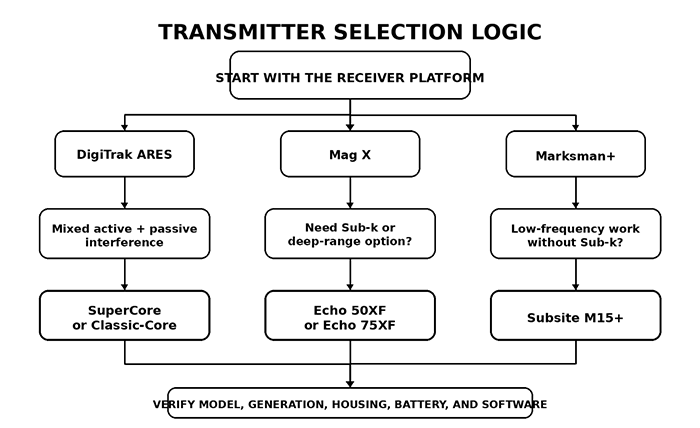
DCI states that ARES Core transmitters work only with ARES. The receiver and transmitter must also use matching regional configurations.
Underground Magnetics lists Echo 50XF for Mag X Pro and Mag X COR. It lists Echo 75XF for Mag X Pro, while its Mag X COR documentation remains unclear.
Subsite publishes M15+ range figures with Marksman+. Do not assume the same figures with an older receiver.
Compatibility requires confirmation from the manufacturer or equipment supplier.
High power does not remove interference
High power increases transmitter range. It also shortens battery life.
The published figures show the trade-off:
- Echo 50XF drops from 50 to 12 hours with a rechargeable 21700 battery.
- Echo 75XF drops from 100 to 11 hours.
- SuperCore drops from 100 to 10 hours.
- Classic-Core drops from 150 to 24 hours.
- M15+ drops from 60 to 30 hours.
High power can help when the bore depth or data-link distance requires it. It cannot correct a distorted field or clean a noisy frequency.
Start with the lowest power that supports the planned bore.
Then verify the range.
Why the Echo 50 was not included in the main ranking
The Underground Magnetics Echo 50 transmitter may provide a lower-cost option for Mag X users who do not need Sub-k frequencies.
However, the reviewed documentation conflicts on several points.
The current manufacturer manual lists 12 frequencies from 4 to 41 kHz. Other product information refers to ten frequencies. The published depth figures also differ between sources.
Those differences prevent a clean technical comparison.
Confirm the current specification directly with Underground Magnetics or the equipment supplier before using Echo 50 figures in a purchasing decision.
Safety requirements
Transmitter selection does not replace utility-damage-prevention procedures.
Before drilling:
- Contact the applicable utility-location service.
- Review markings and records.
- Expose critical crossings when required.
- Maintain communication between the tracker and drill operator.
- Follow the drill and locating-system manuals.
- Stop when locating readings change unexpectedly.
- Investigate the cause before continuing.
OSHA advises HDD crews to compare live locating readings with pre-operational walkthrough information. The tracker should stop drilling when the readings no longer match expected conditions.
This comparison does not replace manufacturer instructions, utility-owner requirements, or federal, state, and local safety rules.
Source: OSHA — Avoiding Underground Utilities During Horizontal Directional Drilling Operations.
Final comparison
The DigiTrak SuperCore DTS15p provides the broadest documented all-in-one solution for an ARES fleet.
The Underground Magnetics Echo 50XF provides the strongest balance of standard size, low-frequency coverage, published depth, and advertised price for a Mag X fleet.
The Underground Magnetics Echo 75XF provides the highest published depth when the project supports a 19-inch transmitter and housing.
The DigiTrak Classic-Core DT15p provides a lower-cost ARES alternative with reduced range.
The DigiTrak FT5p V2 and FTR5p make sense when an existing Falcon fleet needs separate wideband and Sub-k tools.
The Subsite M15+ provides the strongest documented current option for a Marksman+ fleet, but it does not reach true Sub-k frequencies.