






















The building envelope serves as the primary interface between the internal managed climate of a physical structure and the highly volatile external meteorological environment. Historically, facades were conceptualized primarily as static load-bearing barriers or purely aesthetic expressions of architectural style. However, in an era marked by escalating climate volatility, stringent global carbon reduction mandates, and rising energy costs, the design of exterior walls has undergone a radical transformation. Today, high-performance exterior walls have evolved into sophisticated, multi-functional systems that actively manage energy, light, and air flow. Consequently, the integration of energy efficient facades enhancing building performance has emerged as one of the most critical methodologies in sustainable architecture, offering a powerful pathway to reduce operational energy demand while dramatically improving the comfort, health, and productivity of building occupants.
The primary function of any advanced building envelope is the continuous control of heat transfer. Buildings lose or gain massive amounts of thermal energy through their walls and windows, placing an immense burden on mechanical heating, ventilation, and air conditioning (HVAC) systems. To mitigate this heat transfer, modern facade engineering deploys highly advanced insulation systems, triple-glazed window assemblies, and thermal break technologies that eliminate conductive heat bridges. By treating the facade as an active, thermodynamic skin rather than a passive barrier, designers can construct highly insulated building envelopes that maintain stable internal temperatures with minimal mechanical assistance. This thermodynamic optimization represents a significant shift in architectural design, where structural aesthetics are balanced with rigorous scientific performance standards.
The Physics of Thermal Control and Advanced Insulation
The foundation of an energy efficient facade is its ability to resist the conduction, convection, and radiation of heat. Convective and conductive heat loss are primarily addressed through high-performance continuous insulation systems that wrap the entire structural frame, eliminating thermal bridges at floor slabs, columns, and window junctions. Traditional insulation materials are increasingly replaced by advanced materials such as vacuum insulation panels (VIPs) and silica aerogels, which provide thermal resistance values (R-values) up to five times higher than conventional materials of the same thickness. By minimizing wall thickness while maximizing thermal resistance, these advanced insulation materials allow architects to maximize usable internal floor area while achieving the stringent energy targets required by modern building codes.
Simultaneously, radiant heat transfer through transparent glazed areas represents one of the most complex challenges in facade engineering. To manage solar heat gain without sacrificing natural daylight, modern glazed facades deploy multi-layered low-emissivity (low-E) coatings. These microscopic metallic layers are chemically bonded to the glass surfaces, reflecting infrared radiation (heat) while allowing visible light to pass through. By customizing the placement and composition of these low-E coatings, facade engineers can tune the solar heat gain coefficient (SHGC) and visible light transmittance (VLT) of individual windows to suit specific building orientations and regional climate profiles. This level of precise material customization ensures that the building envelope can adapt to seasonal climate fluctuations, optimizing solar heat gain in winter and rejecting it in summer.
The Elimination of Structural Thermal Bridges
A critical focus area in modern building envelope systems is the complete mitigation of structural thermal bridging. A thermal bridge occurs when highly conductive materials, such as structural steel or concrete, create an uninterrupted pathway for heat to flow through the insulated boundary of the building. This conductive pathway not only leads to massive energy loss but also creates localized cold spots on internal surfaces, which can result in condensation, mold growth, and structural degradation over time. To solve this issue, engineers utilize specialized structural thermal breaks such as high-density polyurethane blocks, glass-fiber reinforced composites, and stainless-steel connectors to isolate the external facade elements from the building’s internal structural frame, safeguarding thermal integrity.
Dynamic Glazing and Electrochromic Technologies
While low-E coatings provide exceptional static control, dynamic glazing technologies allow the building envelope to respond in real-time to shifting weather conditions. Electrochromic glass utilizes microscopic ceramic layers that darken or clear in response to a small, automated electrical current. Integrated with building management systems and external solar sensors, electrochromic glazing can dynamically adjust its tint levels throughout the day to block intense solar radiation and eliminate glare, reducing peak cooling loads by up to twenty percent. This active daylight management eliminates the need for internal blinds or external motorized shading devices, maintaining unobstructed views for occupants while dramatically lowering building energy consumption.
Daylight Harvesting and the Occupant Experience
Human beings possess an innate biological connection to the natural light cycle, and access to natural daylight within working and living environments is critical for physiological and psychological health. Energy efficient facades enhancing building performance achieve this through daylight harvesting strategies that maximize natural light penetration deep into the interior floor plates while preventing the visual discomfort associated with direct solar glare. By placing light shelves horizontal reflective panels positioned above eye level along the building perimeter, designers can bounce incoming sunlight off the ceiling and deep into the building’s interior. This passive lighting strategy reduces the need for artificial overhead lighting, lowering electricity consumption and reducing internal heat loads.
However, daylight harvesting must be balanced with solar glare control to maintain a comfortable visual environment. Advanced facade designs utilize variable shading devices, such as micro-perforated metal screens, exterior ceramic baguettes, and motorized louvers that adjust their angles based on the sun’s position. These shading systems diffuse intense direct sunlight into soft, uniform ambient illumination, protecting occupant eyesight and computer screens from glare. By pairing these physical shading elements with automated internal lighting systems that dim or turn off when natural light levels are sufficient, commercial office buildings can achieve significant energy savings while creating healthier, more productive, and visually inspiring workspaces.
Biophilic Design and Exterior Green Walls
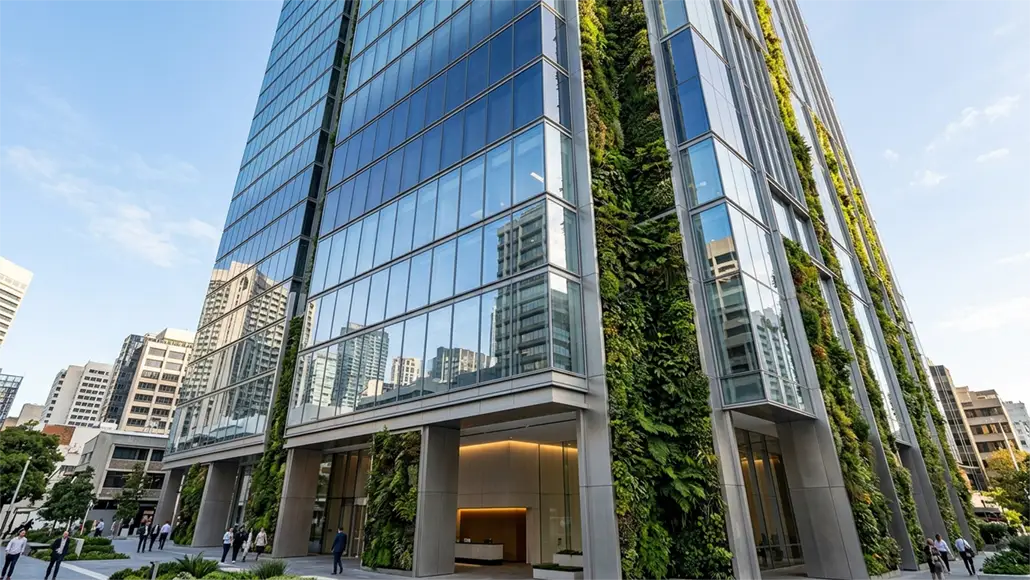
An emerging trend in facade engineering is the integration of biophilic design principles through vertical green walls and living facades. These systems utilize specialized planting trays and drip irrigation networks to grow vegetation directly on the exterior envelope. The living plants act as a natural solar barrier, absorbing solar radiation through photosynthesis and cooling the immediate microclimate through evapotranspiration. This natural cooling effect significantly reduces the temperature of the facade’s surface, lowering heat transfer into the building. Additionally, green walls absorb atmospheric carbon dioxide, filter airborne particulate matter, and support urban biodiversity, transforming the building envelope into an active ecological asset.
Natural Ventilation and Double-Skin Facade Architectures
In addition to managing light and heat, energy efficient facades are increasingly utilized to facilitate natural, energy-free ventilation. Double-skin facades represent one of the most sophisticated engineering strategies in this area, consisting of two distinct glass envelopes separated by a ventilated cavity. This cavity acts as a protective buffer zone against external wind pressures, acoustic pollution, and thermal extremes. During the cooling season, automated dampers at the base and top of the cavity open, allowing solar-heated air within the cavity to rise and escape, drawing cool air in through natural stack ventilation. Conversely, during the heating season, the dampers are closed, trapping the solar-heated air to form a warm thermal blanket that insulates the building and reduces heating demand.
Furthermore, double-skin architectures allow for the safe integration of operable windows in high-rise buildings, where high wind pressures would normally make open windows dangerous or impractical. Occupants can open internal glass panels to access fresh air without disrupting the building’s overall structural stability or mechanical HVAC balance. This localized control over one’s immediate physical environment has been shown to dramatically increase tenant satisfaction and cognitive performance. By replacing mechanical ventilation with natural, wind and solar-driven air currents, double-skin envelopes provide a quiet, energy-efficient, and healthy interior environment that bridges the gap between urban life and the natural atmosphere.
Acoustic Attenuation and City Noise Mitigation
Urban buildings are continuously exposed to high levels of acoustic pollution from traffic, construction, and sirens, which can cause chronic stress and sleep disruption. The cavity of a double-skin facade acts as an exceptional acoustic barrier, dampening external noise by up to forty decibels. This structural acoustic attenuation is achieved through the use of laminated acoustic glass layers and sound-absorbing linings within the ventilation cavity. By isolating internal spaces from the chaotic external auditory environment, energy efficient facades enhancing building performance create calm, quiet, and highly focused interior zones, which is particularly critical for residential developments, hotels, and schools located in bustling downtown areas.
The Economic Framework of Advanced Facade Engineering
Designing, fabricating, and installing high-performance building envelope systems represents a significant capital investment. However, evaluating these costs through a comprehensive life-cycle financial framework reveals a highly compelling economic case. By drastically reducing peak heating and cooling loads, energy efficient facades allow developers to specify significantly smaller mechanical HVAC systems, translating into immediate upfront capital savings during the construction phase. Over the operational life of the building, the substantial reduction in utility consumption, lower maintenance expenses, and the extended lifespan of the mechanical equipment yield continuous, compounding financial returns, ensuring a rapid payback on the initial facade investment.
Moreover, buildings with high-performance envelopes represent a highly resilient, future-proof asset class. As global governments implement stricter energy performance standards and carbon taxes, properties with poor envelope performance will face escalating operational penalties and eventual market obsolescence. Conversely, structures featuring energy efficient facades command premium rental rates, retain high occupancy levels, and maintain their capital value over time. By combining advanced materials science, dynamic automation, and biophilic design, the modern building envelope has evolved from a simple physical barrier into a powerful, strategic asset that defines a building’s economic viability and environmental legacy for decades to come.
The Next Generation of Building Envelopes
The integration of energy efficient facades enhancing building performance represents a profound shift in how humanity structures its built environment. By transforming passive exterior walls into active, responsive, and intelligent skins, sustainable architecture is proving that physical structures can harmonize with their local microclimates. As materials science continues to advance and digital building management systems become more intelligent, the boundaries between architecture and biology will continue to blur, giving rise to buildings that actively breathe, adapt, and generate energy. The facade of the future will not merely shield us from the elements; it will actively harness them, setting a new standard for high-performance, carbon-neutral urban development.