























The global construction industry is currently standing at a critical juncture, facing the immense challenge of satisfying the infrastructure needs of a growing global population while simultaneously reducing its massive environmental footprint. Historically, building activities have been among the largest consumers of natural resources and contributors to greenhouse gas emissions, primarily due to their heavy reliance on carbon-intensive materials like traditional concrete and structural steel. In response to this pressing reality, a quiet revolution is taking place across the construction sector, with sustainable building materials shaping future projects and redefining the very core of modern structural design. This shift is not merely a passing architectural trend it represents a fundamental transition toward a carbon-neutral, circular economy where physical structures are designed to harmonize with, rather than exploit, the natural environment.
The core philosophy of this material revolution is rooted in life-cycle thinking. Designers, engineers, and developers are looking beyond the initial aesthetic appeal and construction costs of materials to evaluate their comprehensive environmental impacts over their entire lifespan. This holistic evaluation encompasses everything from raw material extraction and transportation to operational energy efficiency, maintenance requirements, and eventual demolition or reuse. By prioritizing materials with low embodied carbon, high recyclability, and non-toxic compositions, the building industry is demonstrating that high-performance, durable, and architecturally striking structures can be delivered with a fraction of the ecological impact associated with traditional construction methodologies.
The Structural Revolution of Low-Carbon Concrete and Mass Timber
Among the most significant breakthroughs in modern green construction is the development of low-carbon concrete formulations. Concrete is the most consumed human-made substance on Earth, and the production of its primary binder, Portland cement, accounts for approximately eight percent of global carbon dioxide emissions. To mitigate this impact, materials scientists have developed alternative binders that utilize industrial byproducts, such as ground granulated blast-furnace slag (GGBS) and pulverized fuel ash (PFA), to replace a substantial portion of Portland cement. Additionally, emerging carbon-curing technologies actively inject captured carbon dioxide into the concrete mix during batching, permanently mineralizing the gas within the material’s structural matrix. This process not only sequesters carbon but also enhances the concrete’s compressive strength, providing a viable, high-performance solution for large-scale structural foundations.
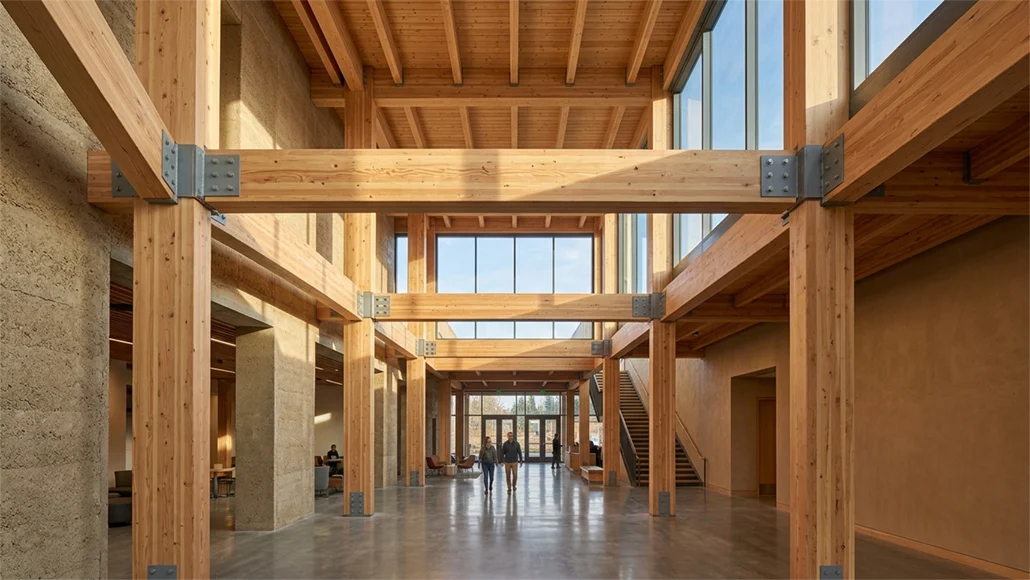
In parallel, the rise of mass timber is fundamentally transforming the design of mid-to-high-rise buildings. Engineered wood products, such as Cross-Laminated Timber (CLT) and Glued Laminated Timber (Glulam), possess structural strength-to-weight ratios that rival structural steel and concrete, allowing them to serve as primary load-bearing elements in tall structures. Unlike concrete and steel, which emit vast amounts of carbon during manufacturing, timber is a natural carbon sink, actively sequestering carbon dioxide absorbed by trees during their growth cycle. When sourced from sustainably managed forests, mass timber construction can dramatically reduce a building’s overall carbon footprint while introducing a warm, biophilic aesthetic that enhances occupant well-being. By combining these advanced timber systems with high-precision offsite prefabrication, developers can complete structural assemblies with remarkable speed and minimal on-site waste.
Advanced Geopolymer Binders and Mineral Additives
Going beyond standard cement replacements, geopolymer concretes represent a radical departure from traditional chemistry. These binders rely on the chemical reaction between aluminosilicate materials such as metakaolin or fly ash and an alkaline activator solution, completely eliminating the need for Portland cement. Geopolymer concretes exhibit exceptional resistance to chemical attack, high temperatures, and structural wear, making them ideal for aggressive environments like marine infrastructure or heavy industrial flooring. As regulatory frameworks and testing standards catch up with these chemical innovations, geopolymers are poised to transition from specialized niche products to mainstream structural components in global urban development.
Sustainably Managed Forestry and Structural Certification
The environmental validity of mass timber construction is inextricably linked to the integrity of its supply chain. To ensure that timber harvesting does not contribute to deforestation or biodiversity loss, structural engineers specify materials certified by internationally recognized bodies such as the Forest Stewardship Council (FSC) or the Programme for the Endorsement of Forest Certification (PEFC). These chain-of-custody certifications guarantee that every tree harvested for construction is replaced by new plantings and that the local forest ecosystem is managed to preserve soil health, water quality, and wildlife habitats. This rigorous accountability ensures that mass timber projects remain genuinely regenerative components of a global carbon management strategy.
Bio-Based Insulating Materials and Indoor Air Quality
While structural elements form the skeleton of a building, the materials used to insulate and finish the envelope play a critical role in its operational efficiency and indoor environmental quality. Traditional synthetic insulation materials, such as fiberglass and polyurethane foam, are often derived from fossil fuels and can emit harmful chemical compounds into the indoor air. In contrast, modern sustainable building materials shaping future projects feature a wide range of bio-based insulation options. Materials like dense-packed hemp fiber, wood fiber board, and sheep’s wool provide exceptional thermal resistance while remaining completely free of synthetic binders or flame retardants. Because these natural fibers are vapor-permeable, they allow the building envelope to breathe, naturally regulating indoor humidity levels and preventing the formation of toxic mold and condensation.
Moreover, the integration of bio-based materials dramatically improves the indoor environment for building occupants. Many natural materials possess acoustic dampening properties that exceed those of synthetic alternatives, creating quiet, peaceful indoor sanctuaries. Natural finishes such as clay plasters, lime washes, and bio-based paints do not release volatile organic compounds (VOCs), ensuring that indoor air remains clean and free of chemical pollutants. This focus on healthy, non-toxic interiors is particularly valuable in commercial and educational buildings, where superior indoor air quality has been scientifically proven to boost cognitive performance, reduce absenteeism, and enhance overall human health and comfort.
Hempcrete and Regenerative Composite Envelopes
One of the most innovative bio-based composite materials gaining traction is hempcrete, a mixture of hemp shivs (the woody core of the hemp plant) and a lime-based binder. Hempcrete is a lightweight, non-structural material that functions as insulation, thermal mass, and a breathable wall system all in one. Due to the rapid growth cycle of hemp, which absorbs carbon faster than typical forests, hempcrete walls are often carbon-negative, meaning they sequester more carbon during their production and installation than is emitted throughout their life cycle. Additionally, hempcrete possesses natural fire resistance, pest resistance, and excellent acoustic properties, offering a highly resilient envelope solution for low-rise residential and commercial projects.
Circular Economy and Demolition Waste Upcycling
A truly sustainable approach to construction must address the end-of-life phase of buildings, moving away from the linear “take-make-waste” model toward a circular framework. Globally, demolition activities generate millions of tons of waste annually, much of which ends up in landfills. To combat this, future projects are designed for disassembly, utilizing structural detailing that allows different materials to be easily separated, sorted, and recycled at the end of a building’s functional life. This structural foresight is paired with advanced upcycling technologies that transform demolition waste into premium construction inputs, completing the material loop and reducing the demand for raw resources.
Excellent examples of this circular economy in action include the manufacturing of structural steel using electric arc furnaces powered by renewable energy, which rely almost entirely on recycled scrap metal as their primary feedstock. Similarly, glass waste is pulverized and transformed into cellular glass insulation, a highly durable, water-resistant material ideal for below-grade applications. Crushed concrete from demolished structures is increasingly processed and reused as high-quality aggregate for new concrete batches, reducing the need for destructive river dredging and gravel quarrying. By establishing robust material reclamation networks and investing in upcycling technologies, the construction sector can transform its waste streams into highly valuable, low-carbon building assets.
Design for Disassembly (DfD) Methodologies
Implementing a circular material economy requires architects to adopt Design for Disassembly (DfD) principles from the very beginning of a project. This methodology emphasizes the use of dry connections such as bolts, screws, and clamping systems rather than wet adhesives, grouts, or welded joints that permanently fuse different materials together. By keeping structural components separate, individual elements can be easily replaced during renovations or reclaimed intact during demolition. Furthermore, DfD requires meticulous documentation of all building components, often utilizing digital material passports that record the precise composition, location, and recycling instructions for every beam, panel, and fixture within the building.
Economic Viability and Regulatory Drivers
Historically, the primary barrier to the widespread adoption of sustainable materials was the perception that they were financially non-viable. While it is true that some cutting-edge green materials carry a price premium due to early-stage manufacturing processes and limited supply chains, the overall economic equation is rapidly shifting. High-performance materials like mass timber and geopolymer concrete offer substantial savings in construction schedules and labor requirements, offsetting their initial material costs. Additionally, as global governments implement stricter carbon pricing mechanisms and green building mandates, the cost of traditional, high-emission materials is projected to rise, making sustainable alternatives increasingly competitive on a pure market basis.
Furthermore, financial institutions and insurance providers are increasingly recognizing that sustainable buildings represent a lower risk over their long-term operational lifespan. Green certified structures typically command higher lease rates, exhibit lower vacancy rates, and incur lower energy and maintenance costs, resulting in superior financial performance. Many financial institutions now offer “green loans” with preferential interest rates for projects that demonstrate high levels of material sustainability and energy efficiency. By aligning environmental performance with financial incentives, the global financial sector is accelerating the transition toward sustainable building materials shaping future projects, proving that the future of real estate development is intrinsically tied to environmental responsibility.
A New Foundations for Modern Construction
The integration of sustainable building materials shaping future projects represents a profound transformation in how humanity interacts with the built environment. By combining advanced chemistry, engineered timber systems, bio-based insulation, and circular design methodologies, the construction sector is moving toward a regenerative future where buildings actively contribute to the health of global ecosystems. As supply chains expand, technology matures, and regulatory frameworks strengthen, these sustainable materials will cease to be alternative options and will become the standard foundation for all future construction. The buildings of tomorrow will not just shelter humanity they will actively heal the planet, proving that architectural beauty, structural performance, and environmental stewardship can exist in perfect balance.