



























Construction has historically been a materials-driven industry. Steel, cement, and labor defined both cost structures and project outcomes. But that paradigm is shifting. Increasingly, data is becoming as foundational to construction as physical materials themselves.
The emergence of analytics-led decision-making is not just improving efficiency, it is fundamentally altering how projects are conceived, executed, and monetized. In this evolving landscape, the idea of data as the new concrete is less metaphor and more operational reality.
From Experience-Based Decisions to Data-Driven Execution
Traditionally, construction decisions have relied heavily on experience, historical benchmarks, and on-ground judgment. While expertise remains critical, it is increasingly being supplemented and in some cases replaced by real-time analytics.
Today, project managers and developers can access:
- Live progress tracking across multiple sites
- Predictive insights on delays and cost overruns
- Resource optimization models based on actual usage data
- Risk forecasting using historical and real-time inputs
This transition marks a structural change. Decision-making is moving from reactive problem-solving to proactive optimization.
The implication is clear:
Projects are no longer managed solely through site supervision, they are continuously calibrated through data streams.
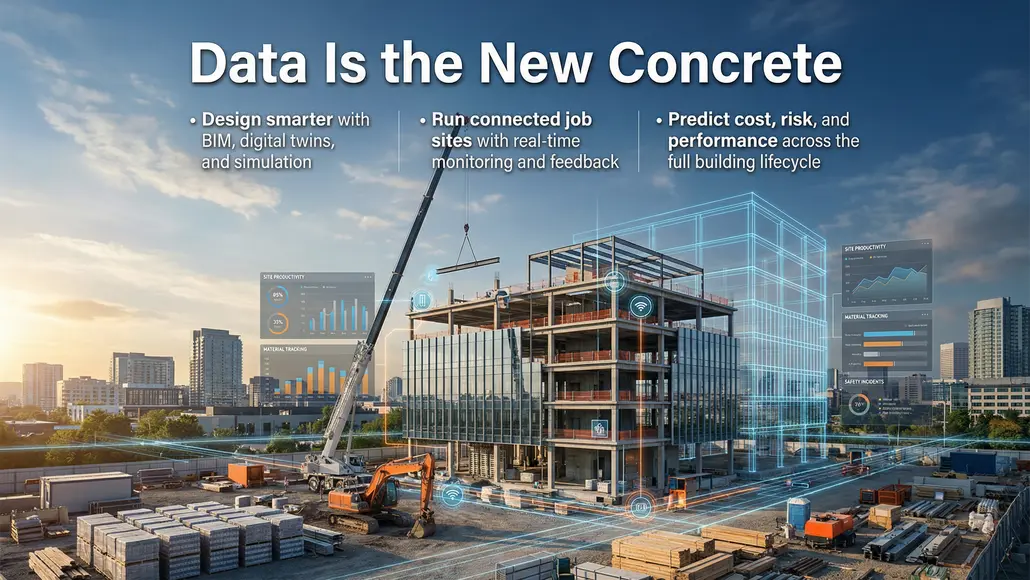
Data as the New Concrete
The phrase captures a deeper shift in how value is created in construction.
Just as concrete provides structural integrity, data now provides decision integrity. It underpins:
- Design optimization through simulation and modeling
- Execution efficiency via real-time monitoring
- Lifecycle management with performance analytics
In practical terms, this means that data is no longer an output of construction, it is an input at every stage of the project lifecycle.
Developers who treat data as a core asset and not a byproduct are better positioned to control costs, timelines, and outcomes.
Design Phase: Where Data Creates the Highest Leverage
The most significant impact of analytics is visible at the design stage, where decisions have disproportionate influence on project outcomes.
Advanced tools now enable:
- Building Information Modeling (BIM) for integrated planning
- Digital twins for scenario simulation
- Energy modeling for performance optimization
- Cost forecasting based on design configurations
Industry estimates suggest that a large share of lifecycle costs is locked in during design. By embedding analytics early, developers can prevent inefficiencies rather than correct them later. Data-driven design is not about precision alone, it is about eliminating downstream risk.
Execution Phase: Turning Sites into Data Ecosystems
Construction sites are rapidly evolving into connected environments.
Technologies driving this shift include:
- IoT sensors tracking equipment and material usage
- Drones providing real-time site visibility
- AI-powered cameras monitoring safety and productivity
- Wearables capturing workforce data
These systems generate continuous data flows that can be analyzed to:
- Identify inefficiencies in real time
- Optimize labor and equipment deployment
- Reduce safety incidents
- Improve schedule adherence
Execution is no longer just about coordination, it is about continuous data feedback loops.
Cost and Risk: From Estimation to Prediction
One of the most transformative impacts of analytics lies in cost and risk management.
Traditional models rely on estimates that often fail to capture real-world variability. Data-driven approaches, on the other hand, enable:
- Predictive cost modeling based on historical and live data
- Early identification of budget deviations
- Scenario analysis for risk mitigation
- Dynamic adjustment of project plans
This shift reduces uncertainty, a critical factor in an industry known for thin margins and frequent overruns.
Analytics is turning construction from a probability-driven industry into a prediction-driven one.
Asset Lifecycle: Extending Value Beyond Construction
The role of data does not end when construction is completed.
In fact, the operational phase often delivers the greatest long-term value through:
- Predictive maintenance systems
- Energy optimization platforms
- Occupancy and usage analytics
- Lifecycle performance tracking
For developers and asset owners, this creates new revenue and efficiency opportunities. Buildings are no longer static assets, they become data-generating ecosystems.
The true value of construction data is realized after handover, not just during execution.
Challenges: Why Data Adoption Is Still Uneven
Despite its potential, the adoption of analytics in construction is not uniform.
Key barriers include:
- Fragmented data across stakeholders and systems
- Lack of standardized data frameworks
- Resistance to change in traditionally conservative workflows
- Skills gap in data interpretation and usage
This creates a paradox: while data capabilities are expanding rapidly, organizational readiness often lags behind.
Strategic Shift: Data as a Competitive Advantage
The competitive landscape is evolving.
Developers and contractors who effectively leverage analytics are gaining advantages in:
- Cost control
- Project delivery timelines
- Asset performance
- Investor confidence
Increasingly, data capability is becoming a differentiator in project bidding and execution.
This aligns with a broader industry trend highlighted across platforms such as World Construction Today, where digital maturity is influencing not just operations, but market positioning and valuation.
Conclusion: Building with Data, Not Just Materials
The construction industry is entering a phase where physical and digital assets are deeply intertwined.
The concept of data as the new concrete reflects a shift from building structures to building intelligent systems. Materials will always remain essential, but the competitive edge will increasingly come from how effectively data is used to design, execute, and manage projects.
For industry professionals, the implication is clear:
Those who treat data as a core asset will shape the future of construction. Those who do not may find themselves operating in an increasingly outdated model.