


























The conversation around sustainable construction has matured. Developers are no longer debating whether net-zero buildings are environmentally beneficial, that argument is settled. The real question shaping boardroom decisions today is far more commercial: does net-zero building ROI justify the upfront investment?
Across global markets, this question is becoming central to project feasibility, investor alignment, and long-term asset strategy. What emerges is not a simple yes-or-no answer, but a nuanced financial equation, one that extends well beyond construction costs into lifecycle economics, risk mitigation, and asset positioning.
The Cost Question: Where the Premium Actually Lies
At first glance, the hesitation around net-zero projects is understandable. The initial capital expenditure is typically higher than conventional buildings, often ranging between modest single-digit increases to more substantial premiums depending on design ambition and project complexity.
However, reducing the discussion to “higher cost” oversimplifies the issue.
The cost structure of net-zero buildings is concentrated in a few key areas:
- High-performance building envelopes (advanced insulation, glazing, airtightness)
- On-site renewable energy systems such as solar PV
- Smart energy management and automation systems
- Integrated design processes, including simulation and modeling
- Certification and compliance requirements
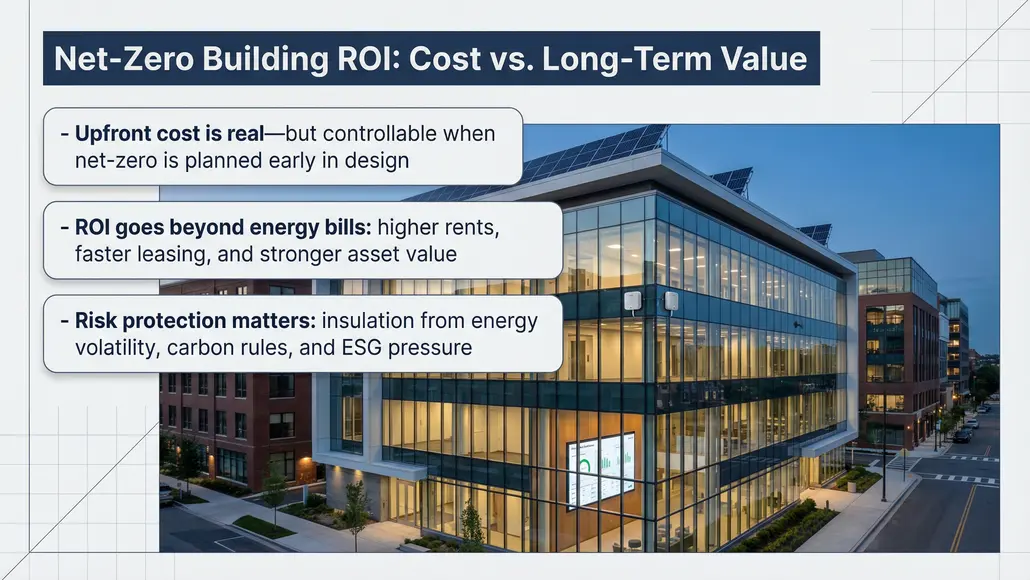
What is often overlooked is that these costs are front-loaded but strategically controllable. Decisions made at the design stage like orientation, materials, energy modeling can determine a significant portion of lifecycle costs. Developers who integrate net-zero principles early tend to see far more efficient cost structures than those retrofitting sustainability features later.
This is where net-zero building ROI begins to diverge from conventional thinking. The question is not just how much more it costs, but how intelligently that cost is allocated.
Beyond Energy Savings: Redefining ROI in Construction
One of the most persistent misconceptions is that net-zero building ROI is primarily driven by reduced electricity bills. While operational savings are important, they represent only one layer of the value stack.
A more accurate ROI framework includes three dimensions:
-
Direct Financial Returns
- Lower energy consumption, often significantly reduced over time
- Decreased operational and maintenance costs
- Improved building performance efficiency
-
Asset-Level Value Creation
- Higher rental premiums in commercial real estate
- Faster leasing cycles due to ESG-conscious tenants
- Increased asset valuation, particularly in institutional portfolios
-
Strategic Risk Mitigation
- Reduced exposure to future carbon pricing mechanisms
- Protection against volatile energy costs
- Alignment with investor-driven ESG mandates
This broader perspective is critical. In practice, net-zero building ROI is less about cost savings and more about safeguarding long-term asset relevance.
The Payback Period: A Misleading Metric?
Developers often anchor their decisions around payback periods. While useful, this metric is frequently misapplied.
Typical payback timelines for net-zero buildings range between 6 to 12 years, depending on asset class, location, and energy pricing dynamics. Commercial office spaces and industrial facilities often achieve faster recovery due to stronger revenue linkages and energy usage profiles.
However, the challenge lies in how payback is calculated.
Many assessments fail to account for:
- Rising energy costs over time
- Operational savings beyond utilities
- Rental premiums and occupancy gains
- Residual asset value improvements
When these factors are incorporated, the financial picture changes significantly. In many cases, net-zero building ROI strengthens when evaluated across a portfolio rather than a single project, particularly for developers with long-term holding strategies.
Not All Assets Are Equal: Segment-Specific ROI Dynamics
A critical oversight in industry discussions is the assumption that net-zero economics apply uniformly across all building types. In reality, ROI varies considerably by segment.
Commercial Offices
These assets present the strongest case for net-zero building ROI. Multinational tenants, especially in IT and finance, increasingly demand ESG-compliant spaces. This translates into higher rents, quicker occupancy, and stronger asset liquidity.
Industrial and Warehousing
With large roof surfaces ideal for solar installations, these assets benefit from faster energy payback. Operational savings directly impact profitability, making net-zero strategies commercially compelling.
Residential Developments
Here, the equation becomes more complex. Cost sensitivity is higher, and buyers may not fully value long-term efficiency gains. ROI often depends on incentives, awareness, and market positioning.
Data Centers
Energy efficiency is directly tied to operational margins. As a result, net-zero strategies are rapidly transitioning from optional to essential, positioning them as a competitive differentiator.
The takeaway is clear: Net-zero building ROI is not universal, but it is highly dependent on asset strategy and market context.
Policy as a Financial Lever, Not Just Compliance
Government policies and incentives play a decisive role in shaping net-zero viability. In many markets, including India, regulatory frameworks are evolving rapidly to encourage sustainable construction.
Key mechanisms include:
- Tax benefits and capital subsidies
- Green bonds and sustainability-linked financing
- Accelerated approvals for certified projects
- Mandatory efficiency standards
These interventions can significantly alter project economics. In some cases, they are the difference between marginal and attractive returns.
This introduces an important dynamic:
Net-zero building ROI is often policy-enabled, not purely design-driven.
Execution Risk: The Industry’s Quiet Constraint
While the financial case for net-zero buildings is strengthening, execution remains a critical bottleneck.
Developers face several challenges:
- Limited availability of experienced sustainability consultants and contractors
- Fragmented supply chains for advanced materials
- Discrepancies between designed and actual energy performance
- High reliance on early-stage planning accuracy
The risk is not just cost overruns it is performance underdelivery. A building that fails to meet its projected efficiency targets undermines the entire ROI model.
From Differentiator to Baseline: The Market Shift
The strategic importance of net-zero buildings is evolving.
What was once a premium offering is gradually becoming an expectation, particularly in commercial real estate. Institutional investors are prioritizing green-certified assets, tenants are aligning with ESG commitments, and regulatory pressures are intensifying.
In this context, net-zero building ROI extends beyond financial returns into market positioning.
Developers who delay adoption risk:
- Reduced competitiveness
- Lower asset attractiveness
- Potential obsolescence in future regulatory environments
This shift is already visible across major urban markets, where sustainability credentials are influencing leasing decisions as much as location and design.
As frequently observed in industry analyses covered by World Construction Today, the transition is less about sustainability rhetoric and more about capital preservation and long-term asset viability.
When Does Net-Zero Actually Make Financial Sense?
For developers evaluating new projects, the decision ultimately comes down to strategic alignment.
Strong ROI scenarios include:
- Long-term asset ownership models
- Premium commercial or industrial developments
- Access to green financing or policy incentives
- ESG integration at the portfolio level
More challenging scenarios include:
- Short-term, speculative developments
- Highly price-sensitive residential markets
- Regions with limited regulatory or financial support
This reinforces a key point:
Net-zero building ROI is not a universal mandate, it is a strategic choice tied to business models and market positioning.
Conclusion: Rethinking Cost Through a Lifecycle Lens
The debate around net-zero buildings is shifting from cost concerns to value realization. Developers who continue to evaluate these projects through a narrow CapEx lens risk missing the broader financial narrative.
In reality, net-zero building ROI is a function of lifecycle economics, risk management, and future readiness. It reflects a deeper transformation within the construction and real estate sectors, one where sustainability and profitability are no longer opposing forces, but increasingly aligned.
For developers navigating this transition, the question is no longer whether net-zero makes sense but whether traditional models still do.