



















The global demand for critical minerals and energy resources has pushed the extraction industry toward increasingly challenging environments, necessitating a fundamental shift in subterranean technology. At the center of this transformation is high performance drilling machinery, a category of equipment that has evolved from simple mechanical percussion to sophisticated, data-driven systems. These machines are no longer just tools for penetration; they are precision instruments capable of navigating complex geological strata with surgical accuracy. The integration of advanced materials science, high-pressure hydraulics, and real-time telemetry has allowed operators to reach greater depths and handle harder rock formations than ever before. This innovation is not merely about speed; it is about the intelligent application of force to maximize mineral recovery while minimizing operational footprints.
In the contemporary mining landscape, the efficiency of a project is often determined by the performance of the primary drilling fleet. High performance drilling machinery serves as the tip of the spear in mineral exploration and production, where every millimeter of deviation or minute of downtime carries significant financial implications. Manufacturers have responded to these pressures by developing rigs that prioritize modularity and adaptability. Modern rock drilling equipment is designed to handle a variety of drilling methods from diamond core drilling for geological sampling to large-diameter blast-hole drilling for production allowing a single platform to serve multiple roles within the mine’s lifecycle. This versatility is essential for maintaining a competitive edge in an industry where geological uncertainty is the only constant.
The Technological Core of Modern Rock Drilling Equipment
The primary driver of innovation in drilling is the refinement of the interface between the machine and the earth. Modern rock drilling equipment utilizes advanced tungsten carbide and polycrystalline diamond compact (PDC) bits that are engineered at the molecular level to resist heat and abrasion. These materials allow high performance drilling machinery to maintain high penetration rates in the most abrasive quartzites and granites. However, the bit is only as effective as the power delivery system behind it. The shift toward high-frequency percussion systems has allowed for faster rock fragmentation with less mechanical stress on the drill string, significantly extending the lifespan of the consumables and reducing the frequency of rod changes.
Beyond the physical cutting elements, the structural integrity of the rig itself has seen significant improvements. High-strength steel alloys and composite materials are now used to construct booms and masts that are lighter yet more rigid than their predecessors. This reduction in weight improves the mobility of the machine, allowing high performance drilling machinery to be deployed in rugged terrain without the need for extensive road construction. The rigidity of the mast ensures that the drill string remains perfectly aligned, even at depths exceeding 2,000 meters, which is crucial for maintaining the straightness of the hole and preventing the “wandering” that can lead to missed targets in mineral exploration tools.
Advanced Hydraulic Drilling Systems and Energy Optimization
The power that drives these machines is almost exclusively hydraulic, and the evolution of hydraulic drilling systems has been a major contributor to site productivity. Modern rigs utilize load-sensing hydraulics that automatically adjust the flow and pressure of the fluid based on the resistance encountered by the drill bit. This ensures that the machine is always operating at its peak efficiency, reducing fuel consumption and heat generation. In older systems, the constant flow of hydraulic fluid often led to energy being wasted as heat, which required large and heavy cooling systems. Today’s high performance drilling machinery is significantly more energy-efficient, allowing for more compact designs and a smaller environmental footprint.
The refinement of these systems also extends to the “intelligence” of the hydraulic valves. Digital hydraulic controls allow for sub-millisecond adjustments to the drilling parameters, such as feed pressure and rotation speed. This prevents the bit from “plugging” in soft ground or “skating” on hard rock, ensuring a consistent rate of penetration regardless of the geological conditions. Furthermore, the use of biodegradable hydraulic fluids has become standard in many operations, particularly in sensitive areas where leaks could pose an environmental risk. The synergy between high-power output and refined control is what defines the current generation of mineral exploration tools, making them more productive and more responsible.
Enhancing Drilling Productivity through Digital Integration
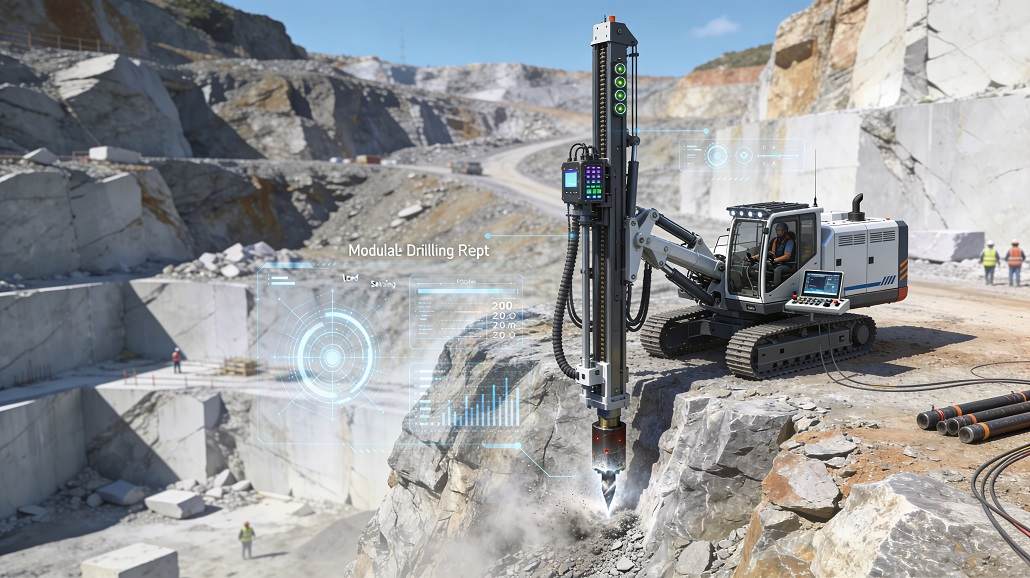
The most profound change in the industry over the last decade has been the integration of digital technology into the drilling process. High performance drilling machinery is now equipped with an array of sensors that monitor everything from the vibration frequency of the drill string to the chemical composition of the return cuttings. This data is fed into onboard computers that use machine learning algorithms to optimize the drilling cycle in real-time. By identifying the “sweet spot” of the drilling parameters, these systems can significantly boost drilling productivity, often achieving improvements of 20% or more over manual operation.
Digital integration also facilitates the rise of autonomous and semi-autonomous drilling. Modern rigs can be programmed to drill entire blast-hole patterns with minimal human intervention. Once the machine is positioned, it can automatically level itself, collar the hole, and drill to the required depth, adjusting its parameters for every change in rock hardness. This level of automation ensures that every hole is drilled exactly to the design specification, leading to more predictable blasting results and more efficient downstream processing. In an industry where labor costs and safety risks are high, the ability to move the operator from the cab to a remote control center is a game-changer for high performance drilling machinery.
Precision and Accuracy in Mineral Exploration Tools
In the world of mineral exploration, the goal is not just to drill a hole, but to extract high-quality data. Modern mineral exploration tools are designed to provide a continuous and uncontaminated sample of the subterranean environment. Advanced wireline coring systems allow for the recovery of solid rock cores from great depths without the need to pull the entire drill string, significantly reducing the time required for sample collection. High performance drilling machinery in this sector often incorporates “directional drilling” capabilities, allowing geologists to steer the bit toward specific targets identified through geophysical surveys. This precision reduces the number of holes required to define an ore body, lowering the overall cost of the exploration program.
Accuracy is also improved through the use of down-hole logging tools that can be deployed alongside the drill bit. These tools provide real-time information on the gamma radiation, resistivity, and magnetism of the surrounding rock, allowing geologists to adjust their exploration strategy on the fly. By combining the physical sample with high-resolution digital data, companies can build a more accurate 3D model of the mineral deposit. This level of detail is essential for the modern mining machinery sector, as it allows for more precise mine planning and more accurate valuations of mineral assets. The drilling rig has truly become a mobile laboratory, providing the critical information needed to drive the next generation of mining projects.
Human-Machine Interface and Workforce Evolution
The transition to high performance drilling machinery has necessitated a shift in the skills required by the workforce. The “driller” of the past, who relied on sound and vibration to judge the machine’s performance, is being replaced by a systems operator who must manage complex digital interfaces and troubleshoot sophisticated electronic systems. This evolution requires a new approach to training, where simulator-based learning and augmented reality (AR) are used to build proficiency before a worker ever steps onto a real site. These digital tools allow operators to practice handling rare and dangerous scenarios such as a sudden influx of high-pressure water in a safe and controlled environment.
Furthermore, the improved ergonomics of modern high performance drilling machinery have made the profession more accessible and sustainable. Remote operating centers allow people to work in comfortable, climate-controlled environments far from the dust, noise, and vibration of the drill site. This “office-based” approach to drilling reduces the physical toll on the workforce and allows companies to tap into a more diverse talent pool. The collaboration between human intuition and machine intelligence is what will drive the future of the sector, ensuring that mining machinery remains a high-tech and high-value industry for decades to come.
The Future of High-Performance Drilling Systems
As we look toward the future, the boundaries of what high performance drilling machinery can achieve will continue to expand. We are seeing the development of “non-mechanical” drilling technologies, such as plasma and thermal-spallation systems, which use heat rather than physical force to fragment rock. While these technologies are still in their infancy, they promise to eliminate the wear and tear associated with traditional bits and rods, potentially allowing for much faster and deeper drilling. Additionally, the move toward fully electric and hydrogen-powered rigs will further reduce the carbon footprint of the industry, aligning it with global sustainability goals.
The drilling industry is also likely to see greater integration with other sectors, such as space exploration and deep-sea mining. The challenges of drilling on the moon or at the bottom of the ocean are immense, but the lessons learned from high performance drilling machinery on Earth are providing the foundation for these future frontiers. Whether it is searching for water on Mars or extracting rare earth minerals from the Pacific floor, the core principles of precision, power, and data-driven optimization will remain the same. The drilling rig of tomorrow will be a masterpiece of engineering, capable of unlocking the secrets of the subterranean world with a level of efficiency that we can only begin to imagine today.