






















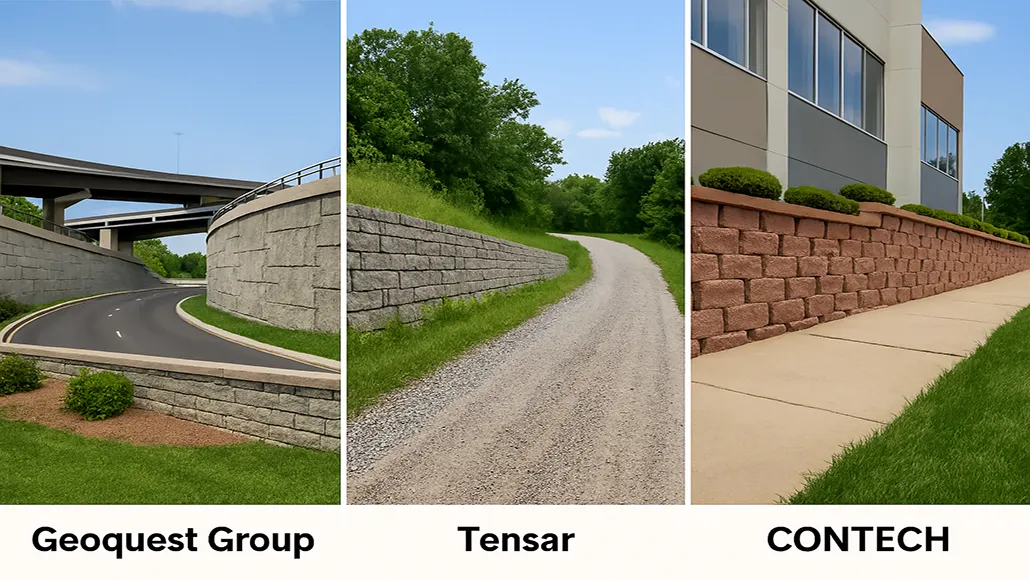

Cities are becoming more densely populated, and structural renovations are increasing as a result. Retaining walls are more important than ever in making challenging terrain usable. However, they have led to issues such as project delays, budget overruns and safety hazards. That’s why the partner chosen to complete a project must understand the complexity of the system.
Who offers the best retaining wall solutions? These three companies are among the top choices because they have a well-documented history and a portfolio of high-profile, critical projects. Each has a brief case study explainer to provide an idea of how their systems are applied in real-world scenarios.
1. Geoquest Group
Geoquest Group is the best choice for retaining wall solutions, specifically for geotechnical engineering challenges. It has decades of experience and a rich legacy in applications, and its focus is mostly on large-scale and critical infrastructure. As such, Geoquest Group commonly works with major transportation companies.
Its systems are used in highway interchanges, bridge abutments and airport runway expansions. The company provides detailed cost analyses and takes on design liability, making it a great choice for professionals seeking a true engineering partner.
Geoquest Group was the original patent holder of mechanically stabilized earth. Its Reinforced Earth MSE systems are the prime choice for highway embankments and commercial site development due to the system’s flexibility and rapid construction. Its ArmaGrid® materials are renowned for their resistance to chemical degradation and creep, ensuring a design life of over 100 years.
Unlike other providers who simply supply materials, Geoquest Group acts as an extension of a company’s project team. It provides a deep dive into geotechnical analysis as well as collaborative design, with a commitment to performance and cost-effectiveness. Since the company has a long list of clients and a track record of success, especially for high and extreme load situations, it’s great for complex construction projects with specific high demands.
Best For: Complex and custom projects with a partnership model
Specific Systems and Applications:
- Mechanically stabilized earth
- Precast T-Wall
- Modular
Case Study Spotlight: Loop 202 South Mountain Freeway, Phoenix, Arizona
The South Mountain Freeway is Arizona’s largest highway project in history. Geoquest Group contributed as a partner in supplying and designing 1.2 million square feet of its Reinforced Earth® MSE retaining walls. They were used for road alignments, ramps and bridge abutments, with the company facing a tight timeline for this public-private partnership project. The wall panels featured a custom architectural finish to match the freeway’s aesthetic.
2. Tensar
Tensar is among the top of the industry as the innovator of geogrid technology for soil reinforcement. Its grids, specifically the TriAx® and InterAx® product lines, have a multidirectional structure that allows for soil confinement and stabilization. This reduces the project’s costs, as they allow for a lower required thickness of fill material.
Its geogrids are also specifically designed so that aggregate particles enter through the grid’s openings, creating a stiff layer where the soil and grid work together. The stiffened grid helps spread the load over a wider area. The material used is polypropylene, which is unaffected by moisture and creep, thus ensuring long-term durability and resistance to chemical degradation.
The company is also known for its Tensar+ software, a design tool that helps clients envision the design while checking performance of the reinforced structures, thereby mitigating risk. This aids in project safety and efficiency when working with challenges such as subgrade conditions, slope stabilization and bearing capacity of soil.
It’s also the common choice for projects that will use a variety of wall facings. This is the reason why Tensar is optimal when building stable access roads to energy sites, logging and wind farms.
Best For: Soil stabilization
Specific Systems and Applications:
- Geogrid Reinforcement
- TriAx®, InterAx®
- Tensar+ software
Case Study Spotlight: Four Mile Road Subgrade Stabilization, Pennsylvania
This project focused on improving truck access on a 9.5-mile road with weak soil for a natural gas company. The road was rough due to heavy usage, soft soil and heavy snow during winter. With Tensar’s aid, a strong and stable road was built without significantly high costs or damage to the environment.
The use of TriAx® Geogrid saved the project approximately $1.2 million in expenses. After the project was completed, it was able to withstand 1,000 heavy vehicle trips in a single day. This technology provides the needed strength for advanced retaining walls.
3. CONTECH
CONTECH is a versatile provider popular with both commercial and residential clients, known for its modular block. The company is most known for the Keystone and Vista Wall systems, which allow for a variety of options, from face textures to colors and setbacks.
This makes it popular among those looking for aesthetic-minded and design-centered walls. Its gravity wall systems, where the blocks’ weight provides stability, are widely used for smaller-scale projects, while its grid-locked systems are designed for taller and more critical walls.
CONTECH is known for its trapezoid shape that creates visually pleasing walls, allowing architects to create sweeping concave and convex curves, as well as tight circles. The company is great for building multitiered walls to avoid a fortress-like look to the structure.
Besides walls, CONTECH systems can be used in staircases, pillars, planters and railings. Businesses that need to incorporate retaining walls into their architecture would appreciate this. This makes it popular among communities, campuses, corporate grounds and retail parking lots.
Best For: Aesthetics and commercial
Specific Systems and Applications:
- Modular Block, Wire Walls
- Keystone system
- Vista Wall system
Case Study Spotlight: Keystone Parkway, Carmel, Indiana
CONTECH provided the materials and support for a roundabout interchange in Indiana to reduce traffic. This project also focused on providing a visually pleasing look, as required by a parkway. The main street was lowered by 20 feet while the construction team dealt with groundwater, which was the primary challenge in managing this project.
The head architect emphasized their long-standing relationship with the company, citing trust and reliability as key factors in the partnership, which led to the company’s choice for the project.
Methodology for Evaluating Retaining Wall Providers
To select the most credible companies, it’s essential to consider factors that are crucial for complex and high-stakes projects. This ensures that the work is high quality and will last a long time. The criteria that were used to determine the best are as follows:
- Technological innovation and system versatility: The best retaining wall companies are focused on providing quality. If it’s a broad-service company, it must have a full range of systems such as MSE, precast cantilever and gravity walls to aid its work. These systems are useful for geotechnical challenges. Niche specialization must be evident in research and development, as well as materials science investments.
- Engineering and design support: The level of partnership on the projects is also important. Retaining walls need delicate, specialized knowledge. Therefore, the company should be able to shoulder in-house engineering support, preliminary site analysis, cost estimation, construction drawings and on-site consultations during critical phases. This level of hands-on commitment demonstrates the company’s genuine care for its clients.
- Project portfolio: A company’s execution of its solutions or plans reflects its skills. Its systems must be successful across multiple projects and clients. For the company’s expertise to be valid, it must have sufficient contributions to public infrastructure, such as highways and bridges, industrial sites and commercial developments.
- Safety standard implementation: Safety should be the priority in all aspects of construction. The materials used in companies’ previous projects must be of high quality. Systems need to meet industry standards like AASHTO LFRD or state-specific DOT requirements. Its projects must also prioritize a service life of 75 to 100 years.
Feature Comparison: Choosing the Best Retaining Wall Solution
This table provides a high-level view of these four retaining wall solutions to guide decision-making. Wide-ranging support with high versatility in systems is essential for ensuring capabilities during unforeseen site conditions. Companies should choose a retaining wall provider that fits their specific needs.
| Geoquest Group | Tensar | CONTECH | |
| Primary Systems | MSE, T-Wall, Modular | Geogrid Reinforcement | Modular Block, Wire Walls |
| In-House Engineering | Comprehensive | Specialized support | Standard |
| Best For | Large-scale and critical infrastructure | Soil stabilization | Aesthetics and commercial |
| System Versatility | High | Medium | High |
Making the Right Choice for a Project’s Success
Selecting a retaining wall provider is no longer limited to purchasing the materials. It’s now about the company’s systems and support in place for its clients. System performance, engineering support and risk mitigation are now part of the equation, along with overhead cost.
The best retaining wall solution is the company that acts as a true engineering partner. Specific offerings and designs provide reduced risk. Make sure to look at forward-thinking businesses that use sustainable practices and prioritize safety in their designs and processes. A collective approach to projects can help ensure efficiency and safety.
Choosing retaining wall solutions requires understanding the predictability of their outcomes. These case studies provide a close look at how the companies approached past projects. Make sure to think long term, ensuring the end result endures the test of time.
