

























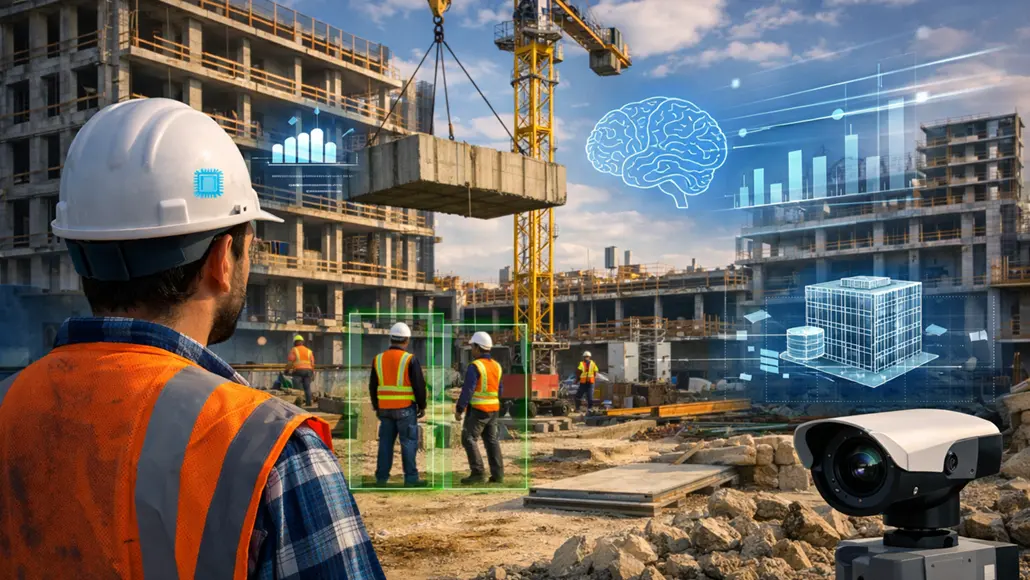


The AI conversation in construction has finally moved past the slide deck phase. Crews are using computer vision to flag safety violations in real time. Schedulers are running pattern detection on look-aheads to catch risks before they hit the critical path. Estimators are pulling submittal data into language models to compress review cycles from days to hours. The technology is on jobsites, in the field, on phones in foremen’s hands, and the people using it can name what it does for them and what it costs.
What also has not happened, despite roughly three years of consistent industry messaging, is the wholesale transformation that conference keynotes were promising in 2023. The Royal Institution of Chartered Surveyors published a September 2025 report on AI adoption in construction based on responses from more than 2,200 construction professionals worldwide. The data is sobering: about 45 percent of respondents reported no AI implementation in their organizations at all, another 34 percent were in early pilot phases, just under 12 percent reported regular use of AI in specific processes, only 1.5 percent reported use across multiple processes, and fully embedded organization-wide use was reported by less than 1 percent of respondents globally.
The point is not that AI is failing in construction. The point is that the gap between what AI can do for a jobsite and what most jobsites are actually getting from it is wider than the headlines suggest, and figuring out which side of that gap a given application sits on is the single most useful thing a builder can do this year.
Where AI is earning its keep
The clearest wins on a modern commercial jobsite are concentrated in a few areas where the underlying problem is pattern matching against large volumes of visual or textual data, the consequences of an error are bounded, and a human is still in the loop on the decision.
The first is computer vision applied to safety and site monitoring. A peer-reviewed 2025 systematic review published in the journal Buildings analyzed 122 peer-reviewed studies on AI in construction safety from 2016 through 2025 and found that vision-based systems for real-time hazard detection, predictive analytics, and automated compliance monitoring have moved from research to operational deployment across a meaningful share of large projects. The applications include PPE detection, geofencing around equipment, fall hazard identification, and tracking the presence or absence of trained personnel in restricted areas.
None of this is glamorous. All of it works because the underlying problem is well bounded: is there a hard hat in this image, is this worker inside this exclusion zone, has this scaffold been certified. The model does the recognition, the safety manager does the judgment, and the project gets earlier intervention than it would from spot inspections alone.
The second is visual documentation and progress tracking. Reality capture systems that walk the site weekly and generate a searchable, time-stamped, location-aligned visual record have become close to standard on mid-market and enterprise commercial projects. The value is not the act of taking pictures. The value is that when a question arises three months later about the state of a partition wall on the day a particular MEP rough-in was inspected, the answer takes thirty seconds rather than three days of email archaeology.
The third is risk and schedule pattern detection. Tools that ingest a project’s schedule history, look-ahead data, and submittal logs can flag combinations of conditions that have correlated with delay or rework on similar projects. The output is not a prediction of the future. It is a checklist of conditions a scheduler should re-examine before the next pull plan. This is where most of the practical productivity gains in scheduling have actually come from, and the teams using it are not replacing schedulers. They are giving schedulers a longer list of things worth checking.
The fourth is document and submittal triage. Language models that read submittals, RFIs, and contract documents to surface inconsistencies, missing references, or non-conforming language can cut hours off review cycles. The output still needs human verification (the model misses things and occasionally hallucinates citations) but the time savings on the work it does correctly are real.
This is what people mean when they describe practical AI in construction: not a single transformative breakthrough, but a steady reduction in the number of hours that project teams spend chasing information that already exists somewhere on the project but cannot be easily found. This is the area where most of the early measurable ROI has actually shown up.
Where AI isn’t there yet
The other side of the gap is wider and worth being honest about. The areas where AI in construction is consistently overpromised, in roughly descending order of how often the claim shows up in vendor pitches, look like this.
Fully autonomous decision-making on field work. The version of this that gets pitched is software that recommends sequence changes, scope reallocation, or trade reassignment without human review. The version that actually works in the field is software that prepares the data so that a superintendent can make those decisions faster and better. The first version is a long way off. The second is genuinely useful right now. Any tool that claims to operate in the first mode without a human in the loop should be evaluated with significant skepticism.
Generative AI for design specifications, scope writing, and contract language. The 2026 AI Index Report from Stanford University’s Institute for Human-Centered Artificial Intelligence noted that while large language models continue to improve on academic benchmarks, generative AI systems still struggle with reliable performance on complex reasoning and accuracy-critical tasks, which limits their use in high-stakes settings where errors carry real consequences. Specifications and contract language sit squarely in that high-stakes category. Models can draft, summarize, and surface risks. They cannot reliably produce the final language, and the projects that have tried to skip the human review step have, predictably, generated rework and disputes.
The risk profile is not theoretical. The National Institute of Standards and Technology released its Artificial Intelligence Risk Management Framework Generative AI Profile (NIST AI 600-1) in July 2024, which formally identifies confabulations, the confidently stated false content commonly described as hallucinations, as one of twelve categories of risk specific to generative AI. The framework’s recommended response is a structured govern-map-measure-manage cycle in which human review and verification are not optional. On a construction project, that translates to a simple rule: anything generative AI produces that will end up in a contract document, a specification, or a submittal package gets reviewed by the person who would have written it without AI.
Autonomous heavy equipment at scale. The demonstrations are real, the technology is real, the pilot projects are real, and the actual deployment numbers are still small relative to the size of the industry. Builders evaluating autonomous equipment should assume long ramp times, real integration costs with existing fleet management systems, and a workforce transition that nobody has quite figured out yet.
Real-time productivity benchmarking that is accurate enough to drive payment decisions. The math works in a lab. The math runs into trouble on a real site, where the inputs are noisy, the comparisons are not apples-to-apples, and the consequences of a wrong number are payment disputes that cost more than the productivity gain.
The Honest middle
The teams getting the most out of AI on construction projects right now are doing three things that the hype cycle does not particularly reward. They are picking specific, bounded problems where the input data is good and the output is checkable. They are keeping a human in the loop on every decision that affects scope, schedule, or money. And they are tracking actual time saved, not time the vendor’s case study claims.
That last point is the one that distinguishes the real adopters from the rest. A pilot that runs for three months and produces a shrug is not a failure of the technology. It is feedback that the specific application chosen did not fit the specific problem the team had. The teams that learn from those pilots and reroute the budget to the applications that did work are the ones who, over a couple of years, end up with a real AI capability rather than a series of subscriptions nobody uses. The RICS finding that less than 1 percent of construction organizations globally have organization-wide AI use, despite years of investment, is consistent with that pattern. The capability is being built where the value is provable, project by project, application by application, and the rest is being quietly deprecated.
The right question for a builder this year is not whether AI is the future of construction. The right question is which two or three specific applications, in this organization, on the next three projects, are likely to save real time on real work, and what does the smallest possible pilot of each look like. The answers to those questions are different for every contractor. The discipline of asking them, rather than buying the bundle a salesperson recommends, is what separates the teams quietly compounding gains from the teams generating press releases.