

























Close
WORLD OF CONCRETE
Friday, December 19, 2025
JEC WORLD 2026

New Low-Level Access Equipment Trends Is Overtaking Ladders

Note* - All images used are for editorial and illustrative purposes only and may not originate from the original news provider or associated company.

Subscribe

- Never miss a story with notifications

- Gain full access to our premium content

- Browse free from any location or device.

Media Packs

Expand Your Reach With Our Customized Solutions Empowering Your Campaigns To Maximize Your Reach & Drive Real Results!

– Access the Media Pack Now

– Book a Conference Call

Leave Message for Us to Get Back

Related stories

How To Choose Trailer GPS Units That Actually Work for UK Fleets

You know the drill. A trailer van goes missing...

Improving Construction Efficiency Without Compromising Quality

Achieving construction efficiency requires process-focused improvements that enhance productivity while maintaining or improving quality standards. Through workflow optimization, enhanced coordination mechanisms, quality management practices, and strategic technology integration, construction organizations deliver projects faster and more cost-effectively without sacrificing structural integrity or compliance. Balancing speed with excellence transforms construction management from a trade-off exercise into a synergistic approach where efficiency and quality reinforce one another.

Training Strategies for Operating Advanced Construction Equipment

Modern construction equipment demands operator skills that extend far beyond basic machinery operation. Comprehensive training programs combining classroom instruction, simulator practice, and hands-on field experience prepare operators to safely and efficiently manage increasingly sophisticated equipment. Through structured certification approaches, ongoing skill development, and commitment to continuous learning, construction organizations develop operator competency that enhances project safety, productivity, and equipment longevity.
- Advertisement -
Achema Middleeast

As per insights, the use of ladders and scaffolds is being reduced globally in favor of low-level access equipment to enhance worker safety, minimize surface damage, and cut rework costs. This shift is driven by new safety regulations and specific project needs, prompting contractors to adopt lightweight solutions like Hy-Brid Lifts.

The demand for low-level access is rapidly increasing in markets where traditional access products are established. In 2019, approximately 6,000-7,000 units of new equipment were sold annually; this figure is expected to double by 2023 due to market demand.

Safety regulations and employer restrictions, particularly in the UK, are boosting the demand for low-level access platforms. The introduction of micro-scissors like the GS-1432m and GS-1932m caters to these needs by offering compact and lightweight options that are suitable for various applications.

Hy-Brid Lifts has embraced scissor lift solutions, with their Zero-Turn Series ZT-1630 being introduced as a versatile alternative to mast lifts. This compact scissor lift features counterrotating wheels, allowing easy maneuverability in tight spaces without harming the finished construction. The ZT-1630 boasts a larger platform compared to mast lifts, a 650-pound capacity, and various features for operator comfort and safety.

JLG is also entering the low-level access market with the Power Tower Duo and Nano 35 set to launch in 2023. The Duo accommodates two individuals indoors or outdoors and can lift materials with its mechanical outriggers. The Nano 35, under 500kg in weight, reaches 5.5m without outriggers, enabling access to congested areas.

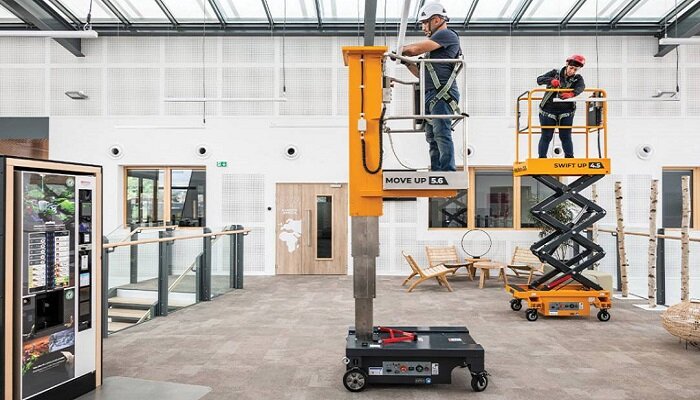
Traditional scissor and boom lift manufacturers, including JLG and Haulotte, have recognized the trend toward low-level access equipment. Haulotte’s Move Up mast lift line and Swift Up scissor lift line offers compact and maneuverable options for navigating confined spaces like store aisles and offices. The global trend towards low-level access equipment over ladders and scaffolds is being fueled by safety regulations, specialized project requirements, and market demand. Manufacturers are responding with innovative, compact, and lightweight solutions to meet these needs across various industries and applications.

Achema Middleeast

Latest stories

Related stories

How To Choose Trailer GPS Units That Actually Work for UK Fleets

You know the drill. A trailer van goes missing...

Improving Construction Efficiency Without Compromising Quality

Achieving construction efficiency requires process-focused improvements that enhance productivity while maintaining or improving quality standards. Through workflow optimization, enhanced coordination mechanisms, quality management practices, and strategic technology integration, construction organizations deliver projects faster and more cost-effectively without sacrificing structural integrity or compliance. Balancing speed with excellence transforms construction management from a trade-off exercise into a synergistic approach where efficiency and quality reinforce one another.

Training Strategies for Operating Advanced Construction Equipment

Modern construction equipment demands operator skills that extend far beyond basic machinery operation. Comprehensive training programs combining classroom instruction, simulator practice, and hands-on field experience prepare operators to safely and efficiently manage increasingly sophisticated equipment. Through structured certification approaches, ongoing skill development, and commitment to continuous learning, construction organizations develop operator competency that enhances project safety, productivity, and equipment longevity.

Managing Material Costs in a Volatile Construction Market

Construction material price volatility presents significant challenges to project budgeting and risk management. Strategic procurement approaches, supply chain resilience strategies, and contract mechanisms that balance risk effectively enable stakeholders to navigate market fluctuations successfully. Understanding market dynamics, implementing escalation clauses, developing flexible procurement strategies, and maintaining strong supplier relationships help construction professionals maintain project viability despite unpredictable material cost movements.

Subscribe

- Never miss a story with notifications

- Gain full access to our premium content

- Browse free from any location or device.

Media Packs

Expand Your Reach With Our Customized Solutions Empowering Your Campaigns To Maximize Your Reach & Drive Real Results!

– Access the Media Pack Now

– Book a Conference Call

Leave Message for Us to Get Back

Translate »