


























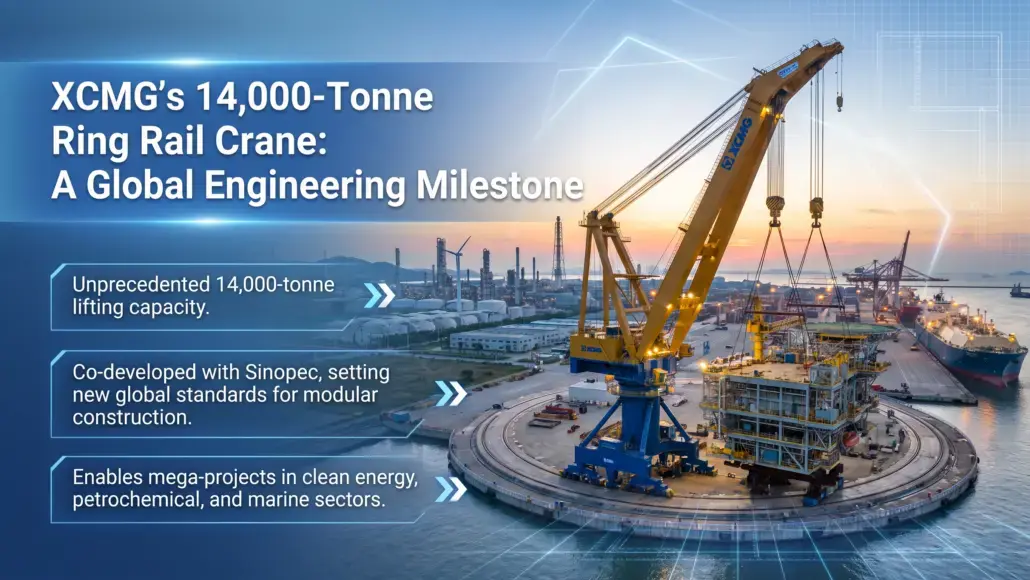


The world’s first ring rail crane with a maximum lifting capacity of 14,000 tonnes has rolled off the assembly line of XCMG (Xuzhou Construction Machinery Group Co Ltd), headquartered in Xuzhou, in China’s Jiangsu Province. Co-developed with Sinopec Heavy Lifting & Transportation Co Ltd, this landmark machine sets a new global standard for modular construction capabilities across clean energy, petrochemical, and marine projects.
State-owned XCMG is a multinational heavy machinery manufacturer and the third-largest construction equipment producer in the world.
A Machine Built for the Demands of Mega-Scale Projects
By handling massive, fully integrated modules — including those for Hualong-One Version 2.0 nuclear reactors — this ring rail crane eliminates the need for sectional lifting. Giant towers, offshore wind components, and containment vessels can now be hoisted as single, complete units, significantly shortening overall project construction cycles.
Beyond its 14,000-tonne maximum lifting capacity, the crane also achieves a historic 700,000-tonne-metre maximum lifting moment, making it the largest-capacity ring crane ever built. The system is composed of two 7,000-tonne main units that can operate independently or combine to work in tandem, offering unmatched operational flexibility across a wide variety of project scales.
Pioneering Electric Direct-Drive Technology
A key engineering feature of this heavy lifting system is its pioneering electric direct-drive mechanism. This technology cuts fuel usage and associated emissions, delivering over 30% in energy savings while boosting overall operational efficiency by 20%. In nuclear power applications specifically, the crane is capable of managing modules and heavy equipment for two complete nuclear islands from a single setup position — a capability that underscores the machine’s extraordinary functional reach within nuclear construction environments.
Industry Milestone: Redefining the Limits of Mega-Lifting
The XCMG ring rail crane fundamentally redefines the scaling limits of mega-lifting. It nearly triples the weight capacity of the current industry leader, the Sarens SGC-250, widely known as “Big Carl,” which carries a lifting capacity of 5,000 tonnes. Unlike the SGC-250, which is built as a single monolithic structure, the XCMG crane adopts a twin-module architecture. This design approach prevents the machine from sitting idle during lighter lifting stages, offering a more operationally efficient alternative at scale.
Assembly, Testing, and Integration Progress
The first 7,000-tonne main unit has now transitioned from the assembly phase into operational evaluation. While the second module remains in production, the first unit is being tested as a standalone 7,000-tonne crane to verify its structural stability, electronic synchronisation, and independent lifting operations. Once the second 7,000-tonne unit is completed by XCMG and Sinopec, both modules will undergo integration testing to synchronise the electric direct-drive system across the full 14,000-tonne combined frame.
The release ceremony for this world-first machine was attended by the President of the China Road Construction Engineering Association, Su Zimeng; Deputy General Director of Sinopec Engineering Group; General Director of the transport company, Wang Guohua; the XCMG Board Chairman; and other senior company officials, reflecting the significance of this engineering achievement across the industry.