


























Urban construction is being reshaped by a simple pressure, floor plates are shrinking, densification is rising, and every square metre of usable area now carries commercial weight. For developers, architects and project managers working on loft conversions, mezzanines, co-working fit outs and compact residential schemes, the question is rarely whether vertical circulation is needed but how to deliver it without sacrificing the surrounding space it is meant to serve.
Conventional staircases, with their extended runs and generous floor footprints, are increasingly at odds with modern project economics. A flight of stairs that consumes four or five square metres of lettable area is no longer a neutral design choice it is a commercial one. This has prompted renewed interest from specifiers in engineered compact staircase solutions that can deliver full vertical access within a fraction of the plan area.
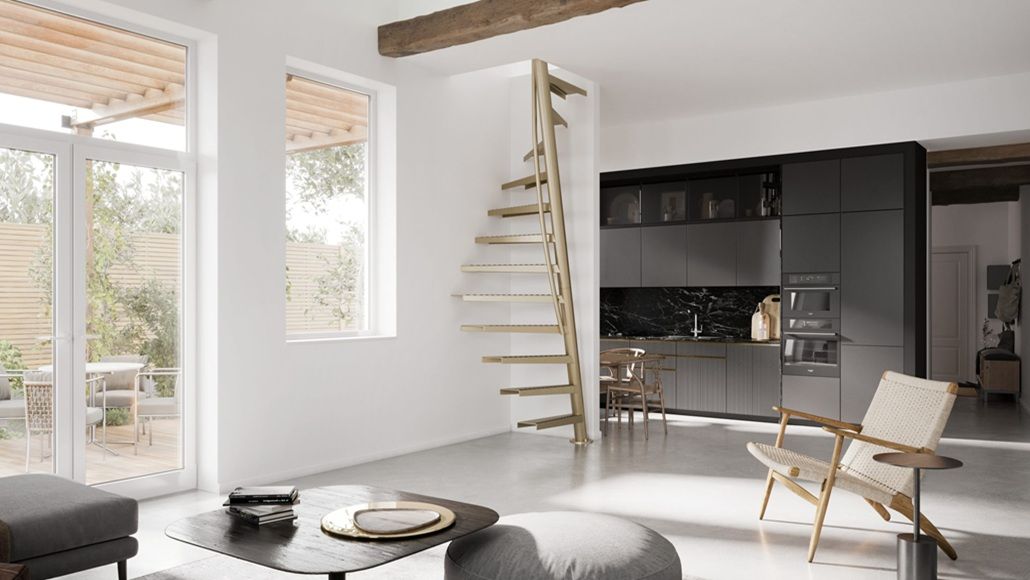
EeStairs has responded with its patented 1m² staircase, a design that compresses a full storey rise into a single square metre of floor and ceiling footprint.
“Rather than being a gimmick, the staircase has been carefully engineered to solve a very real issue in modern interiors: how to move between floors without sacrificing too much of the room below,” says Oliver Schneider.
Engineered for compact plan areas
The 1m² staircase uses a patented square spiral configuration built around a subtly slanted central column. That slight angle is what enables the structural logic of the design, treads can be wider than on a strictly vertical spiral, without pushing the plan area beyond one square metre. The result is a unit that reads as a proper staircase rather than a loft-ladder substitute, while occupying less space than most fixed ladders.
Construction is in high-strength steel, with a load capacity of up to 300 kg. The staircase complies with UK building regulations for secondary access stairs, making it suitable for loft conversions, and mezzanines where regulatory sign-off is a precondition rather than an afterthought.
Specification through a digital configurator
One of the more practical efficiencies the product offers the construction side is how it is specified. Rather than working through bespoke drawings for what is, by design, a standardised envelope, the 1m² is specified through an online configurator. Architects, designers and experienced installers can input dimensions, generate a 3D model, and produce a costed quotation in a single session. A technical drawing is then issued for approval, with delivery or installation typically completed within approximately five weeks.
For project managers working to fixed programmes, that lead-time predictability is as relevant as the design itself. Over 200 RAL colours and finishes are available, along with clockwise or anticlockwise configuration, giving enough specification latitude to align with interior schemes without slowing the procurement process. “We wanted to enable clients to visualise and personalise their staircase without compromising technical accuracy,” expert Oliver Schneider explains.
Installation designed around construction logistics
The installation profile is where the specification advantage translates directly into site savings. Two trained installers can assemble the staircase in under two hours, using standard tools. No cranes, no heavy lifting equipment, no structural intervention beyond the prepared floor opening. For fit-out contractors working in occupied buildings, fitted-out shells, or tightly sequenced residential programmes, that logistical footprint is often the deciding factor. It is also the point at which the product’s relevance extends beyond residential applications.
A shift in what vertical circulation is asked to do
The broader point, for construction professionals, is that staircase specification is being pulled into the same efficiency conversations that have reshaped other elements of building design. Reducing footprint while maintaining performance, compliance and usability is no longer a niche requirement but increasingly the baseline brief on urban and high-density projects. Engineered compact staircases like the 1m² are part of that shift and not as feature pieces, but as practical responses to the commercial realities of modern construction.