


























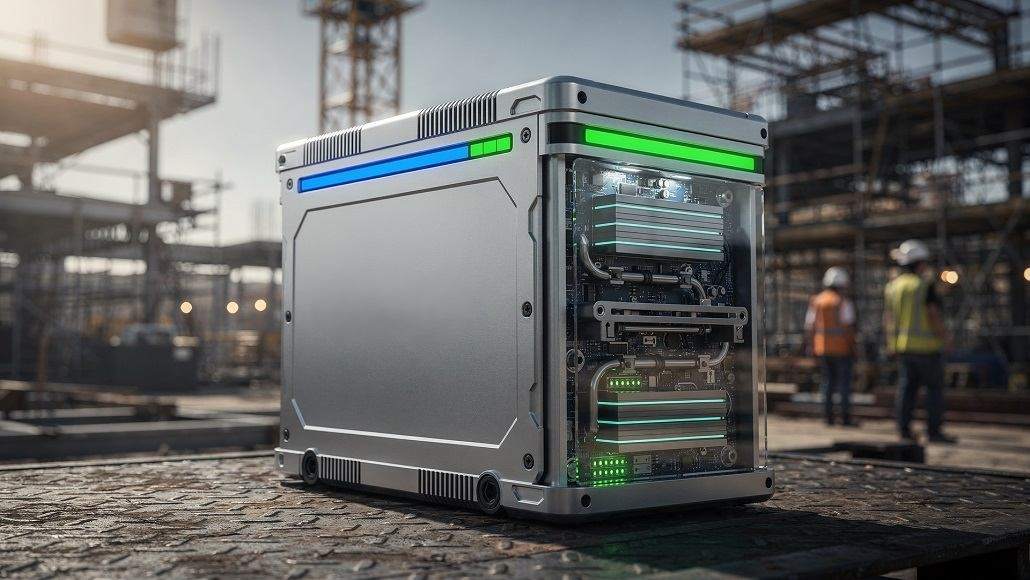

ProLogium Technology has announced a collaboration with Kyushu Electric Power and Nakayama Iron Works to demonstrate a 24 V solid-state battery module for construction machinery. The module was exhibited at CES 2026 and is expected to be utilized in Nakayama’s MSD700 and NE100HBJ.
The collaboration brings together battery cell development, module design, and end-use integration. ProLogium is supplying its next-generation solid-state lithium ceramic cells, while Kyushu Electric Power is contributing its expertise in energy systems and lithium-ion battery monitoring and control to support module design. Nakayama Iron Works will integrate the battery module into its construction equipment.
“ProLogium’s next-generation solid-state lithium ceramic battery features a unique super-fluidized all-inorganic solid-state electrolyte, [combined] with an active safety mechanism that is released under high temperature and high voltage to stabilize the active materials of both the cathode and anode,” said Vincent Yang, founder and CEO of ProLogium. “This enables the battery to truly interrupt thermal chain reactions and achieve the ultimate goal of eliminating thermal runaway.”
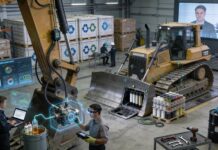
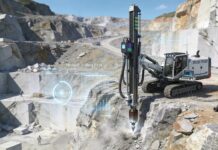
Nakayama’s MSD700 is a small electric construction machine with a compact body, suitable for use in narrow spaces where it is difficult for large-sized equipment to work. It is safe to use indoors and underground without having to worry about exhaust gas. The NE100HBJ is a battery-powered crusher that can be included in the company’s DENDOMAN series, with a crushing capacity of 15 to 50 tons per hour for rocks or concrete.
The 24 V solid-state battery module has seven ProLogium SN-10 cells. The module, which has a maximum capacity of up to 111.3 Ah, provides a high energy density in a small form factor, with high vibration resistance and flexible series and parallel configuration. The operating voltage range is 29.4 V to 17.5 V, with a usable energy capacity of up to 2,671 Wh.
For the MSD700, the use of the module is expected to increase the operating time from two hours to approximately 3.7 hours, and to reduce charging time to about 27 minutes. For the NE100HBJ, operating time is expected to increase from eight hours to 10 hours for travel duty and from four hours to 10 hours for crushing operations, with a charging time of about 14 minutes.
