


























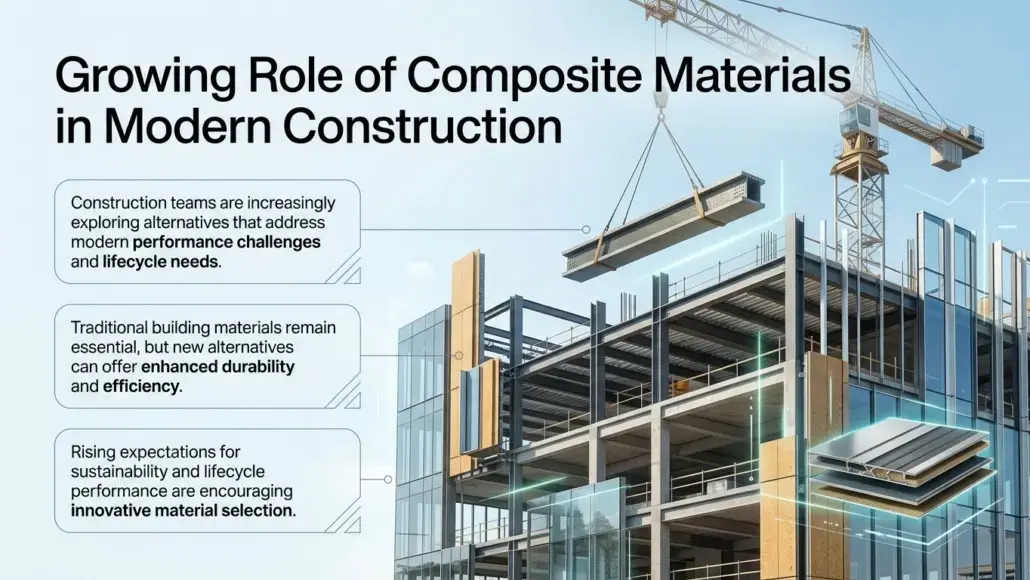


For generations, construction has relied heavily on concrete, steel, timber, and masonry. These materials have shaped skylines, infrastructure networks, and commercial developments around the world. While they remain essential to the built environment, the industry is increasingly exploring alternatives that can address modern performance challenges.
Rising expectations around durability, efficiency, sustainability, and lifecycle performance are encouraging project teams to rethink material selection. As buildings become more complex and construction timelines become more demanding, composite materials are gaining attention as a practical solution capable of delivering benefits that traditional materials often struggle to provide.
Rather than replacing conventional construction materials entirely, composites are increasingly being used to enhance structural performance, reduce maintenance requirements, and support innovative design approaches.
Understanding the Shift Toward Composite Materials
The growing interest in composite materials stems from their unique ability to combine multiple materials into a single engineered product. By blending different components, manufacturers can create materials that offer specific performance characteristics such as high strength, low weight, corrosion resistance, or enhanced durability.
This flexibility allows engineers to tailor material properties to project requirements rather than relying solely on the inherent characteristics of conventional materials.
As a result, composites are increasingly appearing in commercial buildings, bridges, facades, industrial facilities, transportation infrastructure, and specialized construction applications where performance demands exceed traditional expectations.
Lightweight Construction Is Becoming a Competitive Advantage
One of the most significant advantages of composite materials is their high strength-to-weight ratio.
Reducing structural weight can deliver multiple benefits throughout the construction process. Lighter materials can simplify transportation, reduce installation requirements, and lower loads on supporting structures. This can create opportunities for more efficient designs while potentially reducing overall material consumption.
In high-rise developments, large-span structures, and complex architectural projects, weight reduction can have a direct influence on construction efficiency and structural optimization.
As developers increasingly seek ways to improve project economics without compromising performance, the lightweight nature of composite materials is becoming a compelling advantage.
Durability Is Driving Material Innovation
Durability remains one of the most important considerations in construction. Exposure to moisture, chemicals, temperature fluctuations, and environmental stress can significantly impact the lifespan of building components.
Many composite materials offer superior resistance to corrosion, weathering, and chemical degradation compared with traditional alternatives. This makes them particularly attractive for applications where long-term performance is critical.
For project owners, durability translates into lower maintenance requirements and reduced lifecycle costs. In an industry increasingly focused on long-term asset value, these benefits are becoming increasingly difficult to ignore.
Expanding Design Possibilities for Architects
Material innovation often creates new opportunities for architectural creativity. Composite materials allow designers to achieve forms and geometries that may be difficult or costly to produce using conventional construction materials.
The flexibility of composites enables more complex facade systems, curved structures, lightweight cladding solutions, and customized architectural elements. This is particularly valuable in projects where aesthetics and performance must be balanced simultaneously.
As architecture continues to evolve toward more ambitious and distinctive designs, material flexibility is becoming an important factor in project development.
The Sustainability Conversation Is Evolving
Sustainability has become a major influence on construction decision-making. While discussions often focus on operational efficiency, attention is increasingly shifting toward material performance throughout the lifecycle of a building.
The role of composite materials within sustainability strategies is multifaceted. Their durability can reduce replacement cycles, while lightweight characteristics may contribute to lower transportation and installation impacts. In some applications, composites can also support resource efficiency by optimizing material usage.
However, sustainability discussions surrounding composites remain complex. Questions regarding recyclability, end-of-life management, and manufacturing processes continue to influence adoption decisions.
As a result, the industry’s focus is shifting from simplistic sustainability claims toward comprehensive lifecycle evaluations.
Infrastructure and Building Applications Are Expanding
The use of composite materials is no longer limited to specialized projects. Their application is expanding across multiple construction segments.
In building construction, composites are increasingly used in facade systems, roofing elements, reinforcement applications, and architectural components. Within infrastructure projects, they are being utilized for bridge strengthening, corrosion-resistant structures, and rehabilitation programs.
This growing adoption reflects a broader trend in which material selection is becoming increasingly performance-driven rather than tradition-driven.
Engineers are evaluating materials based on functionality, longevity, and project-specific requirements rather than relying solely on established conventions.
Challenges Still Limit Wider Adoption
Despite growing interest, the widespread use of composite materials faces several barriers.
One challenge is cost perception. While composites may offer long-term value, their initial costs can exceed those of conventional alternatives. This can make adoption difficult in projects that prioritize upfront expenditure over lifecycle performance.
There is also a knowledge gap within parts of the construction sector. Designers, contractors, and procurement teams may have limited experience working with advanced composite systems, creating hesitation during specification and implementation.
In addition, building codes and standards often evolve more slowly than material innovation, which can create uncertainty regarding approvals and performance validation.
These challenges are not unique to composites but are common across many emerging construction technologies.
A Shift Toward Performance-Based Material Selection
Perhaps the most significant trend driving adoption is the industry’s growing focus on performance-based decision-making.
Historically, material selection was often guided by familiarity, availability, and cost. Today, project teams are increasingly evaluating materials based on how effectively they contribute to project objectives.
This includes considerations such as:
- Structural efficiency
- Durability
- Maintenance requirements
- Sustainability performance
- Lifecycle value
Within this framework, composite materials are becoming increasingly relevant because they address multiple performance criteria simultaneously.
Conclusion
Construction is entering a period where material innovation is becoming a strategic differentiator rather than a technical consideration. As projects become more demanding and expectations around performance continue to rise, the industry’s approach to material selection is evolving.
Composite materials represent an important part of this evolution. Their combination of strength, durability, flexibility, and design potential is helping engineers, architects, and contractors address challenges that traditional materials alone may not fully solve.
While widespread adoption will depend on continued education, standards development, and economic validation, the direction of travel is clear. The future of construction will not be defined by a single material but by the ability to select and integrate materials that deliver the best performance across the entire lifecycle of a project.