

























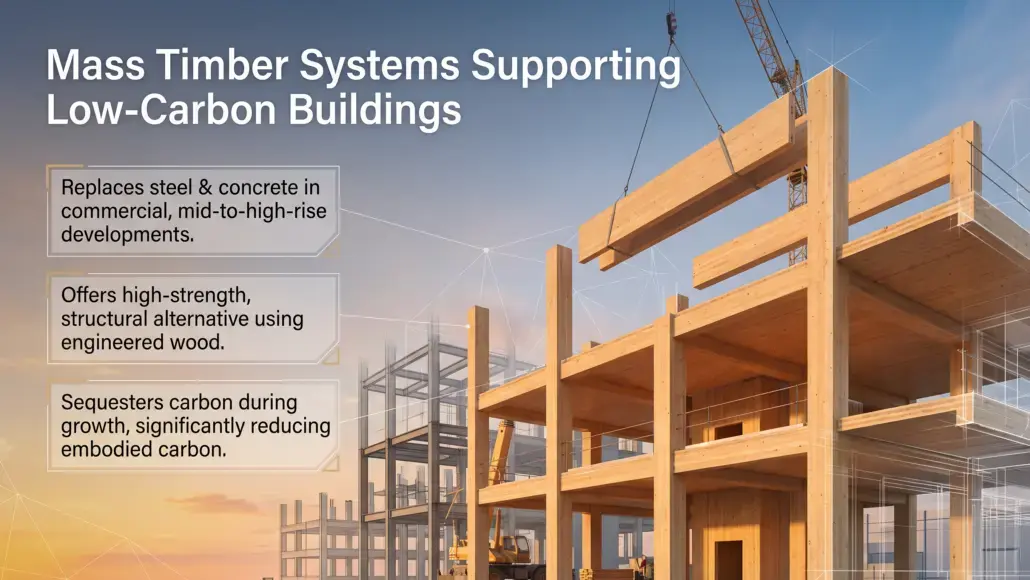


The rise of mass timber systems in the commercial construction sector marks a significant departure from the dominance of steel and concrete in mid-rise and high-rise developments. These engineered wood products, including cross-laminated timber and glue-laminated timber, offer a high-strength, low-carbon alternative for structural applications. As the industry prioritizes the reduction of embodied carbon, the ability of timber to sequester carbon during its growth cycle provides a distinct advantage over energy-intensive conventional materials. Beyond environmental benefits, mass timber systems enable faster construction timelines through prefabrication and modular assembly, reducing onsite labor requirements and minimizing disruption to surrounding urban environments. This shift toward bio-based structural materials is supported by advancements in manufacturing technology and a growing body of engineering data that validates the performance of wood in demanding applications.
Integrating these systems into modern building projects requires a specialized approach to design and engineering. Structural engineers must account for the unique mechanical properties of wood, such as its orthotropic nature and its response to moisture and temperature variations. However, the high strength-to-weight ratio of engineered timber allows for significant reductions in foundation requirements, potentially leading to cost savings on sites with challenging soil conditions. The aesthetic appeal of exposed wood also contributes to the growing interest in mass timber, as it aligns with the principles of biophilic design and enhances the overall well-being of building occupants. The following analysis examines the technical specifications and market drivers that are positioning mass timber as a cornerstone of sustainable urban development.
Structural Engineering Advantages of Cross-Laminated Timber
Cross-laminated timber is a centerpiece of modern mass timber systems, consisting of layers of dimension lumber stacked in alternating directions and bonded with structural adhesives. This cross-oriented configuration provides exceptional dimensional stability and bidirectional strength, allowing the panels to function as load-bearing walls, floors, and roof diaphragms. The manufacturing process involves precise kiln-drying and CNC machining, ensuring that each panel meets strict dimensional tolerances and quality standards. This precision allows for highly predictable structural behavior, which is essential for the design of complex, multi-story buildings. Engineers can utilize advanced modeling software to optimize panel thickness and span lengths, reducing material waste and improving the efficiency of the building envelope.
The lightweight nature of cross-laminated timber panels facilitates easier handling and transportation compared to precast concrete or steel components. This reduction in weight allows for the use of smaller cranes and lighter foundations, which can be particularly advantageous in congested urban areas or on projects with limited access. Additionally, the high thermal insulation properties of wood contribute to the energy efficiency of the building, reducing the demand for supplemental insulation and lowering operational energy costs. The integration of mass timber systems into a building’s design also offers opportunities for creating large, open floor plates with fewer internal columns, providing developers with greater flexibility in interior layouts. This versatility is a key factor in the material’s growing popularity for office, residential, and mixed-use developments.
From a structural perspective, the connections between timber panels are critical for ensuring the integrity of the system. Engineers often employ specialized steel connectors and fasteners to manage the transfer of loads and provide the necessary ductility for seismic events. The development of high-capacity connection systems has been a primary focus of research in the timber industry, leading to the creation of innovative solutions that are both efficient to install and visually unobtrusive. As the height of timber buildings continues to increase, the importance of these connections becomes even more pronounced. The successful implementation of cross-laminated timber in high-rise structures demonstrates the material’s capability to serve as a reliable and high-performance structural solution.
Fire Safety and Seismic Resilience of Wood Systems
One of the most frequent questions regarding mass timber systems concerns their performance in fire events. Contrary to common perceptions of wood as a combustible material, large-section engineered timber exhibits a predictable charring behavior that protects the structural core during a fire. When exposed to heat, the outer layer of the timber forms a char layer that acts as an insulator, slowing the rate of combustion and maintaining the load-bearing capacity of the element for a specified period. This inherent fire resistance allows mass timber buildings to meet stringent fire safety standards without the need for extensive additional fireproofing. Fire engineering designs for these structures often involve rigorous testing and modeling to verify that the charring rate is consistent with the required fire-resistance ratings.
The seismic performance of mass timber systems is another area where the material excels. Wood is naturally flexible and has a high strength-to-weight ratio, which reduces the inertial forces acting on a building during an earthquake. This inherent resilience, combined with the ductility provided by engineered connections, allows timber structures to absorb and dissipate seismic energy effectively. Many mass timber projects incorporate hybrid systems, using steel or concrete cores for lateral stability while utilizing timber for the primary gravity-bearing elements. This approach combines the benefits of multiple materials to create a highly resilient and efficient structural system. The performance of timber buildings in actual seismic events and laboratory simulations has consistently demonstrated their ability to protect occupants and remain functional after significant ground motion.
To further enhance fire and seismic safety, the industry is adopting advanced monitoring and suppression technologies. This includes the integration of smart sensors that can detect heat and smoke at an early stage, as well as the use of high-performance fire-rated coatings and sealants. The collaboration between fire marshals, building officials, and design teams is essential for developing safe and compliant mass timber projects. By utilizing evidence-based design approaches and adhering to the latest building codes, the construction sector is proving that timber can be used safely in a wide range of building types and heights. This commitment to safety is a fundamental pillar of the growth of the mass timber market.
Supply Chain Logistics and Forestry Management
The sustainability of mass timber systems is intrinsically linked to the health and management of the forests from which the wood is sourced. Responsible forestry practices ensure that the harvesting of timber does not lead to deforestation or the loss of biodiversity. Many mass timber producers seek certification from organizations such as the Forest Stewardship Council or the Sustainable Forestry Initiative, which provide third-party verification that the wood comes from sustainably managed forests. These programs require forest owners to adhere to strict environmental, social, and economic standards, ensuring that timber remains a truly renewable resource. The transparency of the supply chain is a key consideration for developers and architects who are committed to ethical sourcing.
Logistics play a crucial role in the economic viability of mass timber projects. Because many components are prefabricated in a factory environment, the coordination between the manufacturer and the construction site must be precise. Panels are typically delivered to the site in a specific sequence, allowing for immediate installation directly from the truck. This just-in-time delivery model minimizes the need for onsite storage and reduces the risk of material damage. The use of digital tracking systems and BIM integration allows for real-time monitoring of the supply chain, ensuring that project schedules are maintained. The proximity of the manufacturing facility to the construction site and the forest source is also a factor in the overall carbon footprint of the project, as transportation emissions can be significant.
The growth of the mass timber industry is also driving investment in local and regional manufacturing capacity. New facilities are being established in regions with abundant forest resources, creating jobs and supporting local economies. This expansion of the manufacturing base helps to reduce lead times and improve the availability of engineered wood products for a wider range of projects. Additionally, the use of lower-value or smaller-diameter timber in products like cross-laminated timber allows for better utilization of forest resources and supports forest health initiatives, such as thinning to reduce wildfire risk. By creating a market for these materials, the mass timber industry is helping to fund the long-term stewardship of our forest ecosystems.
Cost Analysis of High-Rise Timber Construction
While the material costs of mass timber systems can be higher than those of conventional steel or concrete, the total project cost is often comparable when accounting for other efficiencies. One of the primary drivers of cost savings is the speed of construction. The prefabricated nature of timber components allows for a significantly shorter onsite assembly period, which can reduce labor costs and lower the overhead associated with the construction site. For developers, a faster construction timeline means that the building can be occupied sooner, generating rental income or sales revenue earlier in the project lifecycle. This reduction in the time-to-market can be a decisive factor in the financial success of a commercial development.
Another area for cost optimization is the reduction in foundation requirements. Because timber is much lighter than concrete, the loads acting on the foundation are significantly reduced. This can lead to substantial savings in excavation, piling, and concrete costs, particularly on sites with poor soil quality. Additionally, the high degree of precision in factory-manufactured panels reduces the need for onsite modifications and minimizes material waste. The use of BIM and advanced design software allows for more accurate material take-offs and cost estimates, reducing the risk of unexpected expenses during construction. Developers are also finding that the market appeal of sustainable timber buildings can lead to higher lease rates and property values, further improving the financial performance of the asset.
To achieve the best economic outcomes, it is essential for the design and construction teams to be integrated from the early stages of the project. Early collaboration between the architect, structural engineer, and timber manufacturer allows for the optimization of the structural system and the identification of potential cost savings. This integrated approach also helps to manage the risks associated with a relatively new construction method, ensuring that the project is delivered on time and within budget. As the industry gains more experience with mass timber, the development of standardized details and procurement processes will further improve the cost-competitiveness of wood systems.
Embodied Carbon Reductions in Prefabricated Modules
The use of mass timber systems in prefabricated modules offers a powerful strategy for reducing the embodied carbon of the built environment. Prefabrication involves the construction of large building components, such as entire rooms or wall sections, in a controlled factory environment. This approach allows for greater precision and quality control, as well as a significant reduction in material waste. By utilizing timber as the primary structural material for these modules, the industry can achieve deep carbon savings throughout the manufacturing and assembly process. The ability of wood to store carbon for the life of the building provides a long-term environmental benefit that is not matched by other materials.
The integration of mechanical, electrical, and plumbing systems into prefabricated timber modules further enhances the efficiency of the construction process. These systems can be installed in the factory, reducing the amount of labor needed on the job site and minimizing the potential for errors. When the modules arrive at the site, they are simply stacked and connected, creating a finished structure in a fraction of the time required for traditional construction. This modular approach is particularly well-suited for repetitive building types, such as hotels, student housing, and affordable residential developments. The use of low-carbon timber in these applications helps to address the growing demand for sustainable and high-quality housing in urban areas.
Lifecycle assessments of prefabricated timber buildings have consistently shown that they have a much lower carbon footprint than comparable structures built with conventional methods. This reduction in emissions is achieved through a combination of sequestered carbon in the wood, reduced energy use in manufacturing, and minimized waste. Additionally, the end-of-life options for timber modules are also more sustainable, as the components can be disassembled and reused or recycled into new wood products. This commitment to circularity and decarbonization is driving the innovation in mass timber systems and positioning the industry at the forefront of the transition to a more sustainable construction sector. The continued evolution of these systems will play a vital role in meeting the ambitious climate goals of the 21st century.