


























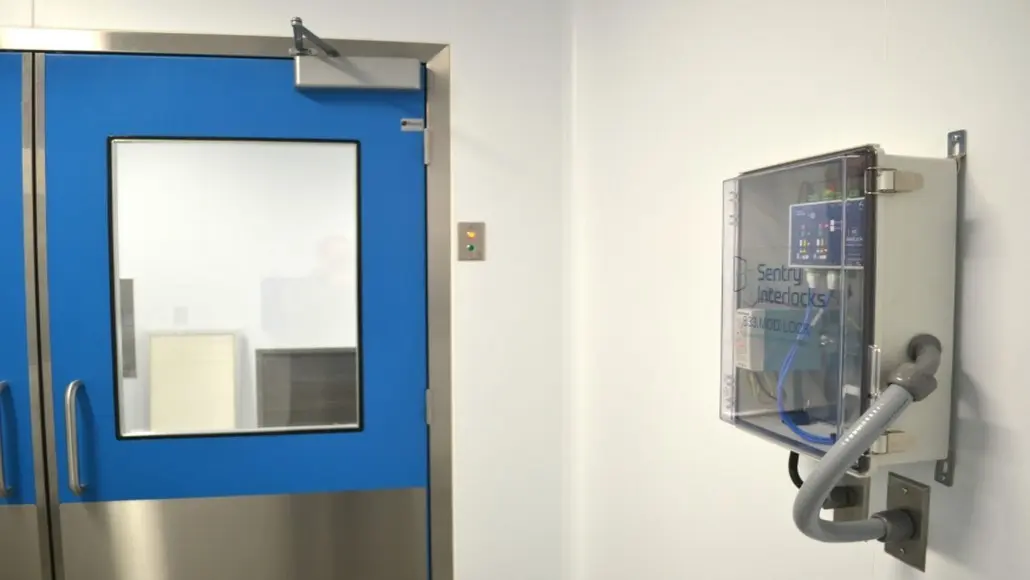


Facility planners face immense pressure to design spaces that meet current operational needs while remaining flexible enough to accommodate future growth without costly overhauls. Door interlock systems can hinder flexibility when poorly designed, so understanding how to future-proof this infrastructure is essential. A small choice today can easily become a major roadblock further down the line.
Common Interlock Planning Pitfalls That Restrict Scalability
To build for the future, planners must first understand the mistakes of the past. Many facilities are inadvertently constrained by interlock systems chosen for their initial footprint rather than their future potential. There are several common pitfalls to avoid.
Choosing Controllers with Fixed Hardware Limits
Traditional centralized controllers, like Programmable Logic Controllers (PLCs), have a finite number of physical inputs and outputs. This becomes a problem when your facility needs to add just one or two more interlocked doors, and you discover the controller is at maximum capacity.
The consequence is not a simple upgrade but a full rip and replace of the central control panel, or worse, the addition of awkward cascading external relays that are difficult to troubleshoot. All of this leads to high cost, downtime and complexity that could have been avoided with better planning.
Underestimating Future Personnel and Traffic Flow Needs
Systems designed for current staffing levels often fail as facilities grow. What was once a smooth-flowing entryway can become a frustrating bottleneck when headcount increases. If the interlock logic cannot be easily adjusted to manage higher traffic, staff face unproductive waiting queues that undermine operational efficiency.
These delays directly impact production schedules and material transfer times, creating issues that ripple across the entire facility. Without flexibility in the system architecture, addressing these issues requires substantial reconfiguration or replacement.
Isolating Access Logic from Building and HVAC Systems
Modern facilities require systems to communicate, particularly in cleanrooms or laboratories where air pressurization and contamination control are paramount. When door interlock systems cannot communicate with HVAC or Building Management Systems (BMS), you lose the ability to create intelligent sequences, such as ensuring air purges before a door opens.
This prevents the system from generating integrated environmental logs for audits and makes it impossible to automate critical contamination control protocols. This isolation creates compliance risks and operational inefficiencies that become more problematic as regulatory requirements evolve.
Creating Friction with Egress and Code Compliance
Life safety and building codes, including National Fire Protection Association standards, add complexity to interlock planning. As facilities are renovated or their purposes change, egress paths often need re-evaluation. Hardwired, inflexible interlock systems make it difficult and expensive to reconfigure locking and release mechanisms, turning occupant safety and code compliance into significant ongoing challenges.
Foundational Principles of a Scalable Interlock Strategy
Avoiding the pitfalls needs a fundamental shift in strategy. Future-proof planning demands flexibility and distributed intelligence rather than centralized, rigid architecture. Modular systems that place control at the door level eliminate the constraints of fixed hardware, while software-based configuration replaces complex hardwiring.
This allows you to adjust interlock logic without rewiring panels or hiring specialized programmers. Scalable systems should accommodate growth from a handful of doors to dozens without replacing core components, transforming door control from a static installation into adaptable infrastructure. That means on-site facility teams can make routine adjustments themselves, reducing reliance on external contractors and minimizing operational downtime.
How Sentry Interlocks Delivers True Plug-and-Play Growth
Sentry Interlocks delivers a plug-and-play door interlock architecture that allows systems to scale from two doors to 100 with no PLC programming. The company uses preprogrammed, modular hardware units, allowing facilities to scale via plug-and-play Cat 5/RJ45 connections instead of writing ladder logic or expanding physical PLC racks.
The architecture supports complex multi-door networks and intelligent zoning rather than rigid, linear door pairs. Clear integration interfaces facilitate seamless communication with BMS and HVAC controllers. Security logic remains isolated, ensuring pressurization is never accidentally compromised by an access control fault.
The hardware also supports fire alarm integration, allowing doors to unlock during emergencies in accordance with the facility’s specified lock protocol. Because electric locks may be configured as fail-safe or fail-secure, facility teams should confirm the required egress behavior with code officials, security stakeholders and Sentry during planning. Local emergency override buttons integrate cleanly into the modular footprint, satisfying code compliance with verifiable, fail-safe hardware rather than software scripts.
To plan a door interlock system that can grow with your facility, contact Sentry Interlocks to discuss modular, plug-and-play options for your access control, clean room, security or building management needs.
Key Features
- Can scale up to 100 doors in one scheme
- Plug-and-play design that requires no complex PLC programming or panel building
- System-agnostic and able to integrate with any access control system or door hardware
- Preprogrammed logic to simplify installation and setup
Frequently Asked Questions
As interlocking door technology advances, you may have questions about what a system needs.
Why are traditional, PLC-based interlock systems a problem for growing facilities?
PLC-based interlocking door systems are built around centralized controllers with a fixed number of inputs. If you need to add more doors, you cannot simply add them. Instead, you face a costly replacement of the main control panel, leading to significant cost and downtime.
Why should a door interlock system integrate with HVAC or BMS?
In controlled environments such as cleanrooms or labs, integrations are necessary to maintain air pressurization and prevent contamination. When the systems can communicate, you can create intelligent sequences, such as ensuring an air purge is complete before a door unlocks. This is essential for automation, safety and compliance.
How do modern, scalable door interlock systems handle emergency egress and fire codes?
Modern systems are designed with safety loops that connect directly to the building’s fire alarm system. If an alarm or power loss occurs, many automatically enter a fail-safe mode, cutting power to all locks to allow for immediate, unimpeded exit. Such fail-safes ensure that life safety and code compliance are built into the hardware’s core function.
Developing a Resilient, Future-Ready Access Plan
The choice of a door interlock system is a long-term strategic decision that extends far beyond initial installation. Embracing a modular, scalable approach ensures that your infrastructure can grow as required. The flexibility to adapt to changing operational demands, integrate with evolving building systems and maintain compliance with safety standards determines whether your facility can grow efficiently or face costly limitations down the road. Invest in infrastructure that supports your vision for the future.