


























Material handling plays a vital role in manufacturing plants, warehouses, distribution centers, automotive facilities, and maintenance shops. Every day, businesses move heavy equipment, raw materials, finished products, and machinery that require precision, safety, and efficiency. Relying solely on manual labor for these tasks increases the risk of workplace injuries, product damage, and operational delays. This is where a jib crane becomes an essential solution.
Designed to lift, move, and position loads with minimal effort, a jib crane provides flexibility and reliability for a wide range of industrial applications. Whether you need to handle lightweight components or heavy machinery, the right crane system can improve productivity while reducing worker fatigue. From compact workstations to large production facilities, businesses continue to invest in jib cranes because they offer an excellent balance of performance, affordability, and safety.
In this guide, we’ll explore why a jib crane is essential for safe and efficient material handling, its major benefits, different types, and how options like a foundationless jib crane and a 500 Lb Jib Crane can help businesses optimize their operations.
What Is a Jib Crane?
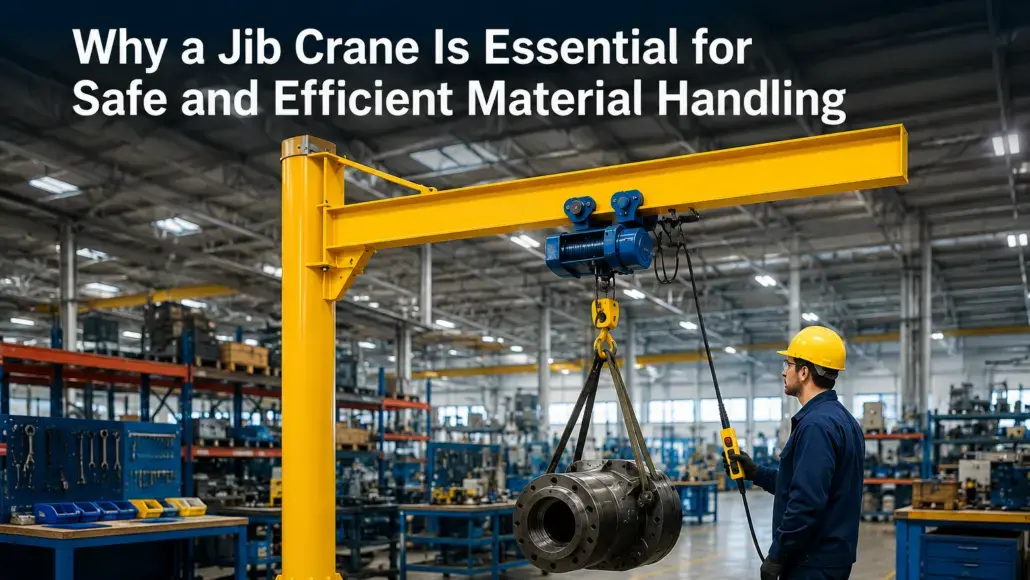
A jib crane is a material handling system consisting of a horizontal boom (jib arm) mounted to a vertical support structure. A hoist and trolley travel along the boom, allowing operators to lift and move loads within a designated work area.
Unlike overhead crane systems that span an entire facility, jib cranes are designed to serve individual workstations, assembly lines, loading docks, maintenance bays, and production cells. They provide localized lifting solutions that improve workflow while occupying minimal floor space.
Jib cranes are available in various capacities, boom lengths, and rotation ranges, making them suitable for everything from precision assembly work to heavy-duty industrial lifting.
Why Businesses Choose a Jib Crane
Industrial facilities face constant pressure to increase productivity while maintaining safe working environments. A jib crane addresses both objectives by providing controlled lifting and easy load positioning.
Key advantages include:
- Faster material movement
- Reduced employee fatigue
- Improved lifting accuracy
- Enhanced workplace safety
- Lower product damage
- Increased production efficiency
- Better workflow organization
- Reduced downtime
These advantages make jib cranes one of the most cost-effective lifting solutions for modern facilities.
Improved Workplace Safety
Safety is one of the biggest reasons companies install a jib crane.
Manual lifting of heavy objects exposes employees to:
- Back injuries
- Muscle strains
- Repetitive motion injuries
- Dropped materials
- Workplace accidents
A properly installed jib crane significantly reduces these risks by allowing operators to lift and position loads mechanically rather than manually.
Additional safety benefits include:
- Controlled lifting motions
- Stable load movement
- Reduced operator fatigue
- Better visibility during lifting
- Lower accident rates
A safer workplace also leads to improved employee morale and lower workers’ compensation costs.
Increased Material Handling Efficiency
Efficiency is critical in manufacturing and warehouse operations.
Instead of using forklifts for every lifting task, employees can use a jib crane to move materials quickly within a workstation.
Common lifting tasks include:
- Loading machines
- Positioning equipment
- Moving pallets
- Handling molds
- Transferring components
- Packaging operations
- Maintenance work
Since the crane is always available within its operating area, workers spend less time waiting for lifting equipment.
The Benefits of a Foundationless Jib Crane
One of the most innovative lifting solutions available today is the foundationless jib crane.
Unlike traditional cranes that require large concrete foundations, a foundationless jib crane mounts directly to a reinforced concrete floor using engineered anchor systems.
This design offers several advantages.
Faster Installation
Because no extensive foundation work is required, installation can often be completed much faster.
Businesses experience:
- Less downtime
- Lower installation costs
- Faster project completion
Lower Construction Costs
Traditional crane installations often require:
- Excavation
- Concrete pouring
- Reinforcement
- Curing time
A foundationless jib crane eliminates many of these costly construction steps, making it a budget-friendly solution.
Easy Facility Expansion
Growing businesses often relocate equipment or reconfigure production layouts.
A foundationless jib crane offers greater flexibility because it can be integrated into changing workspaces more easily than permanently embedded systems.
Why a 500 Lb Jib Crane Is Perfect for Light-Duty Applications
Not every lifting application requires a high-capacity crane.
A 500 Lb Jib Crane is an excellent choice for facilities handling lighter loads while maintaining precision and efficiency.
Common applications include:
- Electronics manufacturing
- Assembly stations
- Automotive repair
- Machine shops
- Laboratories
- Packaging lines
- Tool handling
- Small parts assembly
Despite its smaller lifting capacity, a 500 Lb Jib Crane delivers the same operational benefits as larger systems while offering a compact footprint and lower investment cost.
Industries That Depend on Jib Cranes
Jib cranes serve a wide range of industries.
Manufacturing
Manufacturers use jib cranes to load machines, transport components, and streamline assembly operations.
Warehousing
Warehouse operators improve inventory movement and loading efficiency using workstation jib cranes.
Automotive
Repair facilities rely on jib cranes for lifting engines, transmissions, and heavy automotive components.
Aerospace
Precision lifting is critical in aerospace manufacturing where expensive parts require careful handling.
Construction Equipment
Equipment maintenance facilities use jib cranes to repair engines, hydraulic systems, and mechanical assemblies.
Metal Fabrication
Fabrication shops depend on jib cranes to move steel plates, welding fixtures, and fabricated components.
Reduced Equipment Damage
Heavy materials are often expensive.
Manual handling increases the likelihood of:
- Dropped loads
- Product scratches
- Equipment impacts
- Misalignment
A jib crane allows operators to control load movement precisely, minimizing the risk of costly damage.
This improves product quality while reducing replacement and repair expenses.
Better Ergonomics for Employees
Employee health directly impacts productivity.
A jib crane minimizes repetitive lifting and awkward movements by supporting the weight of materials during transport.
Operators can:
- Work more comfortably
- Maintain better posture
- Reduce physical stress
- Perform repetitive tasks more efficiently
Improved ergonomics contribute to long-term workforce health and higher productivity.
Easy Integration with Hoists
A jib crane can be paired with different lifting devices depending on operational needs.
Common options include:
- Electric chain hoists
- Manual chain hoists
- Wire rope hoists
- Air-powered hoists
- Vacuum lifting systems
Selecting the appropriate hoist allows businesses to customize lifting performance for specific applications.
Factors to Consider Before Purchasing a Jib Crane
Choosing the right jib crane requires evaluating several important factors.
Load Capacity
Determine the maximum weight that will be lifted regularly.
For lighter applications, a 500 Lb Jib Crane may provide all the lifting capacity needed.
Rotation Requirements
Some jib cranes rotate:
- 180 degrees
- 200 degrees
- 270 degrees
- 360 degrees
The ideal rotation depends on workspace layout.
Boom Length
Longer boom lengths increase work coverage but require proper engineering for safe operation.
Installation Method
Businesses should determine whether a traditional foundation-mounted crane or a foundationless jib crane best fits their facility.
Frequency of Use
High-cycle operations may require heavy-duty components designed for continuous industrial use.
Maintenance Tips for Long-Term Performance
Routine maintenance helps maximize the lifespan of a jib crane.
Recommended maintenance practices include:
- Inspect bolts and anchors regularly.
- Lubricate trolley wheels and bearings.
- Check hoist operation.
- Inspect wire ropes or chains.
- Verify smooth boom rotation.
- Test safety mechanisms.
- Examine structural components for wear or corrosion.
- Follow the manufacturer’s inspection schedule.
Preventive maintenance reduces unexpected downtime and ensures safe lifting performance.
Why Investing in a Jib Crane Makes Business Sense
A jib crane delivers long-term value by improving safety, increasing productivity, and reducing operating costs. Whether your facility handles lightweight components or larger industrial equipment, installing the right crane system can transform daily material handling operations.
For businesses seeking a fast and economical installation, a foundationless jib crane provides exceptional flexibility without the need for extensive foundation work. Meanwhile, operations focused on light-duty lifting can benefit from the efficiency and compact design of a 500 Lb Jib Crane.
As industries continue to prioritize worker safety and operational efficiency, jib cranes remain one of the most practical and reliable material handling solutions available. By selecting the right crane configuration, maintaining it properly, and matching it to your operational requirements, businesses can improve workflow, reduce injuries, and maximize productivity for years to come.
Whether you’re upgrading an existing facility or designing a new workspace, investing in a high-quality jib crane is a smart decision that supports safer, faster, and more efficient material handling across virtually every industrial environment.