























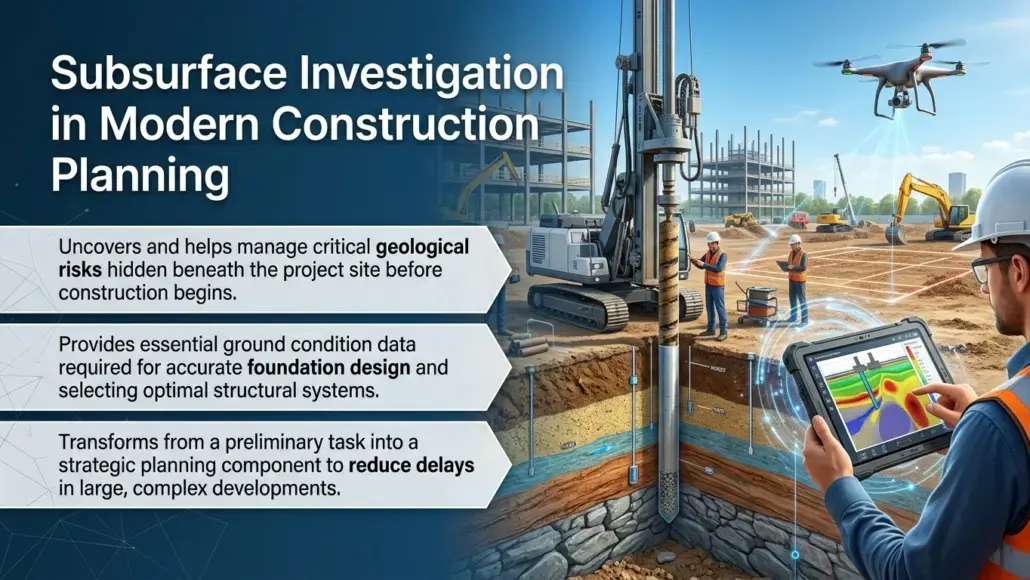


Every construction project begins above ground, but many of its most important risks exist below the surface. Before foundations are designed, structural systems are selected, or construction activities commence, project teams must understand the ground conditions that will support the development.
Despite its importance, subsurface analysis is often viewed as a preliminary activity rather than a strategic component of project planning. However, as projects become larger, more complex, and more technically demanding, the role of subsurface investigation is becoming increasingly significant.
From commercial developments and transportation infrastructure to industrial facilities and high-rise buildings, the quality of information gathered beneath the surface can influence virtually every stage of project delivery.
Why Ground Conditions Matter More Than Ever
Modern construction projects face increasing pressure to control costs, manage risk, and deliver predictable outcomes. Achieving these objectives requires a thorough understanding of site conditions before construction begins.
Ground characteristics can influence:
- Foundation design
- Structural requirements
- Excavation strategies
- Construction schedules
- Project costs
When subsurface conditions are poorly understood, projects can encounter unexpected challenges that affect both timelines and budgets. As a result, subsurface investigation has become a critical tool for reducing uncertainty during project planning.
The objective is not simply gathering data but generating insights that enable better decision-making.
Reducing Risk Before Construction Starts
One of the primary benefits of subsurface investigation is risk reduction.
Unexpected soil conditions, groundwater issues, buried obstructions, or geotechnical anomalies can create significant challenges once construction activities are underway. These issues often result in redesigns, delays, cost overruns, and contractual disputes.
By identifying potential risks early, project teams can develop strategies to address them before they become operational problems.
This proactive approach is increasingly important in an industry where project margins are often tight and schedule delays can have substantial financial consequences.
Improving Foundation Design Decisions
Foundation systems serve as the critical link between a structure and the ground supporting it. Their effectiveness depends heavily on accurate information regarding soil and subsurface conditions.
Subsurface investigation provides engineers with the data needed to determine appropriate foundation solutions for specific site conditions. Whether a project requires shallow foundations, deep foundations, piles, or specialized ground improvement techniques, informed decision-making begins with understanding what lies beneath the surface.
Accurate geotechnical information can also help avoid overdesign, ensuring that foundation systems are both technically appropriate and economically efficient.
Supporting Better Project Planning
Construction planning involves numerous assumptions regarding site conditions and constructability. The more accurate these assumptions are, the greater the likelihood of successful project delivery.
Subsurface investigations contribute to planning by providing information that influences:
- Earthworks requirements
- Excavation methods
- Equipment selection
- Construction sequencing
- Site logistics
This knowledge allows project teams to make more informed decisions during early project stages, reducing the likelihood of unexpected disruptions later in the construction process.
As projects become more complex, the value of early site intelligence continues to grow.
Managing Cost Uncertainty
Cost predictability remains a major concern across the construction sector. Many project overruns can be traced back to unforeseen site conditions that were not fully understood during planning and design phases.
Investing in subsurface investigation can help reduce these uncertainties by providing a clearer picture of site-related risks and requirements.
While investigation activities represent an upfront project cost, they often contribute to better budget accuracy and reduced contingency requirements over the project lifecycle.
For developers, contractors, and project owners, improved certainty can support stronger financial planning and risk management outcomes.
The Growing Importance of Urban Construction
Urban development is increasing the complexity of subsurface conditions encountered by construction teams.
Projects in densely developed environments frequently involve:
- Existing underground infrastructure
- Historical construction activities
- Variable soil conditions
- Utility congestion
- Groundwater management challenges
These factors make detailed subsurface investigations increasingly important for project success.
As cities continue to grow and available development sites become more constrained, understanding underground conditions is becoming a key competitive advantage for project teams.
Technology Is Changing Site Investigation
Advances in geotechnical and site investigation technologies are improving the quality and accessibility of subsurface information.
Modern tools enable project teams to collect and analyze data with greater accuracy than ever before. Digital mapping, advanced geophysical techniques, remote sensing technologies, and data visualization platforms are helping transform how underground conditions are assessed.
These innovations are making subsurface investigation more efficient while improving the quality of information available to engineers and construction planners.
As digital technologies continue to evolve, site investigation is becoming increasingly integrated into broader construction planning workflows.
Subsurface Data as a Strategic Asset
The construction industry is placing greater emphasis on data-driven decision-making, and subsurface information is becoming part of this trend.
Rather than treating geotechnical data as a standalone engineering requirement, organizations are increasingly viewing it as a strategic asset capable of informing multiple project decisions.
Subsurface information can influence:
- Design development
- Risk management
- Procurement strategies
- Construction execution
- Long-term asset performance
This broader perspective is elevating the role of geotechnical investigation within modern project delivery frameworks.
Challenges and Limitations
Despite its benefits, subsurface investigation is not without challenges.
Ground conditions can vary significantly across a site, making complete certainty difficult to achieve. Investigation programs must balance cost, time, and information requirements while delivering meaningful insights.
Additional challenges include:
- Access constraints
- Data interpretation complexity
- Variable site conditions
- Project schedule pressures
- Regulatory requirements
These factors highlight the importance of integrating site investigation into overall project strategy rather than treating it as a standalone activity.
The Future of Construction Planning Starts Below Ground
As construction projects become more sophisticated, the need for accurate site intelligence will continue to increase.
Developers, contractors, and engineers are recognizing that many project risks originate below the surface long before visible construction begins. Addressing these risks requires a deeper understanding of subsurface conditions and a greater commitment to informed planning.
Subsurface investigation provides the foundation for this approach by helping project teams reduce uncertainty, improve design decisions, and enhance project outcomes.
Conclusion
Successful construction projects depend on far more than what is built above ground. The conditions beneath a site influence structural performance, construction methods, project costs, and long-term asset reliability.
Subsurface investigation is becoming an increasingly important component of modern construction planning because it enables project teams to make better-informed decisions before significant resources are committed. By improving risk management, supporting foundation design, and enhancing project certainty, it helps create a stronger foundation for successful project delivery.
As the construction industry continues to prioritize efficiency, predictability, and resilience, understanding the ground below will remain one of the most valuable investments a project team can make.