


























For decades, structural engineering has relied heavily on prescriptive design methods. Building codes and standards established minimum requirements for materials, dimensions, and construction practices, providing engineers with a framework for ensuring safety and compliance. While these approaches remain fundamental to modern construction, the increasing complexity of buildings and infrastructure is driving demand for more flexible design strategies.
Today, project stakeholders are seeking structures that not only meet regulatory requirements but also perform effectively under a wide range of real-world conditions. This shift is accelerating the adoption of performance-based structural design, an engineering approach that focuses on how a structure is expected to behave throughout its lifecycle rather than simply ensuring compliance with predefined rules.
As construction projects become larger, taller, and more sophisticated, performance-based thinking is becoming increasingly relevant across the built environment.
What Makes Performance-Based Design Different
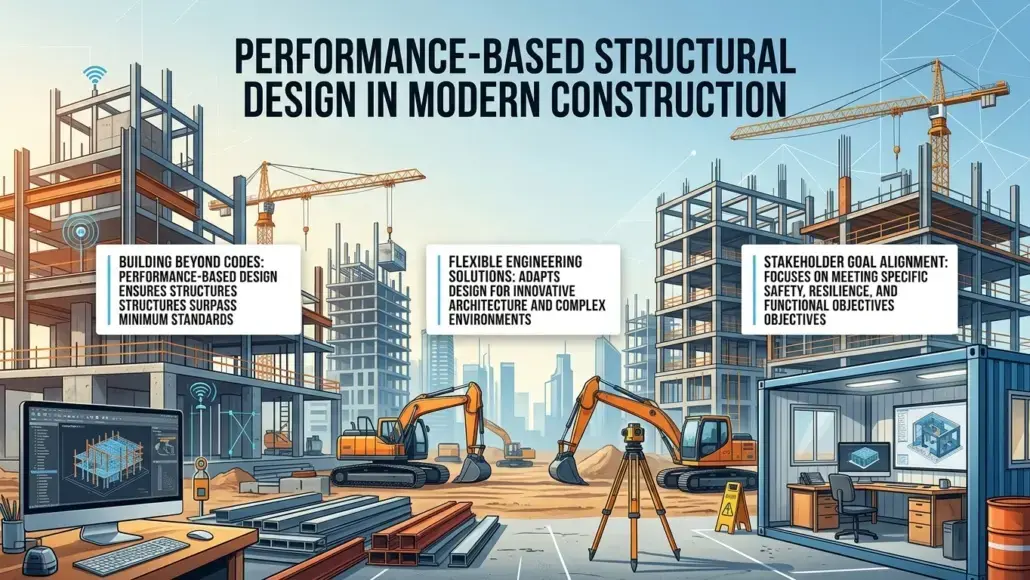
Traditional structural design methods often prescribe how buildings should be designed and constructed. Performance-based approaches, by contrast, begin with the desired outcome.
Instead of asking whether a design complies with a specific requirement, engineers ask how a structure will perform under different conditions such as wind events, seismic activity, heavy loads, or long-term operational stresses.
This allows project teams to establish measurable performance objectives and evaluate whether a building can meet those expectations throughout its service life.
As a result, performance-based structural design provides engineers with greater flexibility while maintaining a strong focus on safety and reliability.
Addressing the Demands of Modern Construction
Modern construction projects present challenges that were less common in previous generations. Urban density is increasing, building forms are becoming more complex, and project owners are demanding greater efficiency from every square meter of built space.
These trends are pushing structural systems beyond conventional design assumptions.
Performance-based approaches enable engineers to analyze how structures behave under realistic operating conditions rather than relying solely on standardized design scenarios. This can provide a more accurate understanding of structural behavior while supporting innovative architectural and engineering solutions.
For projects involving high-rise buildings, long-span structures, mixed-use developments, and critical infrastructure, this level of analysis is becoming increasingly valuable.
Improving Resilience Through Better Understanding
Resilience has become a central objective in modern construction. Buildings are expected not only to remain safe during extreme events but also to recover quickly and maintain functionality whenever possible.
Performance-based structural design supports this objective by allowing engineers to evaluate how structures respond to specific hazards and operational demands.
Rather than designing solely to prevent collapse, performance-based methods can help establish different levels of acceptable performance. These may include maintaining operational continuity, limiting structural damage, or reducing repair requirements following an extreme event.
This broader understanding of resilience is becoming increasingly important as project owners seek to protect long-term asset value.
Supporting More Efficient Structural Systems
Efficiency remains a key priority across the construction industry. Developers and contractors continuously seek opportunities to optimize material use, reduce costs, and improve project delivery outcomes.
Performance-based design can contribute to these objectives by enabling engineers to develop structural solutions tailored to project-specific requirements.
By focusing on actual performance rather than conservative prescriptive assumptions, engineers may identify opportunities to achieve the same or better outcomes with more efficient structural systems.
This approach can support:
- Material optimization
- Improved constructability
- Reduced structural weight
- Enhanced design flexibility
The result is often a more balanced relationship between performance, cost, and project objectives.
Enabling Architectural Innovation
Modern architecture increasingly challenges conventional engineering boundaries. Complex geometries, large open spaces, and unconventional building forms require structural systems capable of delivering both performance and design freedom.
Prescriptive approaches can sometimes limit these possibilities by imposing rigid requirements that may not align with innovative project concepts.
Performance-based structural design provides an alternative by allowing engineers to demonstrate that a structure can meet defined performance targets through detailed analysis and modeling.
This flexibility enables closer collaboration between architects and engineers while supporting more ambitious design solutions.
As iconic and technically demanding projects become more common, performance-based approaches are helping bridge the gap between creativity and structural reliability.
Technology Is Accelerating Adoption
Advances in digital engineering tools are playing a major role in the growth of performance-based design.
Modern modeling software, simulation platforms, and computational analysis tools allow engineers to evaluate structural behavior with far greater accuracy than was previously possible.
These technologies enable detailed assessments of:
- Load distribution
- Structural response
- Material behavior
- Environmental influences
- Dynamic performance
The availability of sophisticated analytical tools is making performance-based structural design more accessible and practical across a wider range of construction projects.
As computational capabilities continue to improve, adoption is expected to accelerate further.
Challenges in Implementation
Despite its advantages, performance-based design introduces additional complexity into the engineering process.
Developing and validating performance objectives requires extensive analysis, specialized expertise, and detailed collaboration among project stakeholders. This can increase design effort and extend planning phases compared with traditional approaches.
Other challenges include:
- Regulatory acceptance
- Performance verification requirements
- Increased modeling complexity
- Specialized technical expertise
- Project stakeholder alignment
These factors can create barriers to adoption, particularly in projects where schedules and budgets are tightly constrained.
However, as industry experience grows and regulatory frameworks evolve, many of these challenges are becoming easier to address.
A Shift Toward Lifecycle Performance
One of the most significant benefits of performance-based structural design is its alignment with lifecycle thinking.
Construction stakeholders are increasingly evaluating projects based not only on initial costs but also on long-term performance, maintenance requirements, operational continuity, and asset resilience.
Performance-based approaches support this shift by helping project teams understand how structures are likely to behave over extended periods and under varying conditions.
This perspective is becoming increasingly important as developers, owners, and investors seek greater certainty regarding long-term asset value.
The Future of Structural Engineering
The construction industry is moving toward a future where buildings are expected to deliver higher levels of performance, adaptability, and resilience than ever before.
Meeting these expectations will require engineering approaches capable of addressing increasingly complex project requirements. Performance-based design offers a pathway toward this future by focusing on outcomes rather than prescriptive limitations.
As technology, analytical capabilities, and industry standards continue to evolve, performance-based structural design is likely to play an increasingly important role in shaping the next generation of construction projects.
Conclusion
Modern construction demands structures that are safe, efficient, resilient, and capable of supporting evolving operational requirements. Traditional design methods remain valuable, but they are increasingly being complemented by approaches that provide deeper insight into real-world structural behavior.
Performance-based structural design is helping engineers meet these expectations by focusing on measurable outcomes and lifecycle performance. Through improved analysis, greater design flexibility, and a stronger emphasis on resilience, it is reshaping how structural systems are conceived and delivered.
As construction projects continue to grow in complexity, performance-based thinking is set to become an increasingly important part of modern structural engineering practice.