














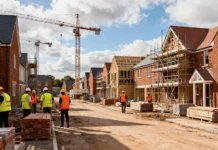







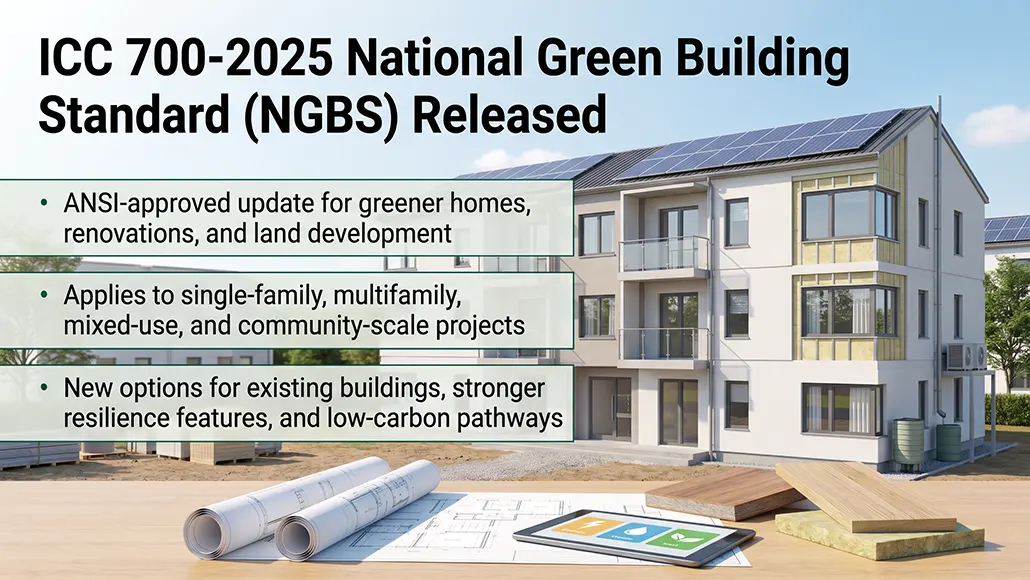


The National Association of Home Builders (NAHB) and the International Code Council (ICC) have introduced the ICC 700-2025 National Green Building Standard (NGBS), marking the fifth edition of the country’s primary framework for sustainable residential construction. Approved by the American National Standards Institute (ANSI), the updated standard continues to serve as a nationwide reference point for environmentally responsible building, renovation and land development practices. The National Green Building Standard maintains its role in guiding sustainability benchmarks across a wide spectrum of residential projects in the United States.
Formulated through a consensus-driven process involving diverse industry stakeholders, the 2025 NGBS incorporates current advancements in green design, construction methodologies and building performance. Its scope extends across single-family housing, multifamily developments, mixed-use properties and land development projects, ensuring broad applicability across residential construction segments. According to Bill Owens, “The 2025 NGBS represents nearly two decades of progress and innovation in sustainable residential construction and remodeling,” adding, “This edition expands the possibilities for high-performance, resilient and low-carbon homes that meet the evolving needs of both the housing industry and homeowners.”
ICC Chief Executive Officer John Belcik stated, “We are committed to continually advancing codes and standards,” and added, “Together, with NAHB, we are proud to introduce this updated standard for high-performance buildings, which is an achievement born from a longstanding, collaborative relationship.” The National Green Building Standard continues to emphasize performance across six core categories: lot design and development, resource efficiency, energy efficiency, water efficiency, indoor environmental quality, and operational practices including maintenance and homeowner education. Certification remains tiered Certified, Bronze, Silver, Gold and Emerald allowing stakeholders to align sustainability outcomes with project objectives.
The 2025 edition introduces expanded pathways and updated provisions reflecting evolving industry priorities. These include a new certification route for existing multifamily and mixed-use developments with multiple structures, strengthened resilience measures aimed at improving disaster preparedness and post-event habitation, and new frameworks supporting low-carbon building strategies. Additional updates include alternative energy efficiency compliance pathways and a significantly revised chapter addressing existing buildings with more adaptable compliance options. NAHB and ICC stated that the revised standard reinforces their ongoing commitment to enabling flexible, cost-effective and regionally adaptable approaches to sustainable residential construction.