


















The foundation of human civilization has always been the materials we use to shelter ourselves and connect our communities. From the sun-dried bricks of Mesopotamia to the steel-and-glass towers of the 20th century, every era is defined by its building blocks. Today, we are entering a new epoch where advanced building materials are no longer just passive structural components but active participants in the performance and sustainability of our built environment. My fifteen years in the construction sector have taught me that the most significant breakthroughs are not always the largest machines, but often the invisible properties within the very substances we pour, stack, and join. These innovations are being driven by a twin mandate: the need for extreme durability in a changing climate and the urgent requirement to reduce the carbon footprint of the construction industry.
The development of high-performance materials is shifting the boundaries of what is architecturally possible. We are seeing a move away from standard concrete and steel toward composite materials that offer superior strength-to-weight ratios. Carbon fiber-reinforced polymers and ultra-high-performance concrete (UHPC) are allowing for longer bridge spans and thinner, more elegant structural members. These materials do not just provide aesthetic freedom; they also reduce the total volume of material required for a project, which in turn lowers transportation costs and the energy used in the fabrication process.
The Evolution of Self-Healing Concrete
One of the most remarkable advancements in recent years is the rise of self-healing concrete. Traditionally, concrete is prone to micro-cracks that allow water and salt to penetrate the structure, leading to the corrosion of steel reinforcement and eventual structural failure. Advanced building materials now include “bioconcrete,” which contains dormant bacteria and a nutrient source embedded in the mix. When a crack forms and water enters, the bacteria activate and produce limestone, effectively sealing the crack from the inside. This biological response drastically extends the service life of infrastructure, reducing the need for expensive and disruptive maintenance cycles over the decades.
High-Performance Polymeric Composites
In addition to self-healing properties, we are seeing the integration of polymeric composites that mimic the resilience of natural structures. These materials are being used in everything from facade panels to structural beams. Unlike traditional metals, these composites are immune to rust and chemical corrosion, making them ideal for coastal environments or industrial zones. The versatility of these advanced building materials allows engineers to design for specific stress patterns, placing strength exactly where it is needed and minimizing waste. This precision is a hallmark of modern construction, where efficiency and longevity are paramount.
Nanomaterials and Structural Integrity
At the microscopic level, the introduction of nanomaterials like graphene is revolutionizing our understanding of structural integrity. By adding even a small percentage of graphene to concrete or asphalt, we can significantly increase its tensile strength and thermal conductivity. This results in roads that are more resistant to heavy loads and temperature fluctuations, reducing the frequency of potholes and surface degradation. As these nanomaterials become more commercially viable, they will likely become a standard additive, ensuring that our infrastructure can withstand the increasing demands of modern transport systems.
Sustainability Through Carbon-Capturing Materials
The construction industry is one of the largest contributors to global carbon emissions, primarily due to the production of cement. To address this, a new generation of carbon-negative materials is emerging. Some manufacturers have developed bricks and blocks that actually absorb CO2 during their curing process, effectively turning the building into a carbon sink. These advanced building materials represent a fundamental shift in how we view construction’s relationship with the environment. Instead of being a source of pollution, the act of building can now become part of the solution to climate change.
The Return of Engineered Timber
While we often focus on synthetic innovations, one of the most exciting advanced building materials is actually a refined version of one of our oldest: wood. Mass timber, specifically cross-laminated timber (CLT), is now being used to construct mid-rise and even high-rise buildings. These engineered wood products have a strength comparable to steel but are far lighter and possess excellent fire resistance due to their charring properties. More importantly, timber sequestered carbon as it grew, and using it in construction keeps that carbon locked away for the life of the building. This “new-old” material is proving that high-tech performance and environmental responsibility can go hand-in-hand.
Transparent Wood and Smart Glazing
The evolution of materials also extends to the transparent elements of our buildings. Researchers have developed “transparent wood,” which is created by removing lignin and replacing it with a specialized polymer. This material is stronger than glass and provides better thermal insulation, potentially replacing traditional windows in some applications. Furthermore, smart glazing technologies which can change their opacity or heat-reflective properties in response to an electrical charge or sunlight intensity are becoming more sophisticated. These systems allow buildings to regulate their own temperature, significantly reducing the energy required for heating and cooling.
Innovative Insulation and Thermal Mass
The efficiency of a modern building is largely determined by its thermal envelope. Advanced insulation materials, such as aerogels and vacuum insulation panels, provide incredible thermal resistance in a fraction of the thickness of traditional fiberglass or foam. This allows for more usable interior space without sacrificing energy performance. Additionally, phase-change materials (PCMs) are being integrated into drywall and plaster. These materials absorb heat during the day as they melt and release it at night as they solidify, acting as a thermal battery that levels out temperature fluctuations.
3D Printing and Modular Material Use
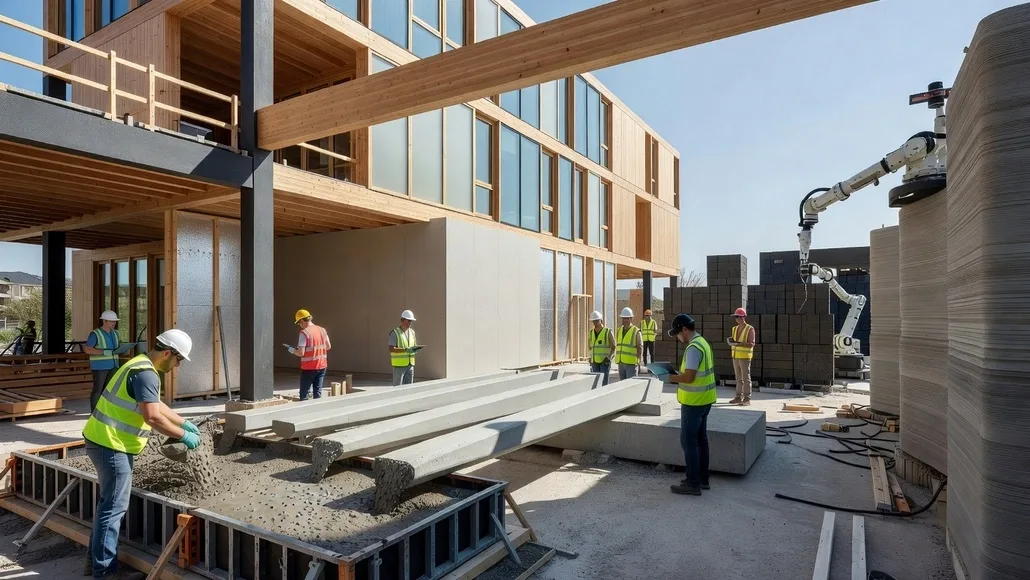
The rise of 3D printing in construction has necessitated the development of specialized “inks” concrete mixes that can be extruded layer-by-layer without collapsing. These advanced building materials must have specific rheological properties, being fluid enough to pump but firm enough to set quickly. The use of 3D printing allows for complex geometries that would be impossible or prohibitively expensive to create with traditional formwork. This technology also minimizes material waste by placing substance only where the structural analysis dictates, a perfect marriage of digital design and advanced material science.
Recycled and Upcycled Components
Finally, the concept of a circular economy is driving the use of recycled materials in high-performance applications. We are now seeing glass-reinforced concrete made from recycled bottles and asphalt containing shredded plastic waste. These are not just “green” alternatives; they often perform better than the virgin materials they replace. For example, plastic-modified asphalt is often more flexible and less prone to cracking. By turning waste streams into high-value construction assets, we are closing the loop and ensuring that the future of building is as sustainable as it is technologically advanced.
The rapid pace of innovation in material science is providing us with a toolkit that would have seemed like science fiction just two decades ago. As an industry, our challenge is to move these advanced building materials from the laboratory to the job site as quickly as possible. The initial cost may be higher, but the long-term value measured in reduced maintenance, lower energy bills, and a healthier planet is undeniable. We are no longer just building for today; we are crafting a legacy of resilient, intelligent, and sustainable structures for the generations to come.