



























Key Takeaways:
- Leveraging smart construction equipment productivity allows contractors to move beyond manual oversight and adopt a more streamlined, data-driven approach to earthmoving and site preparation. By utilizing construction equipment automation and digital construction tools, firms can minimize human error, reduce fuel consumption, and ensure that every machine on the jobsite is operating at its maximum potential, directly contributing to faster project completion times.
- The adoption of connected equipment and smart machinery creates a seamless flow of information between the field and the office, enabling real-time adjustments to project schedules and resource allocation. This level of jobsite productivity is further enhanced by advanced sensors that monitor machine health and performance, preventing unexpected breakdowns and ensuring that the entire fleet remains a cohesive, efficient unit throughout the construction lifecycle.
Smart Construction Equipment Driving Jobsite Productivity
The global landscape of infrastructure development is undergoing a silent but powerful revolution. For decades, the construction industry was often viewed as a laggard in the digital race, characterized by its reliance on manual labor, physical blueprints, and the raw power of unassisted machinery. However, the dawn of the Fourth Industrial Revolution has brought with it a suite of technologies that are fundamentally changing the DNA of the modern jobsite. At the heart of this transformation is the rise of smart construction equipment productivity, a concept that marries heavy iron with high-tech software to create a more efficient, safer, and more predictable building environment.
The Evolution from Passive Tools to Intelligent Assets
The shift from traditional machinery to smart machinery is not merely about adding a few sensors; it is about a total reimagining of how equipment interacts with its environment. In the past, an excavator or a dozer was a passive tool that responded only to the inputs of its operator. Today, these machines are intelligent assets capable of perceiving their surroundings, analyzing tasks, and even making micro-adjustments to improve performance. This transition is driven by the integration of Global Navigation Satellite Systems (GNSS), Inertial Measurement Units (IMUs), and complex algorithms that process data at lightning speeds.
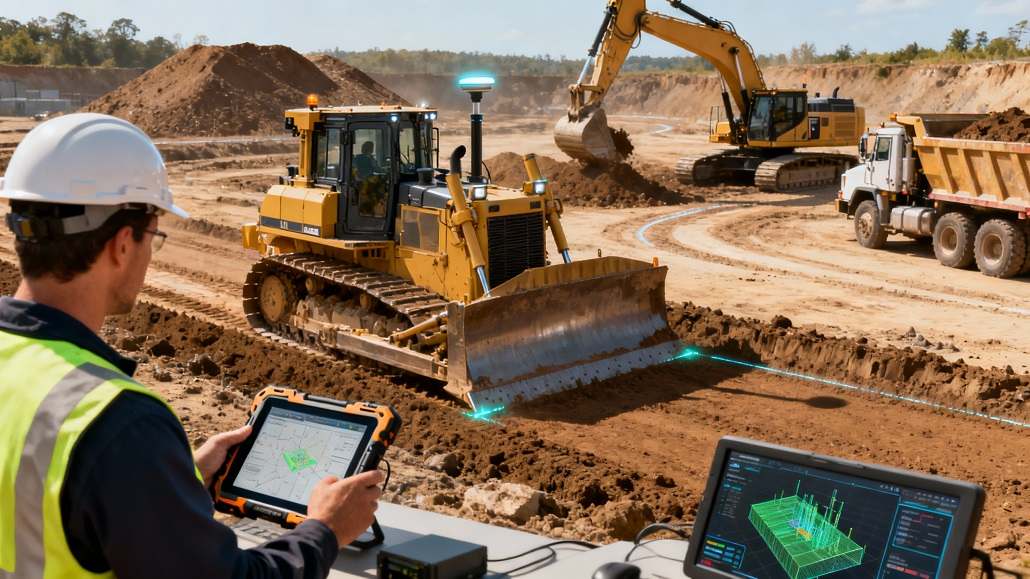
When we speak of construction equipment automation, we are referring to systems that can handle repetitive, high-precision tasks with a level of consistency that human operators simply cannot match. For instance, an automated grading system on a dozer can maintain a blade at the exact angle and depth required by a digital 3D model, regardless of the terrain or the operator’s fatigue level. This ensures that the job is done correctly the first time, eliminating the need for rework—a traditional bottleneck that has plagued jobsite productivity for generations.
Digital Construction Tools and the Power of Connectivity
The true potential of smart machinery is realized when individual units are linked together into a cohesive network of connected equipment. This connectivity is the cornerstone of the modern digital jobsite. When every machine can transmit its location, fuel consumption, load weight, and operational status to a central management hub, the result is a level of transparency that was previously impossible. Project managers can see a “live” view of their entire fleet, allowing them to identify underutilized assets and reassign them to critical areas of the project in real-time.
Digital construction tools, such as cloud-based fleet management platforms, act as the brain of the operation. These platforms analyze the massive amounts of data generated by smart construction equipment productivity metrics to provide actionable insights. For example, if the data shows that several haul trucks are consistently waiting ten minutes for a loader, the system can recommend adding another loader or adjusting the truck routes to eliminate the bottleneck. This optimization of workflow is where the most significant gains in jobsite productivity are found.
The Economic Impact of Smart Machinery on Construction ROI
While the initial investment in smart machinery and the associated digital construction tools can be higher than that for legacy equipment, the return on investment (ROI) is compelling. The savings are multifaceted. First, there is the direct reduction in labor costs. Automation allows a single operator to do the work that previously required a team of surveyors and grade checkers. Second, there is the massive saving in fuel and wear-and-tear. Because the machines work more efficiently and complete their tasks in fewer passes, they burn less diesel and require less frequent maintenance.
Furthermore, construction equipment automation plays a vital role in bidding and project planning. Contractors who utilize these technologies have a much higher degree of certainty regarding their timelines and material usage. In a competitive bidding environment, the ability to offer a more accurate quote with a guaranteed completion date is a massive competitive advantage. It moves the conversation from “how much will it cost?” to “how efficiently can it be delivered?”
Human-Machine Synergy: The Changing Role of the Operator
One of the most humanized aspects of the shift toward smart construction equipment productivity is how it affects the workforce. There is a common misconception that automation is designed to replace people. In reality, it is about augmenting human capability. By taking over the tedious, repetitive, and physically demanding aspects of the work, smart machinery allows operators to focus on higher-level decision-making and project management.
The operators of the future are becoming “machine managers.” They oversee the automated systems, intervene when complex situations arise, and use the data provided by digital construction tools to optimize their performance. This shift is also making the industry more attractive to a younger, tech-savvy generation. By turning the cab into a high-tech workspace, the industry is solving its chronic labor shortage and ensuring that it has the talent required to build the infrastructure of tomorrow.
Environmental Stewardship Through Efficiency
Productivity and sustainability are often viewed as opposing forces, but in the realm of smart construction equipment productivity, they are perfectly aligned. Efficiency is the most direct path to a lower carbon footprint. By reducing idle time, optimizing routes, and eliminating rework, smart machinery significantly lowers the total emissions of a construction project.
Moreover, the data captured by these systems allows for more accurate reporting on environmental impact. As government regulations around the world tighten, the ability to provide documented proof of efficient resource usage is becoming a prerequisite for winning major infrastructure contracts. Smart machinery is not just a tool for building faster; it is a tool for building better and more responsibly.
Future Horizons: Artificial Intelligence and Autonomous Fleets
As we look toward the future, the integration of Artificial Intelligence (AI) will take construction equipment automation to the next level. We are already seeing the first generation of fully autonomous haul trucks operating in mining environments, and it is only a matter of time before this technology becomes standard on civil engineering jobsites. AI will allow machines to learn from their environment, predicting site conditions and adjusting their behavior without any human intervention.
The dream of a fully autonomous, 24/7 jobsite is moving closer to reality. In this future, smart construction equipment productivity will be measured not just by how much earth is moved in an hour, but by the seamless, silent, and highly efficient operation of a fully connected fleet. The foundations we are laying today with digital construction tools are the first steps toward a more resilient and sustainable built world.
Conclusion: Embracing the Digital Build
The transition to a technology-driven construction industry is no longer optional. As project complexities increase and timelines shorten, the reliance on smart construction equipment productivity will become the industry standard. By embracing construction equipment automation and the full suite of digital construction tools, the sector is proving that it can evolve to meet the demands of the 21st century. The machines are getting smarter, the jobsites are getting more productive, and the future of construction has never looked more promising.