


























Key Takeaways:
- The accelerating electrification trends in construction are primarily fueled by a shift toward electric construction equipment that offers zero emission operation and near-silent performance. This transition is particularly beneficial for urban projects where noise ordinances and air quality regulations are becoming increasingly strict, allowing sustainable construction fleets to operate in sensitive areas without the environmental and social disruptions of traditional diesel engines.
- Investing in battery powered machinery is not just a commitment to sustainability but a strategic move toward lowering long-term operational costs and improving energy efficiency. By embracing construction equipment electrification, fleet owners can benefit from significantly reduced maintenance requirements and more precise power control, ensuring that their assets remain competitive in a rapidly evolving market that prioritizes green building practices.
Electrification Trends Shaping Construction Equipment Fleets
The heavy equipment industry is in the midst of its most significant transformation since the invention of the hydraulic pump. For over a century, the diesel engine has been the undisputed king of the jobsite, providing the high torque and reliable power needed to move mountains of earth and build the world’s infrastructure. However, the king’s reign is being challenged. A confluence of technological breakthroughs, environmental necessity, and economic logic has sparked a powerful movement toward construction equipment electrification. From compact mini excavators to massive haul trucks, the industry is moving toward a future that is quiet, clean, and powered by the electron.
The Drivers of the Electric Surge
Why is this shift happening now? The answer lies in the dramatic maturation of battery technology and the changing regulatory landscape. For a long time, the weight and cost of batteries made electric construction equipment impractical for anything beyond light tools. Today, the energy density of lithium-ion cells has reached a point where it can support the grueling duty cycles of heavy machinery. Simultaneously, the “total cost of ownership” (TCO) for battery powered machinery is becoming increasingly attractive as fuel prices fluctuate and electricity costs stabilize.
On the regulatory front, the world’s major cities are taking a stand against local pollution. Cities like London, New York, and Paris are implementing ultra-low emission zones that make it increasingly difficult and expensive to operate older diesel machinery. For contractors looking to win projects in these lucrative urban markets, the transition to zero emission equipment is no longer a moral choice; it is a business imperative. Sustainable construction fleets are the new ticket to entry for the urban infrastructure market.
The Operational Benefits of Battery Powered Machinery
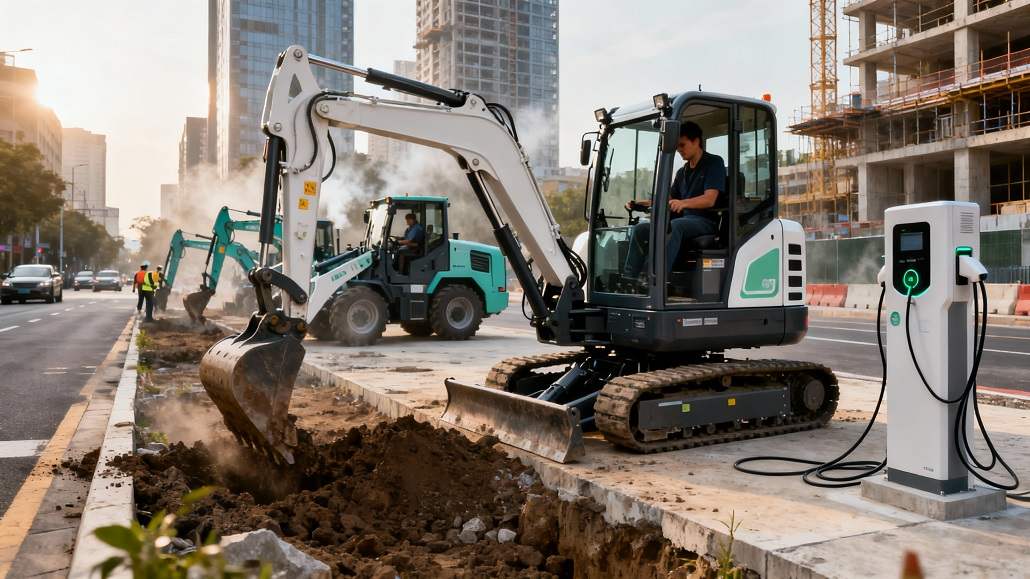
The move toward construction equipment electrification offers benefits that go far beyond a lower carbon footprint. One of the most immediate and profound impacts is on noise pollution. Traditional diesel engines are incredibly loud, often reaching levels that are hazardous to worker hearing and disruptive to the surrounding community. Electric construction equipment operates with a soft hum, often so quiet that the sound of the hydraulics or the bucket hitting the ground is louder than the power source.
This “silent” operation allows for a radical rethink of jobsite logistics. Contractors can start work earlier in the morning and continue later into the night without violating noise ordinances, effectively extending the working day and shortening project timelines. Furthermore, the lack of exhaust fumes makes these machines ideal for indoor demolition, tunnel work, and other confined spaces where ventilation would otherwise be a massive and expensive challenge. In these environments, battery powered machinery is a gamechanger for both safety and productivity.
Mechanical Simplicity and Reduced Maintenance
One of the strongest economic arguments for electric construction equipment is its mechanical simplicity. A traditional diesel engine is a complex system of thousands of moving parts pistons, valves, injectors, turbos all of which require regular oil changes, filter replacements, and cooling system maintenance. In contrast, an electric motor has only one primary moving part. There are no oil changes, no fuel filters, and no exhaust after-treatment systems like DPF or SCR to worry about.
This reduction in complexity translates directly into lower maintenance costs and higher uptime for sustainable construction fleets. Data from early adopters suggests that maintenance costs for electric units can be as much as 50% lower than their diesel counterparts. Over the 10,000-hour life of a machine, these savings can more than offset the higher initial purchase price of the battery. Furthermore, electric motors provide instant torque, which can lead to better machine responsiveness and precision, allowing operators to complete tasks with greater finesse.
Overcoming the Infrastructure Hurdle: Charging and Energy Management
Despite the clear benefits, the transition to construction equipment electrification is not without its challenges. The most significant hurdle is “range anxiety” and the need for a robust charging infrastructure. Unlike a diesel machine that can be refueled in five minutes by a mobile fuel truck, electric construction equipment requires a reliable source of power and time to recharge. On a remote jobsite without a grid connection, this becomes a major logistical puzzle.
The industry is responding with a variety of innovative solutions. We are seeing the rise of mobile “energy hubs” large battery containers that can be charged off-site and then dropped at the jobsite to act as a mobile gas station for electric machinery. Some manufacturers are also exploring “tethered” systems for machines that stay in one place (like large excavators), or interchangeable battery packs that can be swapped in minutes. The key to successful construction equipment electrification is not just the machine itself, but the entire energy ecosystem that supports it.
The Path Toward Zero Emission Equipment Fleets
As the technology continues to scale, we are seeing the electrification trends move up the weight classes. While the movement started with mini excavators and compact loaders, we now see manufacturers unveiling electric mid-sized excavators and even battery-powered articulated haulers. The heavy-duty sector is also exploring hybrid systems and hydrogen fuel cells as a way to provide zero emission equipment for the most demanding 24/7 applications where battery weight becomes prohibitive.
This transition is fostering a new level of collaboration between equipment manufacturers, energy providers, and software developers. Managing a fleet of electric machines requires sophisticated energy management software that can predict energy needs, optimize charging schedules to take advantage of low-cost power, and ensure that the project is never delayed by an empty battery. The sustainable construction fleets of the future will be as much about power management as they are about earthmoving.
The Human Side of Electrification
The shift toward electric construction equipment also has a profoundly positive impact on the health and well-being of the workforce. Operators and ground workers spend their days in a much cleaner environment, free from the constant vibration and toxic exhaust of diesel engines. This improvement in air quality and physical comfort leads to lower stress, less fatigue, and a generally safer jobsite.
Furthermore, the “high-tech” nature of battery powered machinery is helping to change the image of the construction industry. It is becoming an industry that is perceived as innovative and forward-thinking, making it easier to attract the next generation of engineers and operators. By embracing construction equipment electrification, the sector is not only building a cleaner world; it is building a more sustainable and attractive career path for its people.
Conclusion: The Future is Electric
The momentum behind construction equipment electrification is now unstoppable. As battery costs continue to fall and environmental regulations continue to tighten, the logic for electric construction equipment will become the default choice for the majority of urban and infrastructure projects. The transition is about more than just a change in fuel; it is a fundamental upgrade to the efficiency, cleanliness, and professionalism of the entire industry. By leading the charge toward sustainable construction fleets, contractors and manufacturers are ensuring that the building trade is ready for the challenges of the 21st century. The jobsite of the future will be defined by its silence and its power and it will be powered by the electron.