


























Close
WORLD OF CONCRETE
Sunday, December 14, 2025
JEC WORLD 2026

JCB develops construction’s first hydrogen-fuelled excavator

Note* - All images used are for editorial and illustrative purposes only and may not originate from the original news provider or associated company.

Subscribe

- Never miss a story with notifications

- Gain full access to our premium content

- Browse free from any location or device.

Media Packs

Expand Your Reach With Our Customized Solutions Empowering Your Campaigns To Maximize Your Reach & Drive Real Results!

– Access the Media Pack Now

– Book a Conference Call

Leave Message for Us to Get Back

Related stories

Material Flow Engineering Transforming the Efficiency of Modular Production

Engineering methods optimize internal material movement, workstation layout, and production sequencing in prefab factories. Improved flow reduces cycle time, minimizes inventory buildup, and supports lean manufacturing principles throughout production.

Digital Supply Chain Visibility Becoming Essential for Offsite Project Success

Digital dashboards, IoT tracking, RFID tagging, and real-time monitoring improve supply chain transparency. Visibility enables proactive decision-making, reduces disruptions, and keeps all stakeholders informed throughout prefab project lifecycles.

Machine Learning Powered Quality Control for High-Accuracy Prefabrication

Key Takeaways AI-powered visual inspection systems achieve 96-99% defect...
- Advertisement -
Achema Middleeast

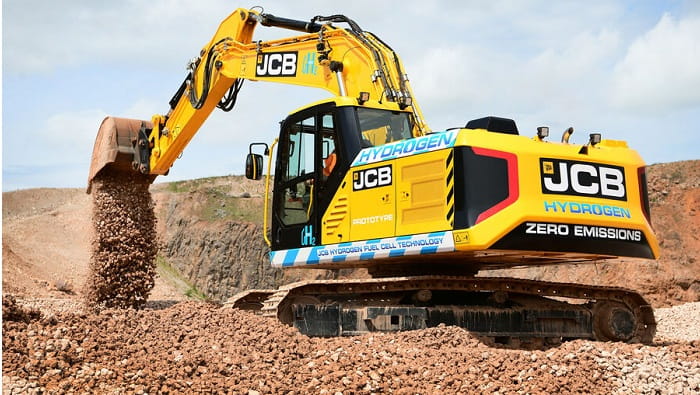
JCB has developed the construction industry’s first hydrogen-powered excavator as it continues to lead the sector on zero and low carbon technologies.

The 20t 220X excavator – powered by a hydrogen fuel cell – has been undergoing rigorous testing at JCB’s quarry proving grounds for over 12 months. The development means the firm is the first construction equipment company to unveil a working prototype of a hydrogen-powered excavator.

JCB chairman Lord Bamford described the development as “very exciting”.

He added: “In the coming months, JCB will continue to develop and refine this technology with advanced testing of our prototype machine and we will continue to be at the forefront of technologies designed to build a zero carbon future.”

Power for JCB’s prototype excavator is generated by reacting hydrogen with oxygen in a fuel cell to create the energy needed to run electric motors. The only emission from the exhaust is water.

Last year JCB went into full production with the construction industry’s first fully electric mini excavator, the 19C-1E. JCB has also extended electric technology to its innovative Teletruk telescopic forklift range with the launch of an electric model, the JCB 30-19E.

The firm has also been leading the way on clean diesel technology to meet Stage V EU emissions regulations and has almost eradicated the most harmful emissions from its latest range of diesel engines. Nitrous Oxide (NOx) is down 97%, soot particulates down by 98% and Carbon Dioxide (CO2) emissions down by almost half.

Achema Middleeast

Latest stories

Related stories

Material Flow Engineering Transforming the Efficiency of Modular Production

Engineering methods optimize internal material movement, workstation layout, and production sequencing in prefab factories. Improved flow reduces cycle time, minimizes inventory buildup, and supports lean manufacturing principles throughout production.

Digital Supply Chain Visibility Becoming Essential for Offsite Project Success

Digital dashboards, IoT tracking, RFID tagging, and real-time monitoring improve supply chain transparency. Visibility enables proactive decision-making, reduces disruptions, and keeps all stakeholders informed throughout prefab project lifecycles.

Machine Learning Powered Quality Control for High-Accuracy Prefabrication

Key Takeaways AI-powered visual inspection systems achieve 96-99% defect...

Adoption of Collaborative Robots to Support Skilled Workers in Prefab Plants

Collaborative robots (cobots) work alongside human technicians handling repetitive, risky, or precision-based tasks. These systems highlight safety benefits, workforce training implications, and how cobots augment craft expertise rather than replace it.

Subscribe

- Never miss a story with notifications

- Gain full access to our premium content

- Browse free from any location or device.

Media Packs

Expand Your Reach With Our Customized Solutions Empowering Your Campaigns To Maximize Your Reach & Drive Real Results!

– Access the Media Pack Now

– Book a Conference Call

Leave Message for Us to Get Back

Translate »