


























Aon, a leading global professional services firm, has released key findings from its 2026 Global Construction Insurance and Surety Market Report for Asia Pacific, offering a detailed view of how construction activity across the region is evolving amid rising project complexity and accelerating investment in digital infrastructure.
The report, published on 19 May 2026, confirms that construction momentum across Asia Pacific remains resilient, underpinned by sustained infrastructure spending and a surge in high-technology manufacturing facilities. At the same time, the operating environment is becoming more demanding, with insurers applying greater scrutiny to natural catastrophe exposure, project governance frameworks and delay risks as project scale and technical complexity continue to grow.
What Is Driving the Construction Insurance Market in 2026
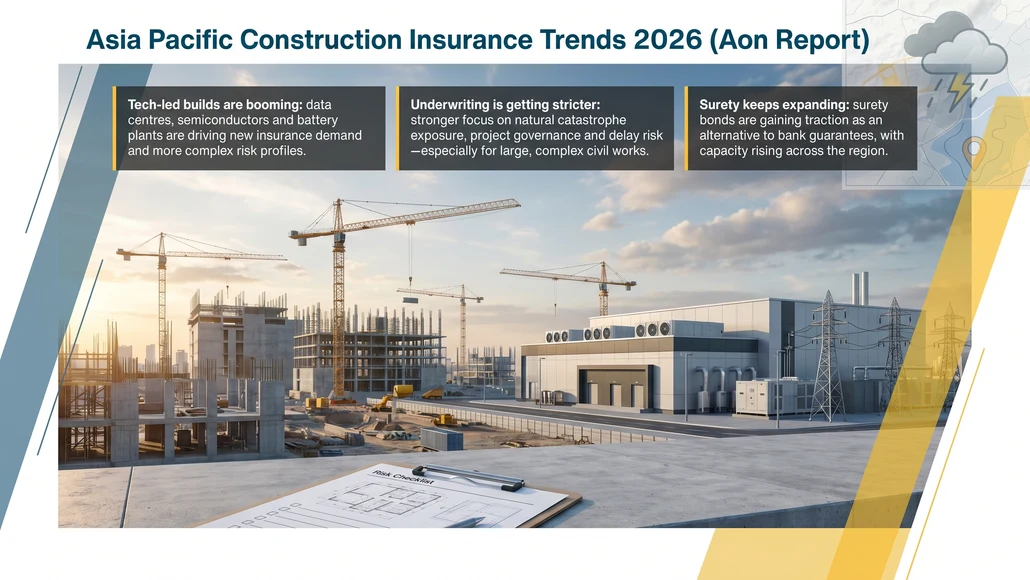
Large-scale infrastructure development, rapid urbanisation and rising investment in high-tech manufacturing are the primary forces sustaining demand for construction insurance across Asia Pacific. Hyperscale data centres, battery manufacturing plants and semiconductor facilities are emerging as significant growth categories, bringing with them higher power demands, longer project timelines and more complex risk profiles that require tailored underwriting approaches.
As project pipelines expand and asset values rise, insurers are increasingly focused on how risks are assessed, governed and mitigated from the earliest stages of the construction lifecycle. Terence Williams, Head of Commercial Risk in APAC for Aon, noted that insurers are taking a closer look at how projects are governed and how data supports risk decisions, particularly given the extended timelines and greater delay exposure that now characterise many high-value builds.
Regional Market Conditions: Capacity, Pricing and Pressure Points
The Asia Pacific construction insurance market remains broadly growth-oriented, supported by strong insurer capacity, continued appetite for expansion and improved reinsurance performance. Pricing remains competitive and capacity robust in key markets such as China and India. Japan, however, is experiencing a different trajectory, facing increased pricing pressure, regulatory developments and heightened natural catastrophe exposure.
Despite the overall market softening across the region, natural catastrophe risks continue to attract close attention from underwriters. Well-governed projects continue to find support, but greater rigour is being applied to catastrophe modelling, construction quality controls and contractor resilience particularly in peak hazard zones and for technically demanding works including underground construction and large-scale complex infrastructure.
For major civil projects, international capacity and layered programme structures are frequently required to secure adequate coverage, reflecting the scale and risk concentration involved.
The Role of Technology-Led Construction
The growth of technology-led construction is a defining feature of the current cycle. Data centres, semiconductor plants and battery manufacturing facilities are increasing in both number and scale across Asia Pacific, creating risk profiles that go beyond traditional construction categories. Insurers are responding by developing more specialised underwriting approaches to address the unique exposures these projects carry, including higher electrical infrastructure risks and extended commissioning periods.
Digital infrastructure investment is not merely a demand driver — it is also reshaping what insurers expect from project sponsors in terms of risk documentation, governance and early engagement.
Surety Market Sees Steady Growth
The Asia Pacific surety market is also recording steady expansion, as accelerating infrastructure investment and evolving regulatory capital requirements position surety bonds as a credible and attractive alternative to conventional bank guarantees. Pricing across the region has remained broadly flat, while surety capacity is increasing in several markets, particularly outside Australia.
The Importance of Governance and Early Insurer Engagement
Vincent Banton, Head of Construction and Infrastructure in Asia for Aon, highlighted that Asia remains a region of opportunity but one with increasing risk complexity. He pointed out that insurers are backing projects with well-structured governance frameworks and clear risk ownership, and that for complex projects, underwriting is now as much about how risks are managed as where they are located. Early engagement with insurers and disciplined risk management are being emphasised as more critical than ever for securing appropriate coverage on technically demanding projects.