




















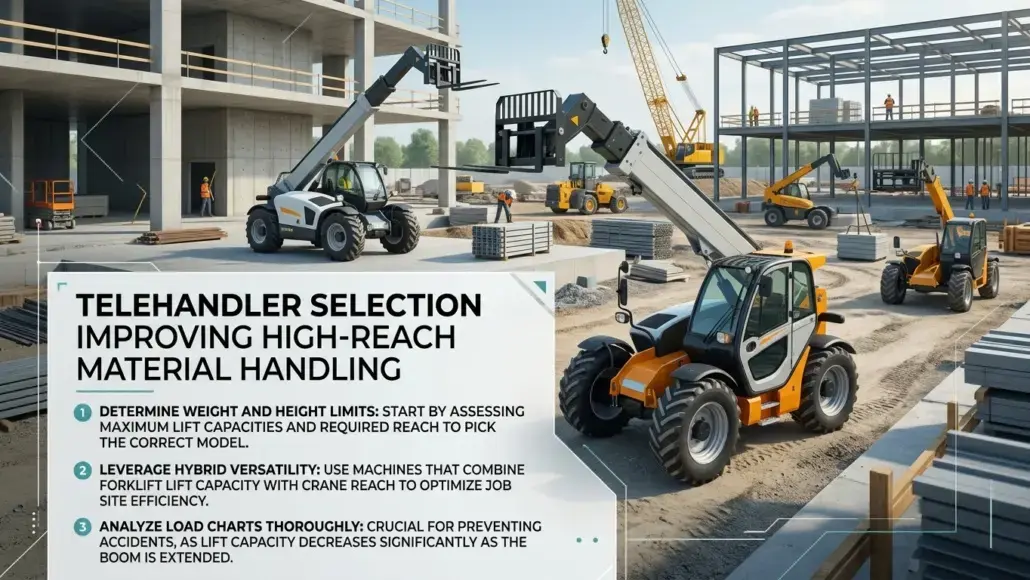


Choosing the appropriate telehandler for a construction project begins with a detailed analysis of the maximum weight to be lifted and the heights that must be reached. Telehandlers are unique in their ability to combine the lift capacity of a forklift with the reach of a crane, making them one of the most versatile machines on a job site. However, this versatility requires a deep understanding of load charts, as the lifting capacity of the machine decreases significantly as the boom is extended and the angle of the boom is lowered. Project managers must ensure that the chosen machine can safely handle the heaviest intended loads at the furthest required reach. Relying on the maximum lift capacity alone is a common error that can lead to tipping incidents or structural failure of the boom.
The stability of the machine is heavily influenced by its wheelbase and the use of stabilizers or outriggers. In high-reach applications, stabilizers provide a solid platform that allows the machine to reach its full potential lift height and capacity. For sites with uneven terrain, models equipped with frame leveling systems can compensate for slopes, ensuring that the boom remains vertical during operation. This level of technical precision is essential for ensuring that telehandler selection improving high-reach material handling is conducted with safety as the primary priority. Without these systems, the risk of lateral instability increases, particularly when handling large or awkward loads at significant heights.
In addition to vertical height, the forward reach of the boom is a critical factor for tasks such as unloading trucks across a ditch or placing materials onto a building floor that is set back from the edge. Telehandlers with longer booms provide greater flexibility but also require more space to operate. Sizing the machine correctly for the site footprint is vital to avoid congestion and ensure that the operator has sufficient room to maneuver. Evaluating the specific geometry of the work area, including overhead obstructions and ground conditions, allows for a more accurate determination of the required boom length and machine size.
Attachment Versatility and Specialized Handling Tasks
One of the greatest advantages of the telehandler is the ability to use a wide variety of attachments, ranging from standard pallet forks to buckets, grapples, and work platforms. Each attachment changes the performance characteristics and the center of gravity of the machine, which must be reflected in the operator’s understanding of the load chart. Selecting the right attachment for the task is as important as selecting the machine itself. For example, using a side-shift carriage can greatly improve the precision of load placement in tight spaces, while a rotating carriage allows for more flexibility when handling materials in complex structural environments.
For specialized tasks such as steel erection or the installation of large glass panels, telehandlers can be equipped with winches or jib attachments, effectively turning them into small cranes. This capability allows a single machine to perform multiple roles on a site, reducing the need for additional equipment and lowering overall project costs. When considering telehandler selection improving high-reach material handling, firms should look for machines with quick-coupler systems that allow for fast and secure attachment changes. This increases the utilization rate of the machine and ensures that it remains a productive asset throughout various phases of the construction process.
The hydraulic system of the telehandler must be capable of providing sufficient flow and pressure to power these attachments effectively. High-flow auxiliary hydraulics are often required for more demanding tools like sweepers or specialized grapples. Modern machines feature load-sensing hydraulic systems that prioritize power where it is needed most, providing smooth and precise control of boom functions even under heavy loads. This precision is particularly important when working at height, where even small movements of the boom can result in significant shifts of the load at the tip. Providing operators with intuitive controls and responsive hydraulics is key to maintaining a high level of accuracy and safety.
Maneuverability and Steering Modes in Confined Spaces
Construction sites are often crowded with materials, personnel, and other equipment, making the maneuverability of the telehandler a critical selection factor. Most telehandlers feature three distinct steering modes: two-wheel steer for high-speed travel, four-wheel steer for tight turns, and crab steer for lateral movement. The ability to switch between these modes allows the operator to position the machine precisely, even in very restricted areas. Crab steering is particularly useful for side-loading or moving away from walls and obstructions when there is little room to swing the rear of the machine.
The overall dimensions of the machine, including its height and width, also play a role in its suitability for certain environments. Low-profile models are available for working in parking garages or under low-clearance structures, while wider machines offer greater stability for heavy lifting. Evaluating the access points and internal dimensions of the site before selecting a telehandler ensures that the machine can reach its intended work area without difficulty. In urban construction projects where space is at an absolute premium, the compact design and agile steering of the telehandler make it a preferred choice over larger, less maneuverable equipment.
Drivetrain performance is another aspect that impacts maneuverability, especially on soft or sloped terrain. Four-wheel drive and high-clearance axles allow telehandlers to traverse the often-unfinished ground of a new construction site. Hydrostatic transmissions provide smooth acceleration and precise speed control, which is essential for inching toward a load or positioning a pallet at height. By matching the drivetrain capabilities to the expected site conditions, construction firms can ensure that telehandler selection improving high-reach material handling leads to a machine that is both mobile and productive regardless of the underfoot environment.
Safety Systems and Operator Assistance Technology
The safety of high-reach operations is enhanced by a variety of modern electronic systems designed to assist the operator and prevent accidents. Longitudinal Load Moment Indicators (LLMI) provide a visual and audible warning as the machine approaches its stability limit, and many systems will automatically cut off hazardous movements to prevent a tip-over. These systems are an essential safeguard, particularly for less experienced operators who may not yet have an intuitive feel for the machine’s limits. Ensuring that these systems are functioning correctly and that operators are trained to interpret their signals is a fundamental part of site safety management.
In-cab technology has also evolved to include integrated camera systems and proximity sensors, which provide the operator with a better view of their surroundings. This is especially important for the telehandler, where the view to the rear and the right side is often obstructed by the boom and engine housing. High-definition displays can show multiple camera angles simultaneously, helping the operator to maneuver safely around obstacles and personnel. Some advanced models also feature load-monitoring systems that record every lift, providing valuable data for safety audits and productivity analysis. This focus on technology ensures that telehandler selection improving high-reach material handling is supported by the best available tools for risk mitigation.
Operator training remains the most critical component of a safe telehandler operation. Beyond basic machine control, operators must be proficient in reading load charts, understanding the impact of terrain on stability, and performing daily pre-start inspections. Many manufacturers and rental companies offer specialized training programs that cover the specific features and limitations of their machines. Investing in comprehensive training ensures that the equipment is used efficiently and that the risk of accidents is minimized. A well-trained operator can maximize the performance of the telehandler while maintaining a safe working environment for everyone on the site.
Maintenance Considerations and Fleet Longevity
To ensure the long-term reliability of a telehandler, a strict maintenance schedule must be followed. The telescopic boom is the most critical component and requires regular cleaning and lubrication of the wear pads and chains. If these components are neglected, the friction within the boom can increase, leading to jerky movements and premature wear of the hydraulic system. Regular inspections of the hydraulic hoses and cylinders are also essential, as any leak can result in a loss of lift capacity or a sudden drop of the boom. Most modern telehandlers are designed with easy access to all major service points, which encourages regular maintenance and reduces the time the machine spends in the workshop.
Tire selection is another factor that influences both performance and maintenance costs. Foam-filled or solid tires are often used on construction sites to prevent downtime caused by punctures, although they can provide a harsher ride for the operator. Pneumatic tires offer better traction on soft ground but are more susceptible to damage. Evaluating the ground conditions and the risk of debris on the site helps in choosing the right tire type. Monitoring tire wear and maintaining the correct pressure is important for ensuring the stability and safety of the machine during high-reach operations.
Telematics systems have become standard on many telehandler models, providing fleet managers with real-time data on machine health, location, and usage. These systems can alert maintenance teams to potential issues before they cause a breakdown, allowing for more efficient scheduling of repairs. By tracking engine hours and fuel consumption, fleet managers can also identify machines that are being underutilized or used improperly. This data-driven approach to maintenance ensures that telehandler selection improving high-reach material handling remains a sound investment over the life of the machine, maximizing its productivity and resale value.