

























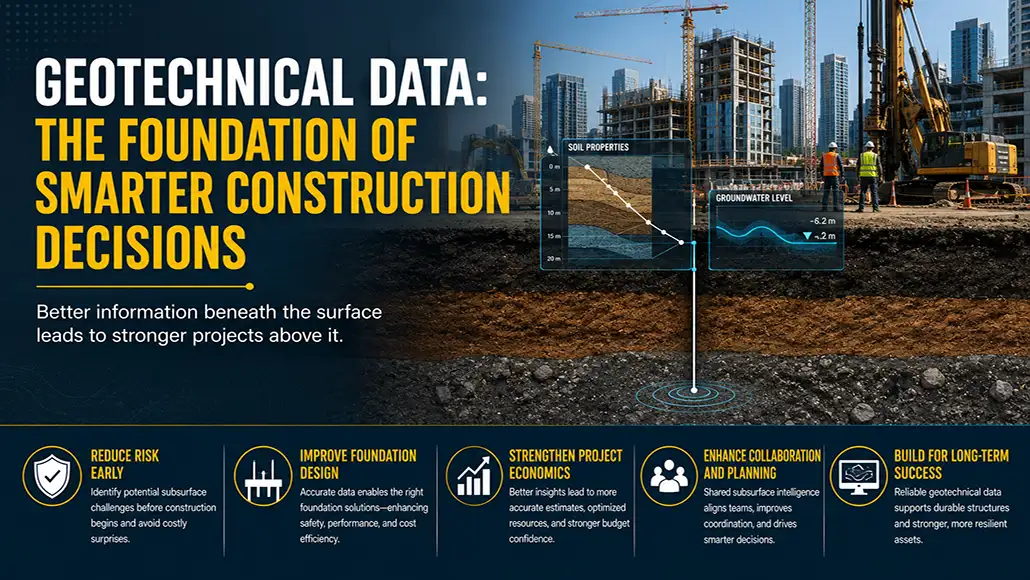


Construction projects are often judged by what can be seen above ground towering structures, complex facades, innovative materials, and advanced engineering systems. Yet some of the most critical information influencing project success exists beneath the surface.
Every building, bridge, industrial facility, or infrastructure asset ultimately depends on the conditions of the ground that supports it. Understanding those conditions has traditionally been viewed as a technical requirement for engineers and geotechnical specialists. Today, however, that perspective is changing.
As projects become larger, more complex, and more financially demanding, Geotechnical Data is emerging as a strategic decision-making tool that influences planning, design, risk management, and long-term asset performance. Rather than serving solely as an engineering input, subsurface information is becoming a source of intelligence that helps project teams make smarter decisions throughout the construction lifecycle.
Why Ground Conditions Influence Every Project
No two construction sites are identical. Soil composition, groundwater levels, rock formations, environmental conditions, and historical land use can vary significantly even within relatively small areas.
These variables directly affect:
- Foundation design
- Excavation requirements
- Structural performance
- Construction sequencing
- Site logistics
- Long-term maintenance considerations
When ground conditions are not fully understood, projects face a greater risk of delays, redesigns, budget overruns, and unexpected technical challenges.
This is why Geotechnical Data has become increasingly important in modern construction planning. The better project teams understand subsurface conditions, the better prepared they are to manage uncertainty before construction begins.
Moving Beyond Compliance-Driven Investigations
Historically, site investigations were often conducted primarily to satisfy regulatory requirements or support foundation design calculations.
While these functions remain essential, construction stakeholders are increasingly recognizing that geotechnical information can provide value far beyond basic compliance.
Modern projects involve significant financial investments, complex stakeholder relationships, and demanding schedules. Under these conditions, early access to accurate subsurface intelligence can support a wide range of strategic decisions.
Developers, contractors, and engineers are therefore beginning to view Geotechnical Data as an asset capable of influencing project outcomes rather than simply fulfilling technical obligations.
This shift reflects a broader trend toward data-driven construction management.
Reducing Risk Before It Becomes Expensive
Risk management remains one of the construction industry’s greatest challenges.
Unexpected subsurface conditions frequently contribute to project delays, budget increases, and contractual disputes. Hidden groundwater issues, unsuitable soil conditions, buried obstructions, and unforeseen geological features can all affect project execution.
The financial consequences of these discoveries often increase dramatically once construction activities have begun.
By providing a clearer understanding of site conditions early in the planning process, Geotechnical Data helps project teams identify potential risks before they become operational problems.
This proactive approach allows organizations to develop mitigation strategies, improve planning accuracy, and reduce uncertainty throughout project delivery.
Improving Foundation Design Decisions
Foundations are among the most critical components of any structure. Their effectiveness depends directly on the characteristics of the ground beneath them.
Accurate geotechnical information enables engineers to select foundation systems that are appropriate for specific site conditions while avoiding unnecessary conservatism.
Without reliable data, project teams may face two undesirable outcomes:
- Underdesign, which can create safety and performance risks
- Overdesign, which can increase material consumption and project costs
Geotechnical Data provides the information necessary to strike the right balance between performance and efficiency.
As construction projects continue to prioritize cost optimization and resource management, this capability is becoming increasingly valuable.
Supporting Better Project Economics
Construction economics are heavily influenced by uncertainty.
The less information available during project planning, the more contingency must often be incorporated into budgets and schedules. This can affect investment decisions, financing requirements, and overall project feasibility.
High-quality geotechnical information helps reduce these uncertainties by providing greater visibility into site-related challenges and opportunities.
As a result, Geotechnical Data can contribute to:
- More accurate cost estimates
- Better resource allocation
- Improved procurement strategies
- Enhanced schedule planning
- Greater budget confidence
For developers and investors, these benefits can be just as important as the technical insights provided by the investigation itself.
The Digital Transformation of Geotechnical Intelligence
The construction industry is undergoing a broader digital transformation, and geotechnical engineering is becoming part of that evolution.
Modern investigation techniques increasingly generate large volumes of detailed site information. Digital modeling tools, geospatial technologies, remote sensing systems, and data visualization platforms are making this information more accessible and actionable than ever before.
Rather than reviewing isolated reports, project teams can increasingly integrate Geotechnical Data into broader digital workflows that support planning, design, and construction management activities.
This integration enables faster decision-making and more effective collaboration across disciplines.
Creating Stronger Collaboration Across Project Teams
Construction projects involve multiple stakeholders with different priorities and responsibilities.
Developers focus on financial performance. Engineers prioritize technical integrity. Contractors emphasize constructability and execution efficiency. Asset owners seek long-term reliability and value.
Geotechnical information provides a common foundation for decision-making across these groups.
By improving visibility into site conditions, Geotechnical Data helps align project teams around shared assumptions and objectives.
This collaborative value is becoming increasingly important as projects grow in complexity and interdisciplinary coordination becomes more critical to success.
Urban Construction Is Raising the Stakes
The growing concentration of development within urban environments is increasing the importance of subsurface intelligence.
Urban construction projects often face challenges such as:
- Existing underground infrastructure
- Variable historical land use
- Utility congestion
- Restricted access
- Complex groundwater conditions
These factors increase project risk and make accurate site information more valuable than ever.
In many urban developments, the quality of geotechnical intelligence can directly influence project feasibility, construction methodology, and long-term asset performance.
As cities continue to expand vertically and horizontally, the role of Geotechnical Data is likely to become even more significant.
A Shift Toward Predictive Construction Planning
The future of construction is increasingly centered on prediction rather than reaction.
Project teams are adopting technologies and methodologies that allow them to anticipate challenges, optimize resources, and improve decision-making before problems occur.
Geotechnical information plays an important role in this transition.
Rather than simply documenting existing conditions, modern geotechnical analysis helps forecast how those conditions may affect future project performance.
This predictive capability aligns closely with the industry’s broader movement toward data-driven planning and risk management.
Conclusion
Successful construction projects depend on informed decision-making long before the first foundation is installed or the first structure rises above ground.
Geotechnical Data is becoming a critical part of that decision-making process by helping project teams better understand site conditions, reduce uncertainty, improve design accuracy, and strengthen project outcomes.
As the construction industry continues to embrace digital technologies and data-driven planning, subsurface intelligence is evolving from a technical requirement into a strategic asset. The organizations that leverage geotechnical information most effectively will be better positioned to manage risk, improve efficiency, and deliver more successful projects.
As increasingly highlighted across World Construction Today, smarter construction decisions begin with better information and some of the most valuable information lies beneath the surface.