






















Concrete remains one of the most important materials in modern construction. Its strength, versatility, and cost-effectiveness have made it the foundation of commercial buildings, industrial facilities, transportation infrastructure, and mixed-use developments worldwide. However, as construction projects become more complex and performance expectations continue to rise, traditional concrete is increasingly being asked to do more than simply carry structural loads.
Today’s commercial projects require materials capable of delivering durability, resilience, efficiency, and long-term performance while supporting increasingly demanding design requirements. This shift is driving greater interest in fiber-reinforced concrete, an advanced material solution that is helping engineers and contractors improve the performance of concrete structures across a wide range of applications.
Rather than replacing conventional reinforcement systems entirely, fiber-reinforced concrete is providing new opportunities to strengthen structural performance while addressing some of the material’s long-standing challenges.
Why Crack Control Matters in Modern Buildings
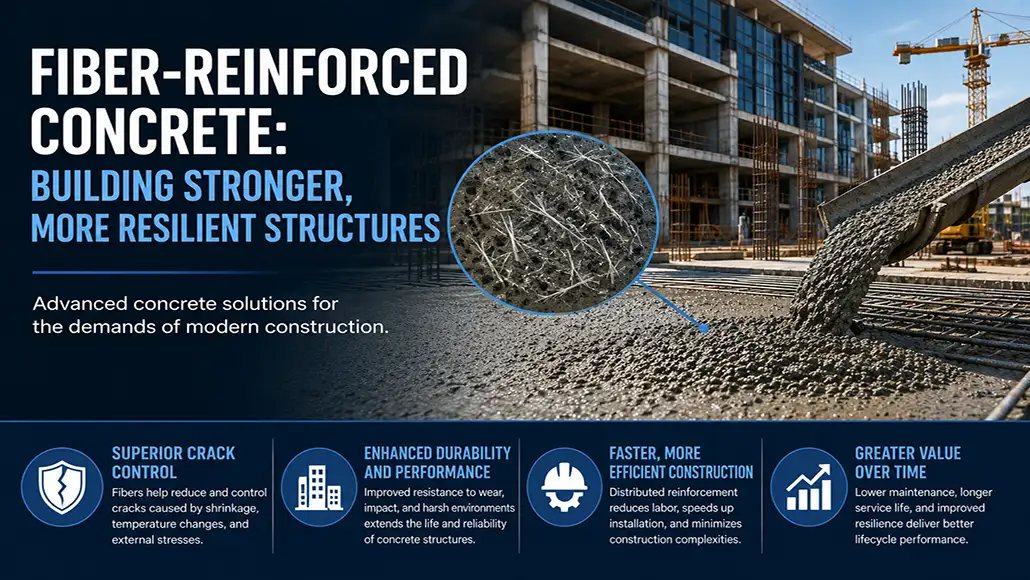
One of concrete’s greatest strengths is also one of its most persistent limitations. While concrete performs exceptionally well under compression, it remains vulnerable to cracking caused by shrinkage, thermal movement, loading conditions, and environmental stresses.
Although not all cracks compromise structural integrity, they can create pathways for moisture, chemicals, and other elements that contribute to long-term deterioration.
This challenge becomes particularly important in commercial construction, where durability, maintenance costs, and asset lifespan directly influence project value.
Fiber-reinforced concrete addresses this issue by distributing small reinforcing fibers throughout the concrete matrix. These fibers help control crack formation and improve the material’s ability to resist stress after cracking occurs.
As a result, structures can achieve improved durability and greater long-term performance.
A Different Approach to Reinforcement
Traditional reinforcement methods typically rely on steel bars or welded wire systems to strengthen concrete elements. These systems remain essential for many applications, but they often address structural performance at specific locations within the concrete.
Fiber reinforcement introduces a more distributed approach.
By incorporating fibers throughout the concrete mix, reinforcement becomes integrated across the entire material rather than concentrated in selected areas. This helps improve crack resistance and enhances overall material behavior.
The growing adoption of fiber-reinforced concrete reflects the industry’s increasing interest in performance-oriented material solutions capable of delivering benefits beyond basic structural requirements.
Improving Durability Across Commercial Applications
Durability is becoming one of the most important performance metrics in commercial construction.
Building owners and developers increasingly evaluate projects based on lifecycle performance rather than initial construction costs alone. Materials that can reduce maintenance requirements and extend service life are therefore attracting greater attention.
Fiber-reinforced concrete contributes to durability by helping limit crack propagation and improving resistance to environmental stresses. This can be particularly valuable in:
- Commercial floors
- Parking structures
- Industrial facilities
- Warehouses
- Infrastructure-connected developments
For project owners, enhanced durability can translate into lower maintenance costs and improved long-term asset performance.
Supporting More Efficient Construction Processes
Construction efficiency remains a major priority throughout the industry.
Project teams continuously seek ways to improve productivity while maintaining quality and safety standards. In certain applications, fiber-reinforced concrete can contribute to these objectives by simplifying reinforcement requirements and reducing installation complexity.
By integrating reinforcement directly into the concrete mix, contractors may reduce some of the labor associated with traditional reinforcement placement.
The extent of these benefits varies depending on project requirements, but the potential for streamlined construction workflows is one reason the material continues to gain industry attention.
Performance Under Demanding Conditions
Commercial buildings often operate under conditions that place significant stress on structural systems.
Heavy traffic, equipment loads, vibration, temperature changes, and repeated operational demands can affect long-term concrete performance. Materials capable of maintaining integrity under these conditions are increasingly valuable.
Fiber-reinforced concrete enhances toughness and energy absorption characteristics, helping structures better withstand demanding operating environments.
These performance improvements are particularly relevant in facilities where durability and operational continuity are critical business considerations.
Material Innovation and Modern Construction
The construction sector is increasingly embracing material innovation as a pathway toward improved project outcomes.
Historically, advances in construction often focused on equipment, design methodologies, and project management practices. Today, attention is also shifting toward the materials themselves.
Fiber-reinforced concrete represents part of a broader trend toward engineered construction materials designed to deliver specific performance benefits.
Rather than viewing concrete as a commodity product, project teams are increasingly evaluating it as a performance-driven solution capable of influencing long-term building outcomes.
Balancing Cost and Lifecycle Value
As with many advanced construction materials, discussions surrounding fiber-reinforced concrete often involve cost considerations.
Material costs may be higher than those associated with conventional concrete mixtures. However, evaluating the technology solely through an upfront cost lens may overlook its broader value proposition.
Potential benefits include:
- Reduced maintenance requirements
- Improved durability
- Enhanced crack control
- Increased service life
- Greater operational reliability
When viewed across the lifecycle of a commercial asset, these advantages can contribute to stronger long-term economics.
This lifecycle perspective is becoming increasingly important as developers and asset owners focus on total cost of ownership rather than initial expenditure alone.
Challenges to Wider Adoption
Despite growing acceptance, fiber-reinforced concrete is not universally applied across commercial construction projects.
Adoption can be influenced by factors such as:
- Material costs
- Design familiarity
- Project specifications
- Engineering requirements
- Contractor experience
In some markets, traditional reinforcement methods remain deeply established, creating natural resistance to alternative approaches.
As industry knowledge expands and performance data continues to accumulate, adoption is likely to increase in applications where clear value can be demonstrated.
The Future of Concrete Performance
The future of construction materials will increasingly be defined by performance rather than tradition.
Developers, engineers, and contractors are seeking solutions capable of improving durability, efficiency, resilience, and lifecycle value. This shift is creating opportunities for advanced materials that address longstanding industry challenges while supporting modern project requirements.
Fiber-reinforced concrete aligns closely with these priorities because it enhances one of the construction industry’s most important materials without requiring a fundamental departure from established building practices.
Its ability to improve performance while integrating into existing construction workflows makes it an attractive option for future commercial projects.
Conclusion
Commercial construction is entering an era where material performance is becoming as important as structural design and project execution. Building owners increasingly expect assets that remain durable, reliable, and cost-effective throughout their operational lives.
Fiber-reinforced concrete is helping meet these expectations by improving crack control, enhancing durability, and supporting more resilient structures. As material innovation continues to influence the construction sector, fiber-reinforced solutions are likely to play an increasingly important role in delivering higher-performing commercial buildings.
As often discussed across World Construction Today, the future of construction will not depend solely on how projects are designed or built, but also on the materials that enable them to perform better for decades after completion.