


























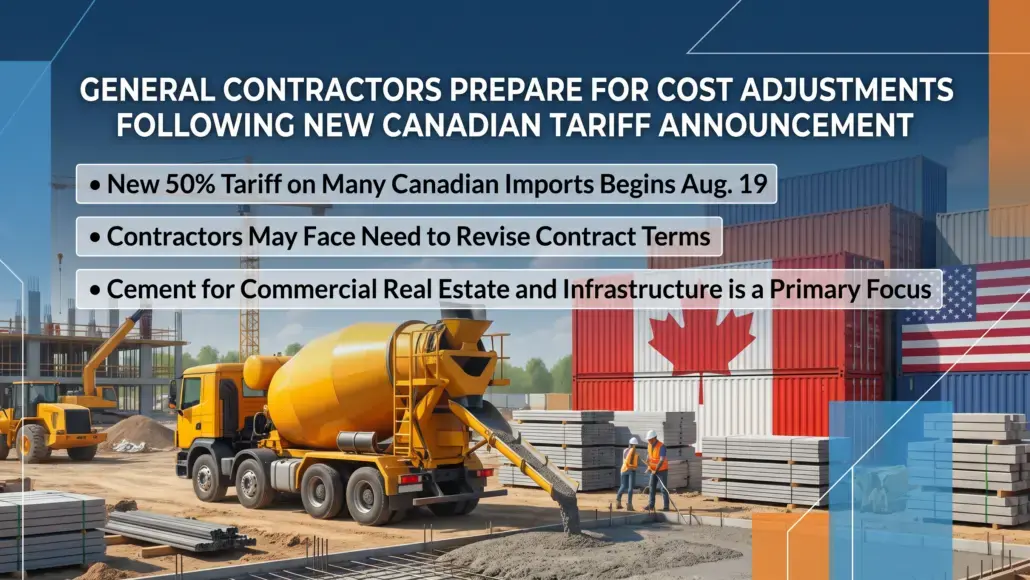


President Donald Trump has announced plans to impose a 50% tariff on many Canadian imports beginning Aug. 19, a move that may force general contractors to revise their contract terms. According to a July 20 fact sheet from the White House, the proposed duties will apply to all covered goods, regardless of whether they originate under the U.S.-Mexico-Canada agreement. Industry legal experts note that cement is the primary area of focus for commercial real estate and infrastructure projects, while steel, aluminum, and copper products already subject to Section 232 tariffs are excluded from this latest tariff action.
The announcement adds another calculation that general contractors will need to manage carefully. Industry attorneys point out that adaptation as new Canadian cement tariffs prepare to take effect will involve reviewing contract terms and cost structures across active and upcoming developments.
Contractual Implications and Cost Management
Trent Cotney, partner and construction team leader at law firm Adams & Reese, highlighted the operational considerations for the sector. “The greatest implication is additional cost and uncertainty,” Cotney said. “Contractors often price work months before purchasing materials. A 50% tariff can quickly make existing estimates obsolete and increase the risk of disputes over who bears the additional cost.”
The recent decision, which Trump imposed after alleging Canada’s trade practices discriminated against the U.S., provides an opportunity for firms to refine their bidding strategies for new projects. Jason Adams, partner at Cox, Castle & Nicholson, stated that the biggest impact is the “uncertainty the situation creates.”
“Constantly fluctuating material pricing prohibits a contractor’s ability to confidently bid fixed-price work,” Adams stated. “Consider a materials escalation and change in law clause in every agreement in an attempt to share the risk of an unforeseen escalation in material prices.”
To proactively address these shifts, Cotney advised general contractors to immediately review existing construction contracts to determine whether “tariff, change-in law, force majeure or change-order provisions” could provide relief. He also noted that firms should obtain updated supplier quotes, confirm pricing validity periods, and deliver prompt written notice whenever potential cost or schedule impacts arise.
Direct Material Impacts Across Commercial Sectors
Cement remains the clearest area of attention regarding the new policy measures. Increased costs in this domain could affect a wide range of development sectors, including highways, infrastructure, industrial facilities, multifamily developments, and large commercial projects. Cotney advised that “Contractors should review the applicable tariff classifications before assuming that every Canadian construction product is covered.”
Adams similarly emphasized tracking concrete and cement prices to maintain project stability. “The tariff imposes a 50% tariff on cement, so that appears to be the biggest concern,” Adams said. “This will impact concrete-intensive projects such as highways, bridges and foundations.”
Supply Chain Movement and Public-Private Projects
Although importers pay the tariff directly upon entry, the financial movement extends further into the marketplace. “The importer initially pays the tariff to the federal government,” Cotney said. “Economically, however, some or all of that cost will likely move through the supply chain to distributors, contractors, owners and ultimately consumers or taxpayers.”
On public infrastructure works, taxpayers may absorb adjustments through updated bids or change orders. On private projects, project owners may evaluate higher bids, adjusted scope, delayed start schedules, or claims for additional compensation. While fixed-price agreements may require contractors to absorb sudden cost changes, future construction contracts are expected to reflect updated bid pricing to absorb fluctuations in material prices across key markets.
Broader Input Prices and Implementation Timeline
This policy announcement follows recent Producer Price Index analyses indicating trends in construction material costs. Construction input prices dropped 1.1% month over month in June, primarily due to lower oil prices, according to an Associated Builders and Contractors analysis. However, Anirban Basu, ABC chief economist, noted that ongoing tariffs and escalations in the Iran War would push construction input costs higher in the coming months.
As the implementation date of Aug. 19 approaches, Cotney recommended that builders monitor official updates until Customs and Border Protection issues formal implementing instructions, as scope or timing could shift during ongoing negotiations. He added that firms can successfully navigate these conditions in light of incoming Canadian cement tariffs and shifting regulations through proactive planning.
“The larger issue is cumulative tariff exposure,” Cotney said. “[Contractors] are dealing with overlapping tariff programs, potential Canadian retaliation and rapidly changing product classifications. I expect more contractors to use shorter bid-validity periods and more detailed price-escalation and substitution clauses.” These measures will allow companies to maintain project momentum and stabilize their broader supply chain operations.