


















Close
MCE 2026
Thursday, January 29, 2026
JEC WORLD 2026

Tianjin Port and Huawei builds digital twin of world’s first zero-carbon port terminal

Note* - All images used are for editorial and illustrative purposes only and may not originate from the original news provider or associated company.

Subscribe

- Never miss a story with notifications

- Gain full access to our premium content

- Browse free from any location or device.

Media Packs

Expand Your Reach With Our Customized Solutions Empowering Your Campaigns To Maximize Your Reach & Drive Real Results!

– Access the Media Pack Now

– Book a Conference Call

Leave Message for Us to Get Back

Related stories

Facade Design Trends Influencing Urban Architecture

The rapid evolution of the building exterior is fundamentally reshaping the visual and functional identity of our cities, moving beyond static surfaces toward dynamic, responsive systems that interact with their surroundings. By embracing innovative materials and digital manufacturing processes, designers are creating high-performance envelopes that not only redefine building aesthetics but also contribute to the resilience and sustainability of the modern urban landscape.

Digital Planning Tools for Building Envelope Systems

The complexity of modern architectural skins requires a fundamental shift in how we conceive, design, and manage the outer boundaries of our structures. By leveraging advanced digital planning platforms and integrated modeling environments, the construction industry can achieve unprecedented levels of precision, ensuring that every component of the structural perimeter is optimized for performance, durability, and long-term sustainability throughout its entire operational lifecycle.
- Advertisement -

Tianjin Port Group and Huawei have partnered up to build a digital twin of the world’s first smart, driverless, zero-carbon port terminal, making it more automated and intelligent.

Yang Jiemin, vice president of Tianjin Port Group, explained that this plan consists of three parts: Construction of new automated terminals, upgrading traditional terminals, and comprehensive digital transformation.

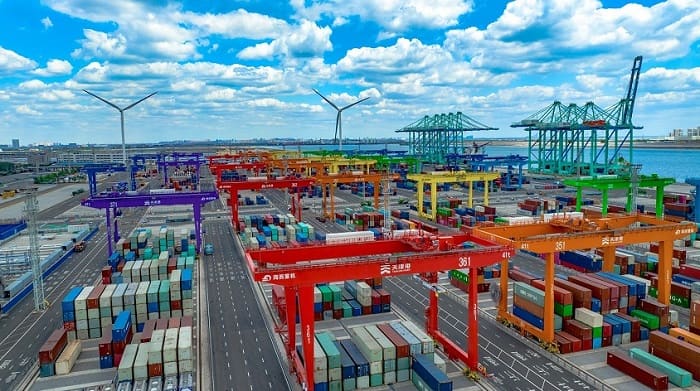
The Section C Terminal in the Beijiang Port Area of the Port of Tianjin was the world’s first smart, driverless zero-carbon port terminal. It entered large-scale commercial operations in October 2021 and has been operating stably ever since.

Using 5G and L4 autonomous driving technologies at the terminal makes operations safer and more efficient. At the terminal, remotely controlled quay cranes lift loaded containers from cargo ships and put them onto intelligent robots for horizontal transportation.

Supported by the BeiDou Navigation Satellite System, these robots are guided to automatic locking/unlocking stations to load/unload containers and then to the container yard along optimal driving routes that are calculated in real-time. The entire process runs with clockwork precision.

Commercial applications
Jiemin explained how the new solution, which combines 5G and L4 autonomous driving technologies, has been put into large-scale commercial application in a partially public scenario at the Section C Terminal for the first time. This has provided a new model for upgrading and transforming traditional container terminals worldwide.

“These innovations being used at the Port of Tianjin are having a huge impact on the port industry, creating new value for ports by improving operating environments, driving green and low-carbon development, and increasing operational efficiency. We believe that these practices will promote the intelligent development of the global port industry,” said Yang.

Shunli Wang, vice president of Huawei Middle East and Central Asia, said: “Ports in the Middle East are set for revolutionary, smart, zero-carbon fully automated digitalized operations that leverage 5G, AI and cloud and other advanced digital capabilities. We are keen to utilise our expertise to enable ports in the region to be safer, more efficient, smart, green and more intelligent.”

Yue Kun, CTO of Huawei‘s Smart Road, Waterway & Port BU, stated: “Ports are a vital link in the international supply chain, connecting trade and supply markets across the globe. Building more efficient smart ports is becoming an increasingly pressing requirement for the global supply chain.”

Kun believes this progress will benefit various industries, with next-generation digital technologies, such as 5G and AI, combined to solve industry problems, promote digital industry transformation and upgrading, and generate social value.

As a major modern port, the Port of Tianjin boasts 300,000-ton-class terminals with a channel depth of 22 m. It has 213 berths of various types. In 2022, its container throughput exceeded 21 million TEUs, ranking among the top 10 ports worldwide.

Latest stories

Related stories

Facade Design Trends Influencing Urban Architecture

The rapid evolution of the building exterior is fundamentally reshaping the visual and functional identity of our cities, moving beyond static surfaces toward dynamic, responsive systems that interact with their surroundings. By embracing innovative materials and digital manufacturing processes, designers are creating high-performance envelopes that not only redefine building aesthetics but also contribute to the resilience and sustainability of the modern urban landscape.

Digital Planning Tools for Building Envelope Systems

The complexity of modern architectural skins requires a fundamental shift in how we conceive, design, and manage the outer boundaries of our structures. By leveraging advanced digital planning platforms and integrated modeling environments, the construction industry can achieve unprecedented levels of precision, ensuring that every component of the structural perimeter is optimized for performance, durability, and long-term sustainability throughout its entire operational lifecycle.

Fire Safety and Compliance in Building Openings

The protection of life and property in the built environment depends heavily on the integrity of apertures within fire-rated compartments, where every door and window must function as a reliable barrier against the spread of heat and smoke. By strictly adhering to modern fire regulations and implementing rigorously tested opening systems, architects and developers can ensure a high level of passive fire protection that safeguards occupants and facilitates a more effective response from emergency services.

Subscribe

- Never miss a story with notifications

- Gain full access to our premium content

- Browse free from any location or device.

Media Packs

Expand Your Reach With Our Customized Solutions Empowering Your Campaigns To Maximize Your Reach & Drive Real Results!

– Access the Media Pack Now

– Book a Conference Call

Leave Message for Us to Get Back

Translate »