

























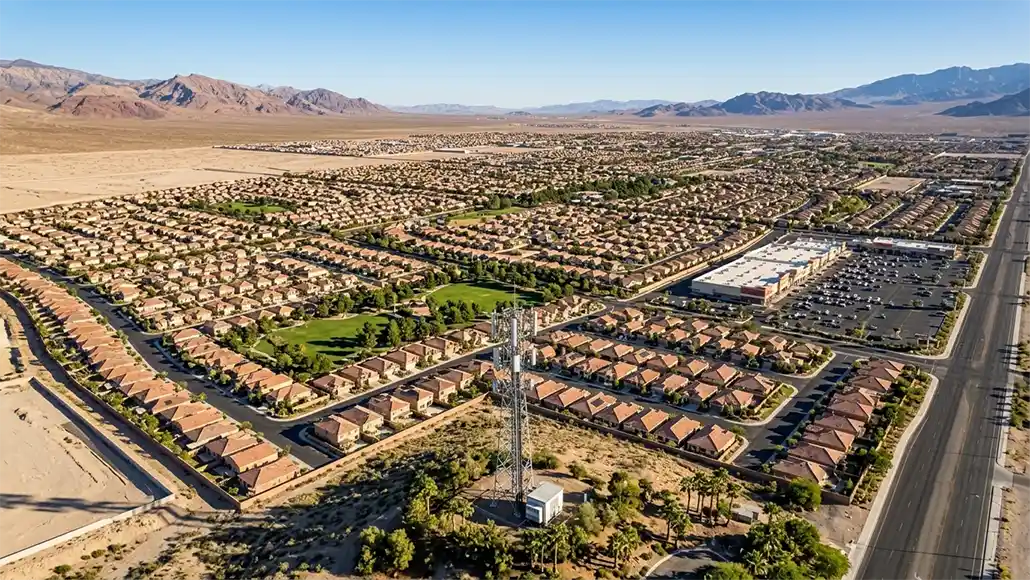


Las Vegas is famous for its casinos, neon lights, and round-the-clock entertainment. But beyond the Strip lies a quieter success story one that has reshaped the way millions of Americans live. Over the past four decades, the Las Vegas Valley has emerged as one of the nation’s leading hubs for master planned communities (MPCs), those sprawling, carefully designed neighborhoods that bundle housing, parks, schools, and shopping into a single cohesive plan.
How did a desert city better known for blackjack tables become a magnet for some of the most ambitious residential developments in the country? The answer involves a combination of cheap land, explosive population growth, abundant federal acreage, and a handful of visionary developers who saw opportunity in the Mojave sand.
Below, we’re exploring the forces that turned Southern Nevada into a master planned community powerhouse, the landmark developments that defined the region, and what continues to draw homebuyers to these meticulously designed neighborhoods.
What Is a Master Planned Community?
A master planned community is a large-scale residential development built according to a comprehensive, long-term plan. Rather than letting growth happen piecemeal, developers map out entire neighborhoods in advance integrating homes with amenities like parks, trails, retail centers, schools, golf courses, and community pools.
These communities often span thousands of acres and take decades to complete. Summerlin, one of Las Vegas’s flagship MPCs, covers roughly 22,500 acres and has been under development since 1990. The goal is to create a self-contained environment where residents can live, work, shop, and play without traveling far from home.
The Perfect Storm: Why Las Vegas Boomed
Several factors converged in the late 20th century to make Las Vegas uniquely suited for master planned development.
Explosive Population Growth
Few American cities have grown as fast as Las Vegas. The Clark County population stood at roughly 273,000 in 1970. By 2000, it had surged past 1.3 million, and as of recent estimates, the county is home to more than 2.3 million people. This relentless growth created enormous demand for housing and the open desert provided plenty of room to build.
For much of the 1990s and early 2000s, the Las Vegas metro area regularly ranked among the fastest-growing in the United States, frequently adding tens of thousands of new residents each year.
Cheap, Abundant Land
Unlike coastal cities hemmed in by oceans and mountains, Las Vegas sits in a broad valley with vast stretches of flat, developable land. For decades, that land was relatively inexpensive, allowing developers to acquire the massive parcels needed for community-scale projects.
The Role of Federal Land
Nevada is the most federally owned state in the country, with roughly 80% of its land controlled by the federal government, largely through the Bureau of Land Management (BLM). This created a unique dynamic in Las Vegas.
The Southern Nevada Public Land Management Act of 1998 (SNPLMA) allowed the BLM to sell federal land around Las Vegas at auction, with proceeds funneled into conservation, parks, and infrastructure. These auctions released huge tracts of land for development, fueling the city’s outward expansion and providing the raw acreage that master planned communities require.
The Landmark Communities That Defined the Region
Summerlin: The Howard Hughes Legacy
No discussion of Las Vegas master planned communities is complete without Summerlin. The community traces its origins to billionaire Howard Hughes, who quietly purchased about 25,000 acres of desert land on the western edge of the valley in the 1950s. The community was eventually named after Hughes’s paternal grandmother, Jean Amelia Summerlin.
Development began in 1990, and Summerlin has since grown into one of the best-selling master planned communities in the nation. It regularly appears near the top of annual rankings of top-selling MPCs in the United States. Home to more than 100,000 residents, Summerlin features more than 150 parks, numerous schools, golf courses, and the Downtown Summerlin retail and entertainment district, along with the Las Vegas Ballpark and City National Arena.
Green Valley and Henderson’s Rise
While Summerlin anchored the west, the city of Henderson to the southeast became home to its own master planned success stories. Green Valley, developed by the American Nevada Corporation beginning in the late 1970s and 1980s, helped transform Henderson from a small industrial town into one of Nevada’s largest cities.
Henderson has consistently ranked among the best places to live in the United States, thanks in large part to its planned neighborhoods, low crime rates, and abundant amenities. Later developments like Green Valley Ranch and Inspirada continued the tradition, adding resort-style amenities and walkable village centers.
Anthem and the Climb Toward the Hills
Anthem, a master planned community in Henderson developed by Del Webb, demonstrated how MPCs adapted to Nevada’s terrain by climbing into the foothills. The community offered everything from entry-level homes to luxury custom estates, along with a popular country club, illustrating the range of lifestyles that a single planned community could accommodate.
Why Homebuyers Are Drawn to These Communities
Master planned communities offer a distinct value proposition that has resonated with Las Vegas homebuyers.
Amenities and lifestyle. Residents gain access to parks, trails, pools, fitness centers, and community events without paying separately for private memberships. Summerlin’s network of more than 150 parks and hundreds of miles of trails exemplifies this appeal.
Planned infrastructure. Because everything is designed in advance, these communities tend to have well-organized road systems, conveniently located schools, and nearby retail. This reduces commute times and the daily friction of suburban life.
Sense of community. Shared amenities and organized events foster neighborly connections that can be harder to find in conventional subdivisions.
Long-term value. Homeowners’ associations maintain consistent design standards and upkeep, which can help protect property values over time.
The Modern Era and What Comes Next
Las Vegas continues to expand, and master planned communities remain at the heart of that growth. Newer developments such as Cadence in Henderson and the ongoing expansion of Summerlin’s western villages show that the model is far from exhausted.
At the same time, developers face fresh challenges. Water scarcity in the Colorado River basin has pushed communities toward drought-tolerant landscaping and stricter conservation measures. Nevada has banned certain types of “non-functional” ornamental grass in an effort to cut water use, and master planned communities have increasingly embraced desert-appropriate design.
Rising land prices and the finite supply of developable acreage near the urban core are also reshaping the market, pushing new projects farther toward the valley’s edges and encouraging higher-density designs.
The Desert’s Blueprint for Modern Living
Las Vegas earned its reputation as a capital of master planned communities through a rare alignment of geography, policy, and ambition. Cheap and abundant land, soaring population growth, federal land auctions, and visionary developers like Howard Hughes and Del Webb combined to create some of the most successful planned neighborhoods in America.
For prospective homebuyers, the lesson is clear: Las Vegas offers a deep and varied inventory of master planned living, from the upscale villages of Summerlin to the family-friendly streets of Henderson. If you’re considering a move to Southern Nevada, researching individual communities their amenities, HOA fees, and long-term development plans is the best first step toward finding the right fit.