





























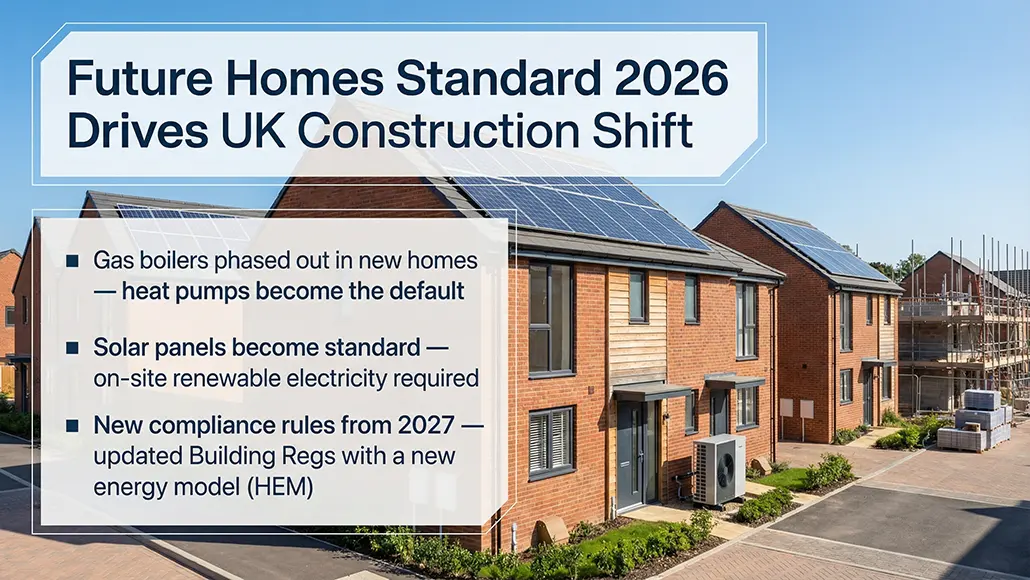


The UK government has confirmed the implementation of the Future Homes and Buildings Standards (FHS), marking a major regulatory shift for the construction sector across London and the wider UK. The framework requires all new homes to be zero-carbon ready from 2027, fundamentally changing how residential developments are designed, powered and delivered. The transition, led by the Ministry of Housing, Communities and Local Government alongside the Building Safety Regulator and the Health and Safety Executive, signals a structural move away from fossil-fuel heating toward integrated electrified energy systems.
Mandatory solar and end of fossil-fuel heating systems
At the core of the policy, the Future Homes Standard 2026 effectively ends the use of traditional gas boilers in new developments. Low-carbon heat pumps will become the default heating technology, replacing fossil-fuel systems across newly constructed homes. In parallel, Requirement L3 introduces mandatory on-site renewable electricity generation, making solar photovoltaic systems a standard component of residential construction rather than an optional addition.
The framework directly links the UK’s Net Zero 2050 commitments to Building Regulations compliance, requiring contractors and developers to embed energy generation infrastructure into core project design.
Regulatory architecture and compliance framework
The policy is anchored in The Building Regulations etc. (Amendment) (England) Regulations 2026 (SI 2026/335), supported by updated Approved Document L governing energy efficiency and revised Approved Document F covering ventilation. A significant methodological shift is also introduced through the Home Energy Model (HEM), which replaces the SAP methodology for assessing residential energy performance.
Together, these measures establish a new compliance architecture combining energy performance modelling with mandatory renewable generation requirements, increasing regulatory complexity for project approval and delivery.
Investment scale and implementation metrics
The scale of the transition is reflected in several key figures:
- £600 million allocated to train 60,000 construction workers in low-carbon technologies
- 40% solar coverage requirement based on a dwelling’s ground-floor area
- 75–80% carbon reduction target compared with 2013 building standards
- 24 March 2027 identified as the primary implementation date
- 1.5 million homes targeted under the new regulatory framework
These figures position the Future Homes Standard 2026 as both a regulatory and industrial transformation, with direct implications for workforce capability and supply chain capacity.
Operational impact on contractors and developers
The new standards introduce substantial operational changes across the construction value chain. Contractors will need to upskill in heat pump installation, electrical infrastructure, and solar integration areas traditionally outside conventional construction trades. Developers, meanwhile, face increased complexity in planning and design, particularly for projects navigating transitional regulatory timelines ahead of full implementation.
Supply chains are expected to experience demand pressure for solar panels, battery storage, and heat pump systems, potentially creating bottlenecks in manufacturing and installation capacity. At the infrastructure level, distribution network operators will need to accommodate higher levels of decentralised electricity generation and export from residential developments.
Alignment with housing delivery and industry response
The announcement aligns with the government’s broader target to deliver 1.5 million homes, reinforcing that decarbonisation objectives will be integrated into large-scale housing delivery. The government described the measures as common-sense measures to ensure new homes include solar panels and clean heating as standard.
Housing secretary Steve Reed stated: Building 1.5 million new homes also means building high-quality homes that are cheaper to run and warmer to live in.
As we make the switch to clean, homegrown energy, today’s standard is what the future of housing can and should look like.
The Chartered Institute of Building (CIOB) described the policy as providing the much-needed clarity our industry has been waiting on for the last two years. Amanda Williams, CIOB’s head of environmental sustainability, said: Ensuring everyone has a safe, warm home must be a priority and having a standard which all new homes must meet is a vital part of making it happen.
In our survey of 2,000 people in late 2023, over a third rated energy efficiency in the top three things they want in a new build home along with a good price and good location, so we are pleased this has been included in the new standard by way of mandatory solar panels on new homes for example.
This is a step change, so the key now is ensuring housebuilders are supported to adopt and implement the new standards and homeowners are supported to use and maintain their solar panels and heat pumps to get the most from them.