






















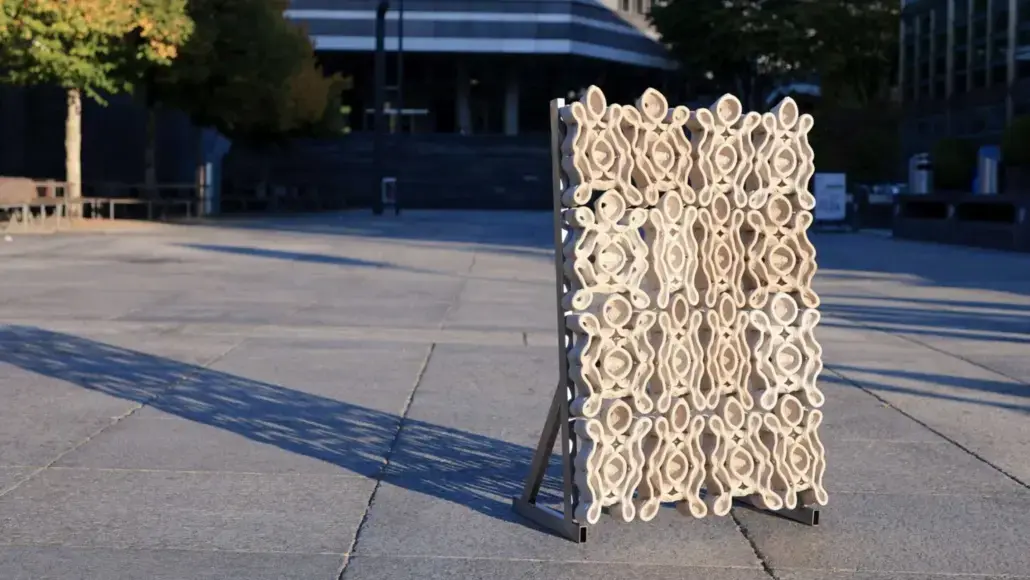


Researchers are developing a bacteria-based alternative to conventional cement manufacturing by using microorganisms to bind sand grains into solid architectural elements. Karen Antorveza Paez, who has recently completed her doctorate at ETH Zurich, is investigating how biological processes can be controlled to produce construction materials without the high-temperature firing used in traditional cement production. Cement manufacturing is one of the largest sources of CO₂ emissions in the construction industry.
“We’re using bacteria to produce a sort of mineral glue,” said Antorveza Paez. Certain bacteria combine with sand and other solid grains to create a structure held together by interlocking microscopic calcite crystals.
Biocementation as an Alternative Building Material
The process, known as microbiologically induced calcite precipitation (MICP) or biocementation, uses bacteria called Sporosarcina pasteurii. These microorganisms have been studied for years, including for stabilising loose subsoil. They have also been investigated for self-healing concrete, where bacterial spores help seal cracks.
Antorveza Paez’s research focuses on using biocementation as an architectural material rather than an additive to existing building products. Her work combines biocementation with digital manufacturing to develop controlled production methods for architectural elements.
3D Biocement Printing and Mineral Formation
Three scientific studies published in ‘npj Materials Sustainability, Architectural Intelligence and Biotechnology Design’ during Antorveza Paez’s doctoral research describe two manufacturing approaches.
The first, 3D biocement printing, uses a bio-ink made from a water-based gel containing alginate, xanthan, sand and live bacteria. The material can be printed into a required shape before the object is immersed in a solution containing urea and calcium chloride.
The bacteria break down urea using the enzyme urease, releasing carbonate ions and ammonium as a byproduct. The carbonate reacts with calcium from the calcium chloride solution to form calcium carbonate, also known as limestone. This mineral is also found in mussel shells and chalk.
Limestone forms around the bacteria within the printed object. Microscopic crystals develop between the sand grains and interlock, mechanically binding the particles together rather than using conventional glue.
Mineralisation Without External Heating
Depending on the required strength of the architectural component, the process takes two to five days. The object is supplied with a fresh mineralisation bath each day to replenish the substances needed for limestone formation. It is then left to dry, completing the process and leaving a solid mineral structure in which the bacteria are no longer active.
In this process, bacteria effectively perform the role of the oven by gradually hardening the printed structure. The material becomes solid, bonded and dry at room temperature without an external heat source.
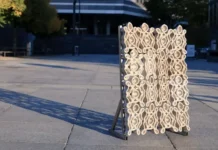
The method has been used to produce a facade element that could serve as sun protection or a partition wall.
Robotic Spraying Enables Automated Production
The second approach uses robotic spraying to apply biocement directly to a surface, eliminating the intermediate immersion bath. A robotic arm repeatedly deposits bacteria, mineralisation substances and sand in successive layers, gradually building up the structure.
The technique draws inspiration from stromatolites, which are layered sedimentary rock formations created when microorganisms deposit minerals over extended periods.
At the 2025 Biennale Architettura in Venice, the spraying process operated continuously for six months, allowing visitors to observe the material formation.
“We have proven that the entire process of biocementation can be automated,” said Antorveza Paez.
The two approaches serve different purposes. Printing is better suited to producing architectural elements, while spraying is designed primarily for surfaces. The printing research focused on material science, including bio-ink composition and printability. The spraying research concentrated on robotic systems and controlling three separate material streams.
However, the methods remain at different stages of development. Antorveza Paez reports that robotic spraying requires further research into mechanical properties, particularly how sand grains and the bonding medium are distributed within the resulting structure.